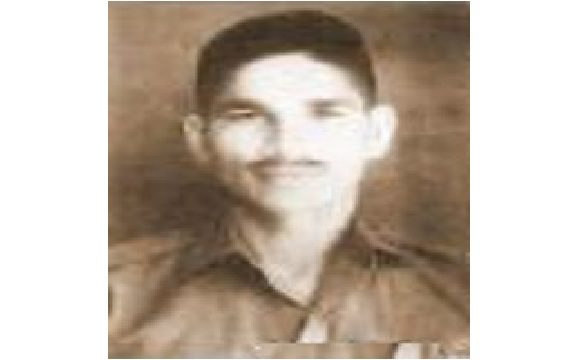

Service No : SS-23003
Place of birth : Hisar Dist (Haryana)
Service : Army
Last Rank : Second Lieutenant
Unit : 4/5 GR (FF)
Arm/Regt : 5 Gorkha Rifles
Operation : Indo-Pak War 1971
Awards : Vir Chakra
Martyrdom : November 21, 1971
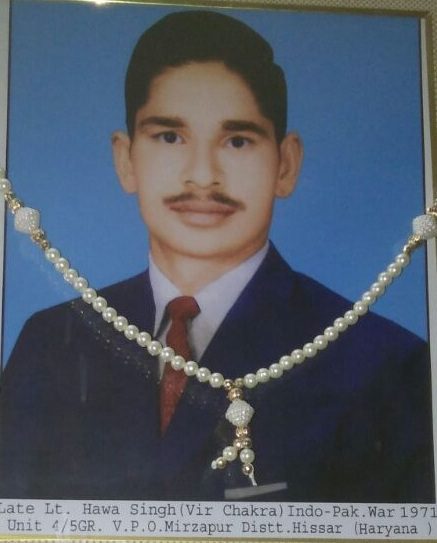
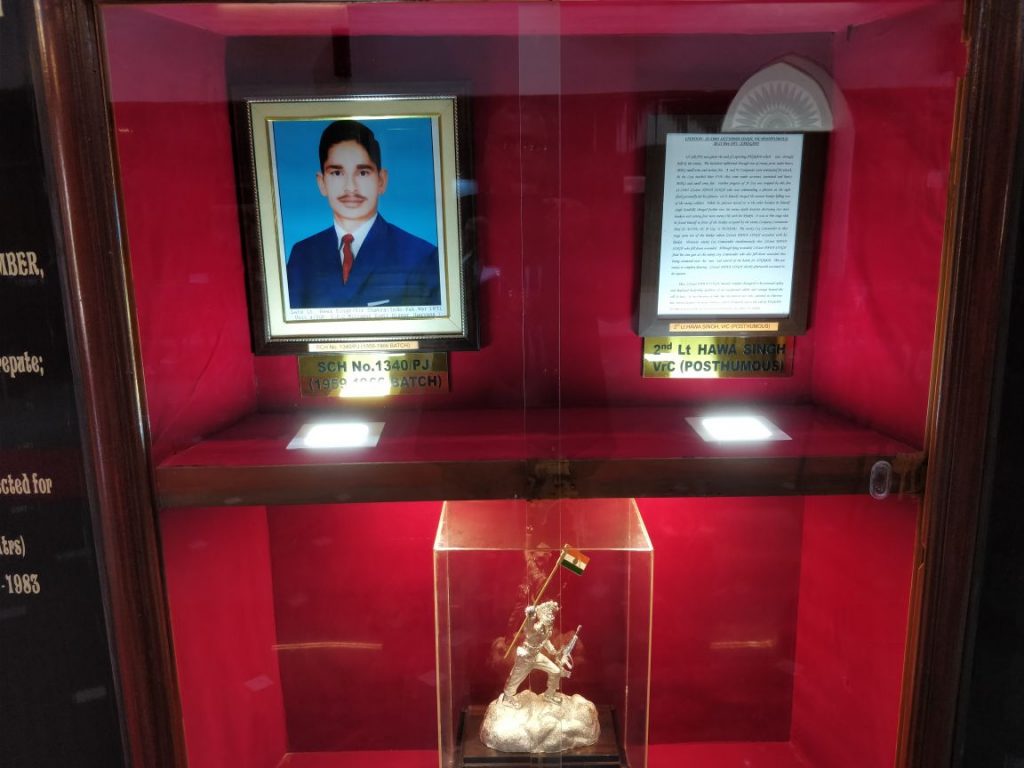
2nd Lt Hawa Singh VrC
Second Lieutenant Hawa Singh hailed from Mirzapur village in Hisar district of Haryana, a region renowned for its proud martial traditions and deep-rooted association with the Armed Forces. He was born to Shri Sheokaran Singh and Smt Chand Kaur, who instilled in him the values of discipline, hard work, and devotion to the nation from an early age. He received his early education at the Rashtriya Military School, Ajmer, where he studied from 1959 to 1966 (PJ House). He was shaped by the school’s strong emphasis on discipline, leadership, and character-building—qualities that further strengthened his aspiration to serve in the Armed Forces. He successfully passed out from the institution in 1966, carrying forward the values and training imparted by the prestigious military school. After completing his schooling, he joined college to pursue higher education, while steadfastly working towards his dream of donning the Indian Army uniform. His perseverance bore fruit when he successfully cleared the Combined Defence Services (CDS) Examination, securing his selection for training at the prestigious Officers' Training Academy (OTA), Chennai.
At OTA, he underwent rigorous physical, mental, and leadership training, designed to mould young cadets into capable officers of the Indian Army. He distinguished himself through dedication and resolve and, upon successfully completing the course, was commissioned as a Second Lieutenant. He was allotted to the 4th Battalion of the 5 Gorkha Rifles (4/5 GR), one of the most distinguished and battle-hardened infantry regiments of the Indian Army, known for its legacy of valour and sacrifice. With his commissioning, Second Lieutenant Hawa Singh began his military career, fulfilling a lifelong dream and committing himself to the highest traditions of honour, courage, and service. The 5 Gorkha Rifles is renowned for its fearless soldiers, unwavering loyalty, and a legacy of gallantry earned across numerous campaigns and battles. Serving in such a storied regiment was both an honour and a responsibility, and Second Lieutenant Hawa Singh embraced it with pride. His commissioning into 4/5 GR marked the beginning of a promising military career, firmly rooted in courage, commitment, and an unflinching sense of duty towards the nation.
Battle of Atgram Complex: 20-21 Nov 1971
In 1971, Second Lieutenant Hawa Singh was serving with the 4th Battalion of the 5 Gorkha Rifles (4/5 GR), which was deployed in the Eastern Sector and took part in one of the earliest and most significant offensive actions preceding the formal outbreak of the Indo–Pakistan War of 1971. The battalion played a decisive role in the Battle of the Atgram Complex, fought on 21 November 1971, an engagement that marked one of the first large-scale assaults launched by the Indian Army against East Pakistani forces. The battle was fought at Atgram, a border village in the Sylhet district of erstwhile East Pakistan, approximately 35 kilometres from Sylhet town. The village lay across the River Surma, which served as a de facto border separating East Pakistan from the Cachar district of Assam. The Atgram Complex, situated about two kilometres inside the international border, was a vital road communication centre linking Zakiganj to the south and Sarkar Bazar to the west, making it a key tactical objective.
As per the operational plan, 4/5 GR was tasked to capture the Atgram Salient by first light on 21 November 1971 and thereafter advance westwards to secure Sarkar Bazar, approximately four kilometres beyond Atgram. The plan, meticulously drawn up by the Commanding Officer, Lieutenant Colonel AB Harolikar, was designed to achieve complete surprise. It involved infiltrating deep behind enemy defences, establishing roadblocks to prevent reinforcement from Zakiganj and Sarkar Bazar, and launching a rear assault on the Atgram position. To achieve this, the battalion was required to undertake a daring night river crossing of the Surma, infiltrate between Pakistani defensive positions at Raigram and Amalsid, negotiate nearly four kilometres of marshy terrain, and strike the Atgram Complex from the rear. C Company, along with an ad hoc force, was tasked to establish roadblocks and secure the approaches, while the main assault was assigned to A and D Companies. To maximise surprise and exploit the psychological impact, the final assault was planned to be carried out with khukris.
Second Lieutenant Hawa Singh, was commanding one of the platoons of A Company. On the night of 20 November 1971, the operation commenced as planned. C Company and the Commanding Officer’s group crossed the River Surma first using pneumatic boats, establishing a firm base on the far bank to enable the rest of the battalion to pass through and infiltrate between the enemy border outposts. The assaulting troops of A and D Companies, including the platoon led by Second Lieutenant Hawa Singh, moved steadily towards their objective under cover of darkness. At approximately 0430 hours on 21 November 1971, as dawn began to break, A and D Companies, led by their company commanders with the Commanding Officer positioned centrally, launched a fierce khukri assault on the Atgram Complex. The attack achieved complete surprise. The Pakistani defenders were caught unprepared and were overwhelmed by the sheer ferocity, determination, and raw courage of the Gorkha soldiers.
During the intense close-quarter fighting that followed, Second Lieutenant Hawa Singh led his platoon with outstanding gallantry and fearless leadership, displaying exceptional bravery in the face of the enemy. Alongside fellow officers, including Captain Praveen Johri, he fought with resolute determination and conspicuous courage. In the course of this fierce engagement, Second Lieutenant Hawa Singh was grievously injured and laid down his life, attaining martyrdom while leading from the front. The successful capture of the Atgram Complex was a significant tactical achievement and set the tone for subsequent operations in the Eastern Sector. The supreme sacrifice of Second Lieutenant Hawa Singh, and the valour displayed by 4/5 Gorkha Rifles, stand as a shining example of leadership, courage, and the indomitable fighting spirit of the Indian Army during the 1971 campaign. For his outstanding courage, unyielding fighting spirit, and supreme sacrifice during the Battle of Atgram, Second Lieutenant Hawa Singh was posthumously awarded the Vir Chakra, the nation’s third-highest gallantry award.
Maj Gen Shri Kant, SM, VSM (Retd)
2025 at 3:43 pmI had the privilege of interacting with 2 Lt Hawa Singh during year 1971 when he was staying in Canal Colony. A very handsome young man who I think was preparing for BA exam.
I salute the brave heart.
Maj Gen Shri Kant,SM,VSM(Retd)
Former VC LUVAS Hisar
Ramesh Kalirawana
2025 at 3:44 pmHe was a true patriot who laid down his life for the motherland. His Supreme sacrifice will always be remembered. We remember our martyr with pride and gratitude. It is a matter of pride that this hero belongs to my village.
Dharambir Jangra
2025 at 3:45 pmSalute to the brave warrior . You will always have a special place in our heart and be remembered for ever. Jaihind
Pammy
2025 at 3:45 pmनमन हैं ऐसे वीर सपूत को. जय हिंद.
अशोक जी
2025 at 3:45 pmदेश के वीर सपूत को सत सत नमन
Sandeep Boora
2025 at 3:46 pmSalute to real hero… movement of pride specially for villgage Mirzapur..Jai Hind…will will never forget his contribution to Nation..
Pummy
2025 at 3:47 pmYour job is good and he was really hero and I salute to martyr.