
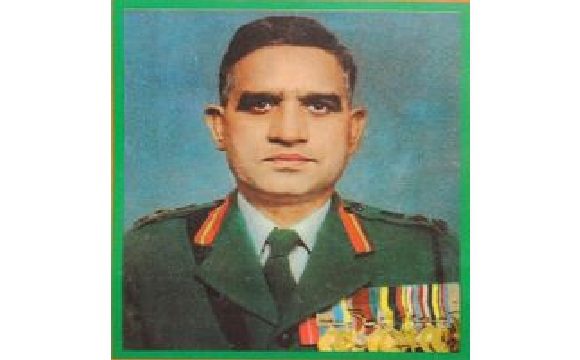
Brigadier Hoshiar Singh was born on 16 December 1916 in the village of Sankhol, near Bahadurgarh, into a Rathee Jat family. At the time of his birth, the village formed part of Rohtak district in undivided Punjab; today, it lies in Jhajjar district of Haryana. He lost his father, Shri Shivlal, at an early age. The youngest among five brothers, he was brought up with great care by his mother, Smt Nanhi Devi, and his elder brother, Shri Amar Singh. He began his education at the village primary school and later enrolled at the Government School on Railway Road in Bahadurgarh. Determined and disciplined from a young age, he would walk nearly two kilometres each day from his village to attend school. In 1932, he passed his matriculation examination with First Division. At just eighteen years of age, in October 1934, he joined the Indian Army as a recruit in the Rajputana Rifles Regiment. Even in his early years of service, his sincerity, discipline, and natural leadership qualities distinguished him from his peers. He was also an accomplished kabaddi player, known for his strength, agility, and competitive spirit.
In 1935, he was married to Ms Pheem Kaur of Naunand village (Rohtak district). The couple was blessed with five children, including one daughter. His dedication and professional competence earned him steady recognition, and in December 1940, he was promoted to the rank of Jemadar (then known as a Viceroy’s Commissioned Officer). As a Junior Commissioned Officer, he served with exceptional distinction in the 4th Battalion (Outram’s) of the Rajputana Rifles Regiment. During the Second World War, he saw active service in the Middle East, where his conduct in battle was marked by courage, initiative, and steadfast leadership under fire. His exemplary performance in operations earned him several prestigious honours. He was awarded the Indian Order of Merit (IOM) and the Indian Distinguished Service Medal (IDSM) for gallantry, as well as the Croix de Guerre, a renowned French decoration for bravery. In addition, he was twice Mentioned in Despatches for his meritorious service. In recognition of his outstanding potential and consistently exemplary service record, the Army selected him in 1941 for a regular commission. He subsequently underwent officer training at the Indian Military Academy, Dehradun.
On successfully completing his training, he was commissioned as an officer, marking the beginning of a distinguished career in the commissioned ranks and setting the foundation for the leadership he would later display in the highest traditions of the Indian Army. He became a Captain on 4 March 1942, and two years later, in September 1943, he was promoted to the rank of Major. After India's independence in 1947, he was appointed Chief Instructor at the Indian Military Academy in Dehradun, where he played a significant role in shaping the future officers of the Indian Army. In 1952, he was entrusted with the responsibility of 2 Rajputana Rifles, one of the most distinguished battalions of the regiment. Later, in 1956, he became the Commandant of the Rajputana Rifles Regimental Centre, Delhi, a prestigious leadership appointment. In February 1961, he was appointed as Deputy Commandant of NDA Khadakwasla, further reflecting the confidence placed in his leadership and professional excellence.
No Comments