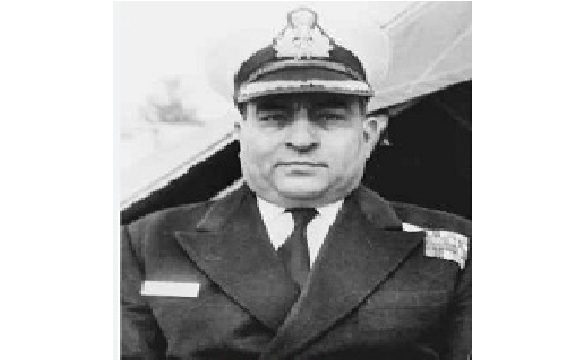
Service No : 00101B

Date of Birth : September 14, 1928

Place of birth : Rewari Dist (Haryana)

Service : Indian Navy

Last Rank : Commodore

Arm/Regt : Indian Navy

Operation : Op Trident

Awards : Maha Vir Chakra

Cmde Babru Bhan Yadav MVC

Commodore Babru Bhan Yadav was born on 14 September 1928 in the village of Bharawas in Rewari district, Haryana. He grew up in a family deeply rooted in military tradition. His father, Shri Bhagwan Singh Yadav, served with distinction in the World Wars and was honoured with the Member of the Order of the British Empire (MBE). His elder brother, (Col MS Yadav (Retd)), also chose a life of service and rose to the rank of Colonel in the Indian Army. Surrounded by such strong examples of patriotism and discipline, it was only natural that Cmde Babru Bhan Yadav would be inspired to serve the nation. He completed his intermediate education at Banaras Hindu University and went on to earn a Bachelor of Science degree from St. Stephen’s College in 1947. An accomplished swimmer in his youth, he had remarkably never seen the sea until he was 20 years old—an ironic detail for someone who would go on to build a distinguished naval career. At the age of 22, driven by ambition and a desire to serve, he applied to join the Indian Navy under the Direct Entry Graduate scheme. In 1949, he was selected by the naval selection board and, in September of that year, proceeded to Dartmouth in the United Kingdom to train with the 1949 class of the renowned Benbow Division at the Royal Naval College. During his training, he served as a Midshipman aboard HMS Devonshire, participating in two training cruises that helped shape his professional foundation as a naval officer.


On 1 January 1951, he was formally commissioned into the Indian Navy. This marked the beginning of a long and distinguished career characterised by steadfast leadership, operational excellence, and gallantry in the face of adversity—qualities that would later earn him one of the nation’s highest military honours. In 1954, he went back to the UK and joined HMS Vernon to specialise in Anti-Submarine Warfare (ASW). He served as the squadron TAS officer in INS Brahmaputra, and in the 1960s was the Fleet TAS officer of the Western Fleet. Cmde Yadav, as Lt Cdr, underwent the Staff course at Defence Services Staff College, Wellington from May 1963 to November 1963.


Operation Trident (Indo-Pak War): Dec 1971


In 1971, during the tense months preceding the Indo-Pak War, Cmde Babru Bhan Yadav (Then as Commander) was serving as the Squadron Commander of the 25th Missile Squadron of the Indian Navy, based in Mumbai. Anticipating the likelihood of conflict, he meticulously prepared his squadron for offensive operations. Under his leadership, the missile boats conducted rigorous training exercises, including simulated “dummy” attacks on port installations. These exercises were designed to sharpen coordination, precision, and combat readiness—preparation that would soon prove decisive. On 2 December 1971, just days before open hostilities commenced, Cdr Yadav assumed command of a three-boat Missile Task Force comprising INS NipatINS Nirghat, and INS Veer. These vessels were Osa-I class (Vidyut-class) missile boats equipped with Styx surface-to-surface missiles, capable of delivering devastating strikes against enemy ships and coastal targets. With the outbreak of war, the Indian Navy launched a bold and unprecedented naval offensive against Karachi, Pakistan’s principal port and naval headquarters. Commander KP Gopal Rao was appointed Task Force Commander by Admiral S. M. Nanda to lead offensive naval operations against Karachi during the 1971 Indo-Pak War. On the night of 4/5 December 1971, under Operation Trident, a strike group comprising two Petya-class ships and three missile boats advanced towards Karachi to launch a surprise attack on the Pakistani Navy’s main harbour. The task group consisted of the Petya ships INS Kiltan, commanded by Commander K. P. Gopal Rao, and INS Katchall, commanded by Commander K. N. Zadu, along with the missile boats INS Nirghat (Lt Cdr I. J. Sharma), INS Nipat (Lt Cdr B. N. Kavina), and INS Veer (Lt Cdr O. P. Mehta). Embarked on board INS Nipat was Commander Babru Bhan Yadav, the Senior Officer of the Missile Boat Squadron, whose leadership and tactical direction played a decisive role in the success of the operation.


Under the overall plan, Commander Babru Bhan Yadav led the missile boat strike element that formed the cutting edge of the attack. Demonstrating exceptional daring, skill, and precise coordination, he directed the missile boats to close in on Karachi harbour under cover of darkness, maintaining strict radio silence to preserve complete surprise. At the decisive moment, the missile boats launched a series of accurate anti-ship missile strikes that resulted in the sinking of the Pakistani destroyer PNS Khyber, the minesweeper PNS Muhafiz, and the destruction of the ammunition-laden merchant vessel MV Venus Challenger, while also causing heavy damage to fuel storage and port installations along the Karachi coast. Throughout the daring execution of Operation Trident, Cdr Babru Bhan Yadav displayed exceptional courage and composure under extreme operational pressure. Confronted with the constant threat of air strikes, hostile surface engagements, and potential submarine attacks, he pressed ahead with unwavering determination. His sharp tactical insight, meticulous planning, and calm, decisive leadership enabled the missile boat task force to penetrate deep into enemy waters, strike Karachi harbour with precision, and withdraw safely without loss. The operation proved to be a turning point in the 1971 Indo-Pak War, establishing India’s naval superiority in the Arabian Sea and significantly altering the strategic balance in India’s favour. In recognition of his conspicuous gallantry, inspiring leadership, and steadfast devotion to duty, he was awarded the Maha Vir Chakra in 1972—India’s second-highest wartime gallantry award. His exemplary service and professional excellence subsequently earned him promotions to the ranks of Captain and later Commodore, reflecting the immense respect he commanded within the Indian Navy.


After completing his active sea service, Commodore Yadav continued to serve the nation in a different yet equally meaningful capacity. He was appointed State Director of the National Cadet Corps (NCC) in Chandigarh, where he oversaw NCC activities across Punjab, Himachal Pradesh, and Haryana. In this role, he played a pivotal part in mentoring and shaping young cadets, instilling in them the values of discipline, leadership, and patriotism that had defined his own career. Commodore Babru Bhan Yadav passed away on 22 January 2010 at the age of 82 after a brief illness. His life remains a powerful testament to courage, professionalism, and unwavering patriotism. Revered as one of the Indian Navy’s most iconic officers, his legacy endures as a symbol of bravery, strategic foresight, and decisive leadership in one of India’s most significant naval victories.

  • If you find any information that is incorrect or inappropriate or have additional information about the soldier that can be added to his memorial site, please contact us by using the tab given below.
14 Comments
  • राजेन्द्र प्रसाद यादव

    2026 at 10:55 am Reply

    हमारी आन बान और शान

  • Dr Sanjeev Singh Yadav

    2026 at 10:55 am Reply

    Think the First Ahirwal in navy made a mark n showed you astute plan n action work in destroying enemy l. Salute to the son of the soil.

  • Sailed Kumar Borah

    2026 at 10:56 am Reply

    My sincere respect to this great brave soul.Praying to God to bless his family and provide eternal peace to his soul.

  • Naveen Kumar

    2026 at 10:56 am Reply

    We shall forever remain indebted to you for your service to the nation. Jai Hind

Post a Comment