

Service No : 00079-B
Date of Birth : November 13, 1926
Place of birth : Madurai, Dist (TN)
Last Rank : Commodore
Unit : INS Kiltan
Arm/Regt : Indian Navy
Operation : Op Trident
Awards : MVC, VSM
Cmde KP Gopal Rao MVC VSM
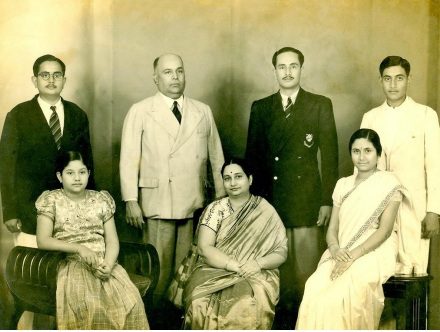
Commodore Kasargod Patnashetti Gopal Rao was born on 13 November 1926 in Madurai, Tamil Nadu, to Shri Rao Bahadur K. P. Janardhan Rao and Smt K. P. Prema Rao. He came from a distinguished family known for its contributions to law and public service. His grandfather, K. P. Madhav Rao, had moved to Madras in 1878, studied law, and went on to practise at the Madras High Court. His father rose to the rank of Deputy Inspector General in the Indian Police—the highest position an Indian could attain during British rule—after superseding four British officers. He was widely regarded as an outstanding officer and handled several notable cases, including the famous Shanmuga Gramani case, in which his brother, Sir K. P. Lakshman Rao, later delivered the judgment. Raised in a culturally active and socially prominent family in Madras, Gopal Rao grew up in an atmosphere of discipline and responsibility. He was educated at PS Higher Secondary School, Mylapore, and at Presidency College, Madras. In 1939, at the age of thirteen, a visit to the British warships HMS Repulse and HMS Enterprise left a deep impression on him and inspired his ambition to join the Navy.
He was commissioned into the Indian Navy on 21 April 1950 as a Sub Lieutenant at INS Venduruthy. In the early years of his career, he served in various operational and instructional appointments, including INS Cauvery and INS Angre, and was promoted to Lieutenant in 1953. He later served as Divisional Gunnery and Maintenance Officer at INS Valsura and was selected for advanced specialization in gunnery, undergoing the prestigious Long Gunnery Course at HMS Excellent in the United Kingdom. On his return, he served as Squadron Gunnery Officer on INS Godavari and later as an instructor at the Gunnery School, INS Venduruthy, where he trained many future senior naval officers. Promoted to Lieutenant Commander in 1961, he continued to combine sea appointments with instructional and staff roles. After completing the Staff Course at the Defence Services Staff College, Wellington, he served as Executive Officer of INS Talwar and later at Naval Headquarters, where he was promoted to Commander in 1966. He played a key role in the induction of Petya-class corvettes, became the Commissioning Commanding Officer of INS Kadmatt in 1968, established the Petya Training School, and took command of INS Kiltan in December 1970.
Operation Trident (Indo – Pak War): Dec 1971
In December 1971, during the Indo-Pak War, Commander KP Gopal Rao was appointed Task Force Commander by Admiral SM Nanda to lead offensive naval operations against Karachi. On the night of 4/5 December 1971, under Operation Trident, he led a strike group comprising two Petya Ships and three missile boats towards Karachi. The task group consisted of two Petya Ships: INS Kiltan (commanded by Commander KP Gopal Rao) and INS Katchall (commanded by Commander KN Zadu), and the three Missile Boats INS Nirghat (commanded by Lieutenant Commander IJ Sharma), INS Nipat (commanded by Lieutenant Commander BN Kavina) and INS Veer (commanded by Lieutenant Commander OP Mehta). Commander BB Yadav, the Senior Officer of the Missile Boat Squadron, was embarked in INS Nipat. Maintaining surprise and precise coordination, his task group launched a devastating missile attack that sank the Pakistani destroyer PNS Khyber, the minesweeper PNS Muhafiz, and destroyed the ammunition-carrying vessel MV Venus Challenger. Despite enemy threats and technical difficulties during withdrawal, he ensured the safe return of his ships without loss. The attack caught Pakistan completely off guard and dealt a severe blow to its naval capability, paving the way for the follow-up Operation Python. For his outstanding leadership and gallantry, Commander KP Gopal Rao was awarded the Maha Vir Chakra, India’s second-highest wartime gallantry award.
Following the 1971 Indo-Pak War, in which he commanded INS Kiltan with distinction, Cdr KP Gopal Rao was promoted to the rank of Captain in January 1972. On 11 February 1972, he took command of the submarine depot ship INS Amba and served there until 19 February 1973. He was then appointed Chief of Staff at Headquarters Eastern Naval Command from February 1973 to January 1974—at that time, a Captain’s appointment, though it later became a Vice Admiral’s post. From 11 January 1974 to 18 January 1976, he commanded INS Circars while concurrently serving as Naval Officer-in-Charge (NOIC), Visakhapatnam. In recognition of his distinguished service, he was promoted to Commodore on 19 January 1976. As a Commodore, he was appointed Director of the National Cadet Corps (Naval Wing) for Tamil Nadu and Pondicherry from January 1976 to November 1978, where he played an important role in mentoring and guiding young cadets. On 1 December 1978, he assumed charge as Commanding Officer and NOIC, Madras, serving until 31 March 1981. During this tenure, he was also a Trustee of the Madras Port Trust and a Senate Member of the University of Madras, besides delivering lectures in Defence Studies. A remarkable feature of his career was that from 1968 until his retirement, every appointment he held was that of a Commanding Officer. Earlier, in 1968, after undergoing specialized training in the Soviet Union on Petya-class corvettes, he became the Commissioning Commanding Officer of INS Kadmatt and sailed her to India. Recognizing the need for indigenous training, he proposed the establishment of a Petya Training School at Visakhapatnam to Admiral S. M. Nanda. The proposal was accepted, leading to the creation of the training establishment later commissioned as INS Satavahana. For this pioneering contribution, he was awarded the Vishisht Seva Medal in January 1971.
Commodore Gopal Rao lived for five decades after the 1971 war and witnessed the nation celebrate the 50th anniversary of victory as Swarnim Vijay Varsh. The commemorative Victory Flame was lit by Prime Minister Narendra Modi at the National War Memorial in New Delhi on 16 December 2020. In July 2021, he was felicitated at three separate functions—by the Governor of Tamil Nadu, Banwarilal Purohit; by the Indian Navy; and by the Chief Minister of Tamil Nadu, M. K. Stalin. Describing one such ceremony as “the best evening of his life,” it became his final public appearance. Commodore Kasargod Patnashetti Gopal Rao passed away on 9 August 2021 in Chennai at the age of 94 and was laid to rest with full military honours, befitting a distinguished war hero.
Commodore Kasargod Patnashetti Gopal Rao is survived by his wife Smt Radha Rao, daughters Smt Tara Rao and Smt Savita Rao and son Shri Vinay Rao.


No Comments