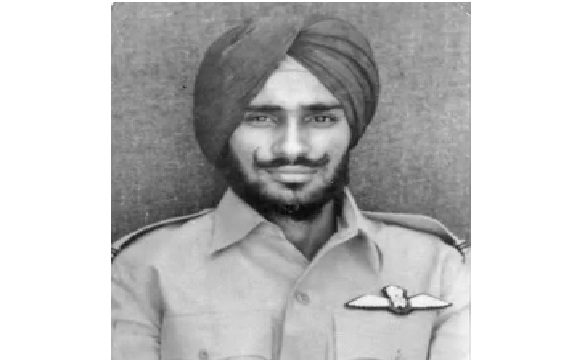
Flying Officer Nirmal Jit Singh Sekhon was born on 17 July 1945 in the village of Issewal, near Ludhiana, Punjab. Son of Shri Sardar Trilok Singh Sekhon and Smt Harbans Kaur, Fg Offr Nirmal Jit's formative years were spent in an environment heavily influenced by the military. Issewal lay close to Air Force Station Halwara, and the sight and sound of military aircraft operating from the base left a deep and lasting impression on the young boy. From an early age, he displayed an intense fascination with flying and combat aviation. He was equally inspired by tales of valour, especially those of the legendary Sikh warrior Hari Singh Nalwa, whose courage and leadership stirred his imagination. A powerful influence in shaping his aspirations was his father, who had served in the Indian Air Force and later retired as an Honorary Flight Lieutenant—listening eagerly to his father’s accounts of life in uniform and the challenges of flying instilled in him a firm resolve to don the blue uniform and serve the nation from the skies. Even as a schoolboy, he was determined—come what may—to become a fighter pilot.
He received his early education at Khalsa High School, Ajitsar Mohie, near Ludhiana, where he earned a reputation for being disciplined, warm-hearted, and diligent. He passed his matriculation examination in first division, a testament to both his academic ability and perseverance. In 1962, he enrolled at Dayalbagh Engineering College, Agra, following the conventional academic path expected of a promising student. Yet, his passion lay elsewhere. Even while pursuing engineering, his heart remained firmly set on aviation. During this period, he joined the National Cadet Corps (NCC), where his keen interest in aeromodelling further deepened his fascination with flight and strengthened his resolve to become a pilot. The 1965 Indo-Pak War proved to be a decisive turning point in his life. Witnessing the Indian Air Force in action and the courage displayed by its pilots convinced him that his true calling was not in engineering classrooms, but in the cockpit of a fighter aircraft. Driven by this conviction and undeterred by the uncertainties ahead, he made the bold decision to leave his engineering course midway and pursue his lifelong dream of joining the Indian Air Force. With unwavering determination, he subsequently joined the Air Force Academy (AFA), Dindigul, where he embarked on the demanding journey of transforming his dream of flight into a distinguished career in military aviation.
His perseverance was ultimately rewarded when he was commissioned into the Indian Air Force as a Pilot Officer on 4 June 1967 as a fighter pilot. He underwent rigorous flying and combat training as a member of the 97th Pilots’ Course, where he consistently demonstrated exceptional dedication, discipline, and aptitude for fighter operations. Tall in stature, he initially experienced physical discomfort while flying the Folland Gnat—a compact yet highly potent interceptor aircraft. The aircraft’s cramped cockpit posed a genuine challenge; however, he refused to allow this limitation to hinder his progress. Through adaptability, determination, and relentless effort, he quickly overcame these constraints, mastered the Gnat’s demanding handling characteristics, and emerged as a confident and highly competent Gnat pilot. Among his peers, he was known for his generosity, humility, and warm, friendly disposition. Fondly addressed as “Brother,” he earned deep respect and affection within the service. On 04 June 1968, he was promoted to the rank of Flying Officer, and in October 1968, he was posted to No. 18 Squadron of the Indian Air Force, proudly known as the “Flying Bullets.” It was with this elite fighter squadron that he would soon stand sentinel over India’s skies, ultimately writing a chapter of extraordinary courage and sacrifice in the annals of the Indian Air Force. In early 1971, he entered a new phase of his personal life when he married Ms Manjit Kaur.
Indo-Pak War: 14 Dec 1971
During the Indo-Pakistani War of 1971, Flying Officer Nirmal Jit Singh Sekhon was serving as a fighter pilot with a Gnat detachment of No. 18 Squadron of the Indian Air Force, proudly known as “The Flying Bullets.” At the time, the squadron stood at the forefront of the IAF’s combat readiness, entrusted with demanding operational responsibilities that required exceptional skill, courage, and unwavering resolve. No. 18 Squadron was among the most distinguished and battle-hardened fighter squadrons of the Indian Air Force. Since its inception, it has earned a formidable reputation for precision strike capability, aggressive air combat tactics, and an indomitable fighting spirit—qualities forged through decades of intensive training and combat deployments. Raised on 15 April 1965, with Wing Commander Aubrey Leslie Michael as its first 'Commanding Officer', the squadron had consistently remained at the cutting edge of the IAF’s fighter capability. The squadron was formed at Ambala with an initial strength of five Folland Gnat aircraft and eleven pilots. Owing to the Gnat’s small, lean, and lethal profile, the unit was aptly christened “The Flying Bullets.” Its crest symbolically depicts a winged bullet slicing through a shockwave, representing speed, lethality, and supersonic performance. The squadron’s motto, “Teevra aur Nirbhay”—translated as “Swift and Fearless”—aptly reflected its operational ethos and combat philosophy.
In 1971, a Gnat detachment of No. 18 Squadron was deployed at Srinagar Air Base to provide air defence of the Kashmir Valley against potential Pakistani air attacks. Until the outbreak of hostilities, no air defence aircraft had been permanently based at Srinagar, in accordance with an international agreement dating back to 1948. Consequently, Fg Offr Sekhon and his fellow pilots were operating in unfamiliar terrain, at high altitude, and in the harsh conditions of the Kashmir winter, marked by severe cold and biting winds. Despite these disadvantages, they resolutely defended the valley against repeated Pakistani air intrusions from the very first days of the conflict. By November 1971, violations of Indian airspace by the Pakistan Air Force (PAF) had become increasingly frequent. At least ten major intrusions were recorded over areas including Srinagar, Amritsar, Jammu, Jamnagar, and Ganganagar. On 3 December 1971, Pakistan launched simultaneous air attacks on several Indian airfields—among them Amritsar, Srinagar, Avantipur, and Pathankot—formally marking the beginning of full-scale hostilities. While the Indian Air Force (IAF) rapidly achieved air superiority in the Eastern Sector and executed landmark operations such as the heli-borne insertion of 4/5 Gorkha Rifles at Sylhet, the Western Sector remained fiercely contested. Srinagar, in particular, was subjected to repeated PAF attacks, and No. 18 Squadron was tasked with its air defence. On 14 December 1971, Srinagar Airfield came under attack by six PAF F-86 Sabre jets from No. 26 Squadron, operating out of Peshawar. At the time, Flying Officer Sekhon was on readiness duty. As the first bombs fell on the runway, he scrambled for take-off as No. 2 in a two-aircraft Gnat formation, with Flight Lieutenant Ghumman leading. Dust thrown up by the lead aircraft initially delayed his take-off, and by the time the runway cleared, all six enemy fighters were already overhead, strafing and bombing the airfield.
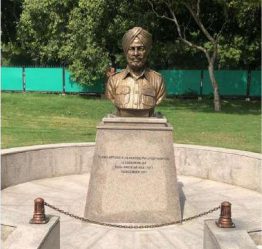
Undeterred by the extreme danger of launching during an ongoing attack, Fg Offr Sekhon took off and immediately engaged the enemy. In the fierce air combat that followed, he attacked a pair of Sabres, scoring a direct hit on one and setting another ablaze. The damaged Sabre was seen fleeing towards Rajauri, trailing smoke. In quick succession, Fg Offr Sekhon had effectively neutralised two enemy aircraft. The battle then descended to treetop height, where Fg Offr Sekhon continued to fight with exceptional skill and determination. Outnumbered six to one, he held his own until his aircraft was hit. Though advised to return to base, his Gnat had suffered critical damage. It is believed that the aircraft flew straight and level for a short while before rolling inverted and plunging earthward, likely due to control system failure. Fg Offr Sekhon attempted a last-moment ejection, but it proved unsuccessful. His aircraft crashed, and he was martyred in action. His sacrifice, however, achieved its purpose. Shaken by the unexpected resistance and losses, the remaining Sabre jets abandoned their attack on Srinagar town and airfield and withdrew immediately. Flying Officer Sekhon’s supreme courage, superb flying skill, and indomitable resolve—displayed far beyond the call of duty—stood as a shining example of the highest traditions of the Indian Air Force. For his extraordinary gallantry in the face of overwhelming odds, Flying Officer Nirmal Jit Singh Sekhon was posthumously awarded the Param Vir Chakra, India’s highest wartime gallantry decoration. He remains the first and only officer of the Indian Air Force to receive this honour, and is remembered as one of the greatest air warriors in the history of the IAF—an enduring symbol of sacrifice, bravery, and unwavering commitment to the defence of the nation.
Flying Officer Nirmal Jit Singh Sekhon is survived by his sister, Smt Inderjit Bhoparai.



RAVINDER SINGH GILL
2025 at 8:22 pmAir Marshal A D Joshi sir, you were lucky indeed to have a course mate like BROTHER SEKHON.
Your cource was one of the longest if not the longest.
Results could be different if his Team leader was Flt Lt A T Cooke instead of Ghumman.
Nutan Kumari
2025 at 7:45 pmPlease give me for in 250 words
संजय सक्सेना, आजमगढ़
2025 at 7:29 amआप थे, तो हम हैं। कृतज्ञ श्रद्धांजलि
Rana Ranjeet Singh
2026 at 6:31 amBharat Maa ke veer Ko koti koti salute. Aise shourey AUR breaveheart Jawan ki wajah se ash Bharat Ka naam uncha hai,, salute.