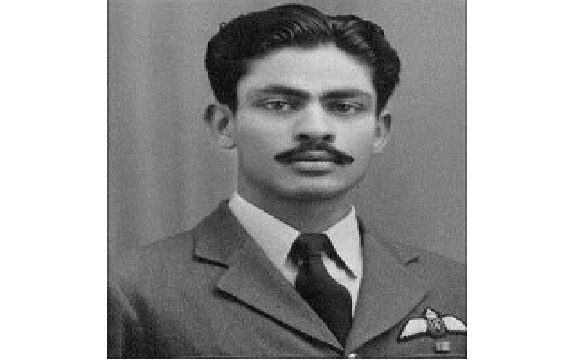

Service No : 3181 GD(P)
Date of Birth : March 10, 1925
Place of birth : Coimbatore Dist (TN)
Last Rank : Flight Lieutenant
Unit : 10 Sqn
Arm/Regt : Indian Air Force
Operation : Indo-Pak War 1947-48
Awards : Vir Chakra
Martyrdom : May 3, 1949
Flight Lieutenant Arthur Srihari VrC
Flight Lieutenant Arthur Srihari was born on 10 March 1925 in Coimbatore, Tamil Nadu, into a disciplined and values-driven family as the son of Shri Hari Naidu. From an early age, he displayed a keen sense of purpose and an inclination towards service, traits that would later define his military career. He received his early education at Montfort Boys’ School, Salem, and Doveton Corrie Boys’ High School, Madras, institutions known for their emphasis on character, discipline, and academic rigour. Building on this strong foundation, he pursued higher studies at Madras Christian College, where he graduated with distinction. His years in college further sharpened his sense of responsibility and reinforced his aspiration to serve the nation during a time of global upheaval. On 8 November 1943, at a young age, he was commissioned into the Indian Air Force, marking the beginning of a career distinguished by professionalism and operational excellence. He joined the flying stream and underwent rigorous training as a fighter pilot with the 19th Pilots’ Course. The demanding training honed his flying skills and cultivated in him a sharp operational mindset.
Following the successful completion of his training, he served with various flying squadrons across different Air Force bases, gaining wide-ranging operational experience. As a pilot, he earned a reputation for his exceptional ability to detect and engage camouflaged enemy targets, a skill that proved invaluable in combat conditions. He also underwent the No. 102 Flying Instructors Course (102 CFS) at the Royal Air Force Central Flying School, Little Rissington, from 28 August 1947 to 14 January 1948, successfully qualifying as a flying instructor. In recognition of his growing experience and competence, he was promoted to the rank of Flying Officer on 15 August 1948. By this time, he had firmly established himself as a dependable and skilled fighter pilot, respected by his peers and superiors alike.
Air Operations: Indo-Pak War: 1947-48
In 1946, he was serving with No. 2 Squadron IAF, proudly known as the “Winged Arrows.” The squadron had a distinguished but turbulent early history—raised at Peshawar before Independence, it relinquished its assets to the newly formed Pakistan Air Force during Partition and was number-plated in December 1947. He was subsequently posted to No. 10 Squadron, Indian Air Force, a unit that would soon be deeply involved in combat operations during the Jammu and Kashmir operations of 1947–48. No. 10 Squadron, known as the “Winged Daggers,” was the last Indian Air Force squadron to be raised during the Second World War. It was formed on 20 February 1944 at Lahore and was initially equipped with the Hawker Hurricane Mk IIc. In May 1947, Squadron Leader H. Moolgavkar assumed command when the squadron was based at Chakeri. Shortly thereafter, the unit came under the command of Squadron Leader Zafar Ahmed Shah, who led the squadron during its first combat operations after Independence.
During the 1947-48 Kashmir Operations, No. 10 Squadron was tasked with providing close air support to hard-pressed ground forces. The squadron was re-equipped with Hawker Tempest Mk II aircraft and redeployed from Ambala, from where sorties were flown over the Srinagar Valley and adjoining areas. As operations intensified, the squadron operated from Ambala and Amritsar, and later from Srinagar and Jammu as advanced landing grounds. During this period, the squadron flew over 300 operational sorties in support of the Jammu and Kashmir Forces. It was during these demanding operations that Flight Lieutenant Shrihari distinguished himself repeatedly. In a short span, he completed nearly 100 successful operational sorties, all marked by exceptional determination and perseverance in pressing home attacks against the enemy. His long-range missions over extremely difficult terrain in the Northern Sector stood out for their navigational accuracy, his ability to detect well-camouflaged enemy targets, and his skill in delivering effective and destructive attacks.
On one notable occasion during the Kashmir Operations of 1948, Flight Lieutenant Shrihari displayed outstanding presence of mind and decisiveness when he located, attacked, and completely destroyed an enemy brigade headquarters, which was actively controlling operations against Indian ground forces. This action significantly disrupted enemy command and control at a critical juncture. For his exceptional gallantry, operational skill, and devotion to duty during the Kashmir Operations, Flight Lieutenant Arthur Shrihari was posthumously awarded the Vir Chakra, one of India’s highest awards for bravery in the face of the enemy. On 3 May 1949, while undertaking another operational flying task, Flight Lieutenant Shrihari’s Hawker Tempest Mk II crashed approximately seven miles from Rohtak. He was killed in the accident, laying down his life in the service of the nation. His gallantry, professional brilliance, and indomitable spirit in the face of the enemy remain an enduring inspiration and a proud chapter in the annals of the Indian Air Force.
No Comments