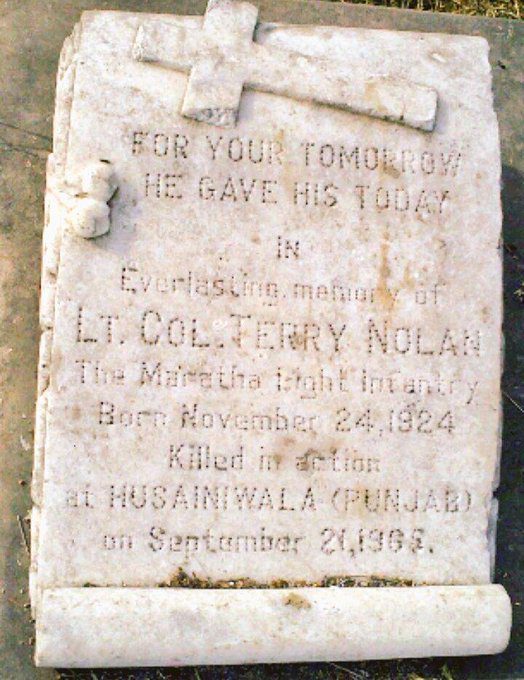
Service No : IC-6023

Date of Birth : November 24, 1924

Place of birth : Lucknow (UP)

Service : Army

Last Rank : Lieutetant Colonel

Unit : 2 Maratha LI

Arm/Regt : The Maratha Light Infantry

Operation : Indo-Pak War-1965

Martyrdom : September 21, 1965

Lieutenant Colonel TTA Nolan

Lieutenant Colonel TTA (Terry) Nolan was born on 24 November 1924 in Lucknow, Uttar Pradesh. He received his early education at the prestigious La Martiniere College, Lucknow, where he developed a strong foundation of discipline and character. Driven by a strong sense of duty and service to the nation, he chose a career in the Indian Army and was commissioned as an officer. He was commissioned into the 2nd Battalion of the Maratha Light Infantry (2 MLI), also known as the “Kali Panchwin,” one of the oldest and most distinguished battalions of the Indian Army. Raised in 1768 as the 3rd Battalion Bombay Sepoys, the battalion has a rich and illustrious history, having seen action in numerous campaigns across India and overseas, including Mysore, Afghanistan, Burma, and Palestine. Known for its courage, discipline, and esprit de corps, the battalion comprises soldiers from Maharashtra, proudly known as “Ganpats.” In the years following Independence, 2 Maratha Light Infantry continued to serve with distinction. It was deployed during the Partition in Punjab, later moved to Jammu & Kashmir, and subsequently served in various locations including Himachal Pradesh and Secunderabad. The battalion also undertook operational deployments along the Line of Actual Control in the Darjeeling sector and served with the United Nations Emergency Force in the Gaza Strip, earning high praise for its professionalism and performance.


He later married Mrs. Gladys Nolan, and the couple was blessed with two children—a son, Michael, and a daughter, Maureen. Despite the demands of military life, he remained a devoted family man, deeply connected to his loved ones. By 1965, he had risen to the rank of Lieutenant Colonel and taken over the command of 2 Maratha Light Infantry. As tensions between India and Pakistan escalated into open conflict, his battalion, then stationed at Mathura, was moved to the Western Sector. It was tasked with the crucial responsibility of defending the strategically important Hussainiwala Headworks near Ferozepore in Punjab—a key installation controlling vital water resources and communications.


Defence of Hussainiwala Headworks (Indo-Pak War): 04-21 Sep 1965


During the Indo–Pakistan War of 1965, Lieutenant Colonel TTA Nolan was serving as the Commanding Officer of the 2nd Battalion of the Maratha Light Infantry (2 MLI), which was deployed in the Hussainiwala sector of Firozpur district in Punjab—an area of significant tactical importance along the border. 2 MLI Battalion was placed under the operational control of 67 Infantry Brigade Group, itself functioning under XI Corps commanded by Lieutenant General JS Dhillon. The Corps, under the overall plan of Lieutenant General Harbaksh Singh, GOC-in-C Western Command, was tasked to launch offensive operations towards the Ichhogil Canal, establish bridgeheads, and threaten Lahore, while simultaneously defending critical sectors in Punjab and Rajasthan against Pakistani offensives. Within this framework, 67 Infantry Brigade was entrusted with the vital responsibility of defending the stretch from Harike Headworks to Anupgarh, with Hussainiwala Headworks being a key strategic objective. The Hussainiwala Headworks, located on the Sutlej River near Ferozepore, was of immense operational importance as it controlled vital water resources and communications, including a key bridge linking Ferozepore with areas towards Lahore.


2 Maratha Light Infantry was ordered to move from Mathura to Ferozepore with the specific task of defending this critical installation. The battalion arrived at Ferozepore on the evening of 4 September 1965 and was immediately tasked to secure the Hussainiwala sector. Lieutenant Colonel Nolan swiftly organised the defence, deploying his companies in well-coordinated positions around the bridge and adjoining areas to guard against enemy ingress. In the opening days of the war, the sector witnessed increasing enemy activity. Pakistani forces launched repeated attacks in the Fazilka and Sulaimanke sectors, while also employing artillery and air strikes against Indian positions. Despite these pressures, 2 Maratha Light Infantry maintained firm control over its assigned sector. On the night of 5 September, enemy elements crossed the Hussainiwala Bridge but were soon detected, and the battalion prepared to engage them. Supported by limited artillery resources, including 3.7-inch howitzers and mortars, the battalion dominated the area through aggressive patrolling and resolute defence, preventing the enemy from consolidating any gains. Between 12 and 18 September, the sector was subjected to intermittent but intense shelling, testing the endurance and morale of the troops. Lieutenant Colonel Nolan’s leadership during this period was exemplary, as he ensured that his men remained steadfast despite continuous enemy pressure. His companies not only held their defensive positions but also carried out effective local actions, repelling enemy probes and maintaining dominance in the area. The battalion’s determined stand at Hussainiwala denied the enemy any opportunity to exploit this strategically vital sector.


The situation reached a critical phase on the night of 19/20 September when the enemy launched a major attack on Hussainiwala, employing an infantry battalion supported by tanks. 2 Maratha Light Infantry, under Lieutenant Colonel Nolan’s inspiring leadership, fought with exceptional courage and determination, holding their ground against overwhelming odds. However, on the afternoon of 21 September 1965, while directing operations and inspiring his troops in the thick of battle, Lieutenant Colonel Nolan was grievously wounded by a shell splinter and succumbed to his injuries, making the supreme sacrifice in the line of duty. His sacrifice deeply affected the battalion, but his stirring resolve—to hold Hussainiwala “to the last man and the last round”—continued to inspire his men. The steadfast defence of Hussainiwala by 2 Maratha Light Infantry remains a shining example of courage, leadership, and devotion to duty in the face of grave adversity. In the course of the operation, besides the Commanding Officer, Lieutenant Colonel TTA Nolan, one more officer, Lieutenant Colonel RS Rana, and eleven other ranks also made the supreme sacrifice in the line of duty. These included Naik Vishnu Kadam, Naik Shamrao Chavan, Lance Naik Laxman Shinde, Sepoy Banda More, Sepoy Baban Falke, Sepoy Mahadeo Paste, Sepoy Daga Nikam, Sepoy Shankar Bhosle, Sepoy Raghunath Chalke, Sepoy Vasu Naik, and Sepoy Narayan More.Their courage, determination, and supreme sacrifice remain a testament to the highest traditions of the Indian Army.


Lieutenant Colonel TTA Nolan is survived by his son Mr Michael Nolan, and daughter Mrs Maureen.

  • If you find any information that is incorrect or inappropriate or have additional information about the soldier that can be added to his memorial site, please contact us by using the tab given below.
No Comments

Post a Comment