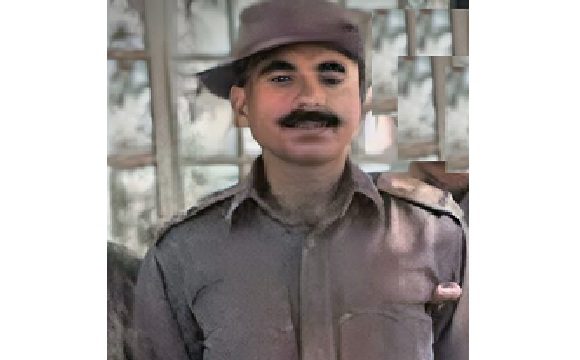

Service No : IC-3534
Place of birth : New Delhi
Service : Army
Last Rank : Lieutenant Colonel
Unit : 4 Sikh LI
Arm/Regt : The Sikh Light Infantry
Operation : Indo-China War 1962
Martyrdom : November 19, 1962
Lt Col RB Nanda
Lieutenant Colonel RB Nanda hailed from New Delhi and grew up in a simple and value-driven environment that emphasised discipline, hard work, and service. From an early age, he was deeply influenced by the inspiring stories of courage and sacrifice of soldiers who had served the nation with distinction. Determined to pursue a career in uniform, Lt Col Nanda joined the Indian Military Academy (IMA), Dehradun, where he underwent rigorous training designed to mould young cadets into professional military leaders. Upon successful completion of his training, he was commissioned as a Second Lieutenant into the 4th Battalion of the Sikh Light Infantry Regiment (4 Sikh LI), a regiment renowned for its gallantry, discipline, and steadfast fighting spirit.
Through years of dedicated service, professional competence, and leadership in challenging conditions, Lt Col Nanda steadily rose through the ranks. During this period, he also began his family life and was married to Miss Veena, who stood by him throughout his demanding military career. By 1962, on the eve of the Indo–China War, he had risen to the rank of Lieutenant Colonel and had assumed command as the Commanding Officer of the 4th Battalion, Sikh Light Infantry. As a commanding officer, Lt Col RB Nanda was known for leading from the front, setting high standards of discipline, and placing the welfare and morale of his men above all else.
Battle of Bomdila (Indo-China War): Oct-Nov 1962
During the 1962 Indo–China War, Lieutenant Colonel RB Nanda, the Commanding Officer of the 4th Battalion of the Sikh Light Regiment (4 Sikh LI), was deployed in the Bomdila Sector in the then North-East Frontier Agency (NEFA). What is collectively remembered as the Battle of Bomdila during the 1962 Indo–China War was, in reality, a series of interlinked engagements fought successively at Se La, Dirang Dzong, and finally Bomdila. The battle is therefore also frequently referred to as the Battle of Se La, reflecting its northernmost and most decisive phase. These engagements formed part of the wider Chinese offensive against the 4th Infantry Division in the Kameng Frontier Division of NEFA.
At the strategic level, the Indian Army was facing severe challenges. The Eastern Command, under Lieutenant General LP Sen, was operating from Lucknow and was in the process of shifting to Calcutta. IV Corps, commanded initially by Lieutenant General BM Kaul, was a newly raised and largely paper formation. Frequent changes at senior levels, coupled with political interference and unrealistic forward policies, compounded the difficulties faced by formations on the ground. The 4th Infantry Division was stretched across nearly 100 kilometres of mountainous terrain, with its main logistics base at Misamari, over 200 kilometres away. The terrain, climate, and lack of infrastructure meant that even routine resupply took several days. The defensive positions were laid out sequentially from north to south—Se La, Dirang Dzong, and Bomdila. Among the units deployed in this critical sector was the 4th Battalion, Sikh Light Infantry (4 Sikh LI), commanded by Lieutenant Colonel RB Nanda. During this period, 4 Sikh LI was placed under 62 Infantry Brigade, commanded by Brigadier Hoishiar Singh, and deployed in the Se La sector, one of the most vital gateways into the Kameng Valley.
Lt Col Nanda’s battalion, like others in the brigade, was rushed into position under extremely adverse conditions. The battalion lacked full administrative backing, suffered shortages of equipment and communications, and operated in terrain and weather for which it had little time to acclimatise. Despite these constraints, 4 Sikh LI formed a key component of the brigade’s defensive posture at Se La, tasked with holding critical ground against an enemy force that enjoyed superiority in numbers, artillery support, and tactical mobility. In Nov 1962, the Chinese launched a series of coordinated, multi-pronged assaults supported by artillery, mortars, and machine-gun fire. While several Indian battalions across the sector fought resolutely, the Chinese succeeded in outflanking key positions, severing lines of communication, and isolating forward companies. Orders to withdraw were issued inconsistently from higher headquarters, often at odds with the tactical situation on the ground.
Throughout this period, Lieutenant Colonel RB Nanda led 4 Sikh LI with determination and courage, maintaining cohesion under intense pressure and attempting to hold vital ground despite growing isolation. As the situation deteriorated and Chinese forces penetrated deeper into the Se La–Dirang axis, the battalion was drawn into heavy fighting, marked by close-quarter engagements and repeated attempts to delay the enemy advance. On 19 November 1962, Lieutenant Colonel RB Nanda, leading from the front, made the supreme sacrifice while commanding his battalion in battle. His sacrifice epitomised the selfless leadership displayed by many Indian officers during the campaign—officers who fought alongside their men despite overwhelming odds, inadequate resources, and a rapidly collapsing operational framework.
By the time Bomdila itself came under threat, the defensive structure of the 4th Infantry Division had largely disintegrated. Orders for withdrawal, issued amid confusion and lack of coordination, led to further losses. Bomdila eventually fell, marking the end of organised resistance in the sector. Despite the defeat, the stand of units like 4 Sikh Light Infantry under Lt Col RB Nanda remains a powerful testament to courage and duty. The battalion’s actions at Se La and the sacrifice of its commanding officer, stand out as an example of steadfast resistance in one of the most difficult chapters of Indian military history.
Lt Col RB Nanda is survived by his daughter Smt Punam Nanda.
Daljit S Dhanjal
2020 at 7:02 pmWas studying at Dagshai Public School and used to visit Lt Col Nanda’s house because his son was my classmate. Usec to play as goalkeeper in hockey matches against Sikh LI4. Sadly after they left for the war the regiment did not come back to Dagshai but got the information that the regiment had taken severe losses including Lt Col Nanda.
Punam Nanda
2021 at 3:55 pmI am late Lt. Col R.B Nanda ‘s daughter. Punam Nanda.
It was very heartening to see his name mentioned here.
If anyone requires anything from me. Please let me know.
Shivshankaran
2023 at 3:36 amHello Poonamji, proud to know you through this. My own uncle was Maj Rajan 4 Sikh L1 and I. Twang memorial we see his name inscribed as died on 21st Nov’62 two names after your father’s. Do you have pictures of his with the regiment. What was the story you heard about. We were first told missing in action. No body was received. My tel.no. 91 9600070924. Will be happy to speak to you Madam. Namaste. Is mother there?