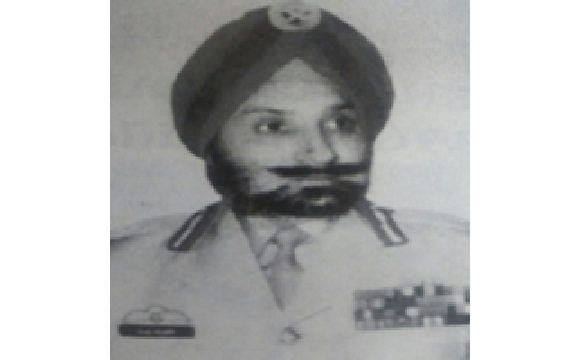
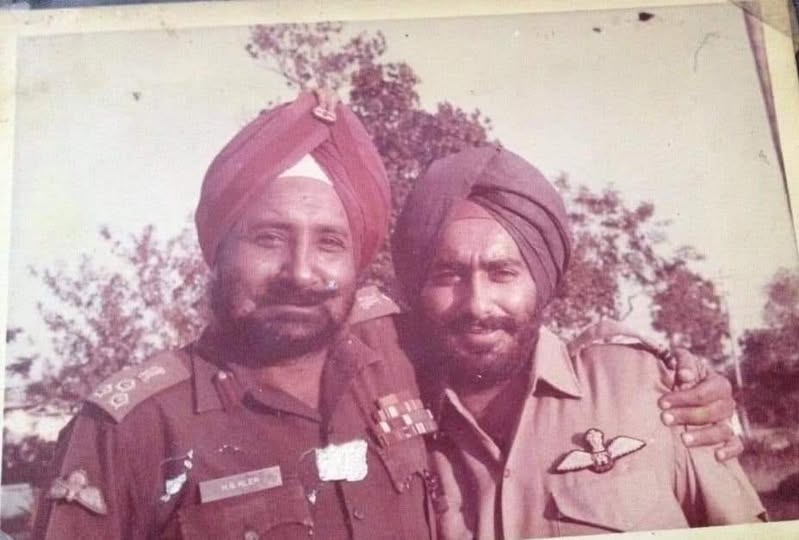
Major General Hardev Singh Kler was born in 1924 in Kakrala Kalan, near Ludhiana, Punjab, into a family renowned for its long and distinguished tradition of military service. He was the son of Hony Capt Chhajja Singh, a highly respected Army veteran who had served with distinction in France and Iraq during the First World War. For his exemplary service, he rose to the rank of Honorary Captain and was awarded the prestigious Order of British India (First Class). The Kler family is widely regarded as a true Kshatriya (military elite) lineage, with nearly three centuries of continuous service to the nation. Major General Kler was the second of three brothers, all of whom chose the path of military service. His elder brother, Shamsher Singh, served in the Corps of Signals but was compelled to take premature retirement due to medical reasons. His younger brother, Gurdev Singh Kler, distinguished himself in the 1965 Indo–Pakistan War, later commanded 56 Brigade, and eventually rose to the rank of Lieutenant General. The family’s legacy of service continued into the next generation. Lieutenant General Gurdev Singh’s son, Jasjit Singh, rose to the rank of Air Marshal. Major General Kler’s own son, Devender Jeet, also served in uniform and fought in the 1971 war. In a remarkable coincidence of duty and destiny, father and son were both deployed during the same conflict without either knowing the other’s exact location. Devender Jeet later retired with the rank of Wing Commander.
Commissioned into the Corps of Signals in 1943, during the closing years of the Second World War, the young 2nd Lt Hardev Singh Kler embarked upon a military career that spanned some of the most defining chapters of India’s post-Independence history. From the very beginning, he displayed exceptional professional competence, intellectual clarity, and an unwavering sense of duty. He saw active service in Burma (now Myanmar), where his distinguished conduct in operations earned him a Mention in Despatches. Over the years, he held a wide range of critical command and staff appointments, consistently earning the respect and admiration of his seniors, peers, and subordinates alike. He came to be regarded as one of the finest senior commanders produced by the Indian Army—remembered for his professional brilliance, inspirational leadership, operational audacity, and deep humanity, even in moments of victory. Calm under pressure and precise in judgment, he inspired confidence wherever he served and led more through personal example than through authority alone. His outstanding service during the Indo–Pakistan War of 1965 was formally recognised with the award of the Ati Vishisht Seva Medal (AVSM), a fitting tribute to the distinguished manner in which he served the nation during a critical period of its history.
Battle of Jamalpur (Easter Theatre): Indo-Pak War - Dec 1971
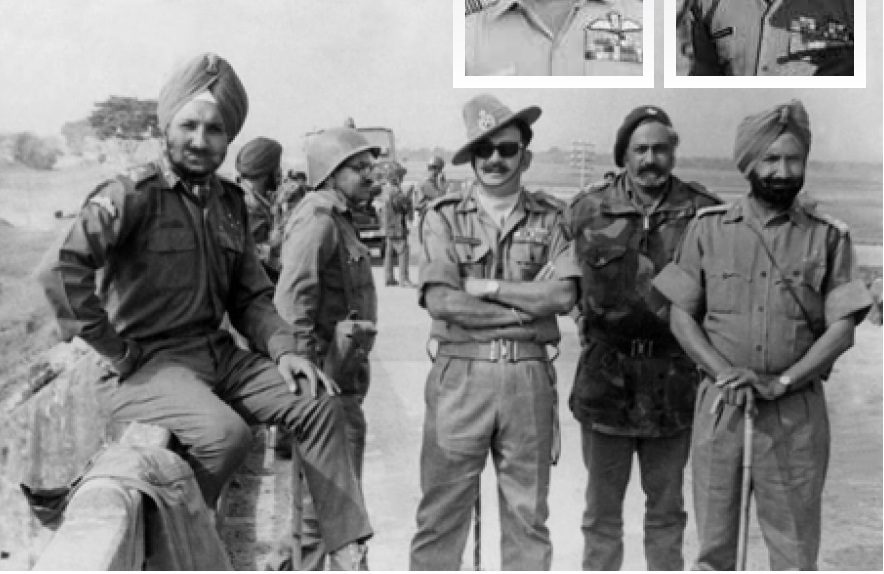
By 1971, Maj Gen Hardev Singh Kler (Then as a Brigadier) was commanding the 95 Mountain Brigade on the Eastern Front during the India–Pakistan War and the Bangladesh Liberation War. Under his leadership, the brigade played a decisive role in the rapid and audacious operations that led to the collapse of Pakistani resistance in East Pakistan. He personally led the brigade’s advance from Kamalpur to the River Turag along one of the most demanding operational axes of the campaign. This advance required the systematic clearance of well-entrenched enemy positions at Kamalpur, Bakshiganj, Jamalpur, Tangail, Mirzapur, and along the western bank of the River Turag, in addition to overcoming several strongly defended delaying positions along the route. Throughout these operations, he remained constantly with the leading troops, directing the battle from forward positions and exposing himself to continuous danger. His leadership style—based on presence, courage, and personal example—had a powerful effect on morale. Soldiers drew strength from the knowledge that their commander was sharing the same risks they faced.
The 'Battle of Jamalpur' became a defining episode of his command. The enemy resistance there was fierce, and Indian troops suffered heavy casualties while maintaining the siege. Recognising the critical moment, Brig Kler moved into the thick of battle, personally motivating and rallying his troops. His presence at the front, under intense fire, inspired renewed determination. Under his resolute and skilful direction, repeated Pakistani attempts to break out were decisively repulsed. The brigade inflicted heavy losses on the enemy, resulting in approximately 300 enemy killed and the capture of 379 prisoners, along with substantial quantities of weapons and ammunition. Brig Kler’s contribution was not limited to battlefield leadership alone; it was equally marked by strategic insight. Although his original task was to capture Mymensingh, he assessed the wider operational picture and visualised a far bolder objective: a rapid thrust towards Dhaka itself. He understood that speed, surprise, coordination, and relentless pressure could cause the enemy’s command structure to collapse before it could reorganise. He communicated this vision to senior commanders, including the Eastern Army Commander, Lieutenant General JS Aurora. His ideas contributed to the shaping of coordinated operations across the theatre, including support for the bold paratroop drop at Tangail. This airborne operation proved decisive, severing Pakistani withdrawal routes, disrupting their command and control, and accelerating the psychological and operational collapse of enemy forces.
During the course of these operations, Brig Kler was seriously injured in a mine blast that caused grave damage to his knees. Despite intense pain and the onset of permanent disability, he refused to relinquish command. Instead, he continued to lead from the front, determined that his personal suffering would not slow the momentum of operations. His advance from Kamalpur to the Turag River continued with fierce engagements against Pakistani forces, embodying extraordinary physical endurance and moral courage. In later years, when asked about the price he paid, he bore no bitterness. Speaking in Bangladesh, he once remarked with characteristic humility, “For your today, we gave our yesterday.” On another occasion, he said simply, “They got their liberation — I just lost a leg… so what?” These words came to symbolise the spirit of sacrifice that defined his life. On 11 December 1971, Pakistani troops at Jamalpur sent a message offering their surrender to Brig Kler. In a moment rich with symbolism, he proceeded to the surrender venue in a jeep that had belonged to a Pakistani officer named Col Sultan and had been captured by Indian troops. He formally accepted the surrender of the Pakistan brigade based at Jamalpur. By the end of these engagements, Pakistani losses stood at approximately 300 killed and 379 captured, with large stocks of weapons and ammunition seized.
Under his dynamic leadership, the 95 Mountain Brigade became one of the first Indian formations to enter Dhaka following the general surrender. Brig Kler was the first Indian officer to enter the office of Lieutenant General AAK Niazi, the Pakistani commander in East Pakistan. In a profoundly symbolic act, he lowered the Pakistani flag and hoisted the Indian flag in its place. What distinguished Brig Kler not only as a warrior but as a commander of exceptional character was his humanity in victory. Conscious that surrendered Pakistani soldiers might face reprisals from certain elements of the Mukti Bahini, he took the extraordinary step of ordering that weapons be issued to prisoners of war so they could defend themselves if attacked. This act reflected the highest ethical traditions of soldiering and earned him deep respect even beyond national boundaries. International observers came to refer to him as the “Liberator of Dhaka.” For his outstanding leadership, conspicuous gallantry, and inspirational example under fire, Maj Gen Hardev Singh Kler was awarded the Maha Vir Chakra (MVC), India’s second-highest wartime gallantry award.
He later rose to the rank of Major General and continued to serve with distinction until his retirement. In his later years, he recorded his experiences in his memoir, 12 Days to Dacca, a candid and powerful firsthand account of the 1971 campaign. The book was released in 2016 in Kolkata by former Chief of the Army Staff, General (Retd) Shankar Roychowdhury. At the event, his son, Wing Commander DJS “Deejay” Kler—himself a gallantry award recipient—spoke movingly about his father’s lifelong commitment to truth, duty, and honour. The injuries sustained in 1971 never truly left him. In his nineties, complications arising from the old mine injury ultimately led to the amputation of his left leg—a poignant reminder of the personal cost of his service. Major General Hardev Singh Kler passed away on 27 May 2016 at his residence in Walnut, California, USA. Major General Hardev Singh Kler’s life represents the very finest traditions of military leadership: courage in battle, clarity of vision, integrity in command, and compassion in victory. His decisive role in the 1971 operations contributed significantly to the liberation of Bangladesh and the swift collapse of Pakistani forces. He is remembered not merely as a highly decorated warrior, but as a commander who led from the front, inspired his men by personal example, and upheld the honour and ethos of the Indian Army in both war and peace.
Major General Hardev Singh Kler is survived by his son, Wg Cdr DJS Kler (Retd).


Gohil Hardevsinh.
2026 at 8:57 amWe highly appriciate dedication of such outstanding Army officer. God bless his soul.