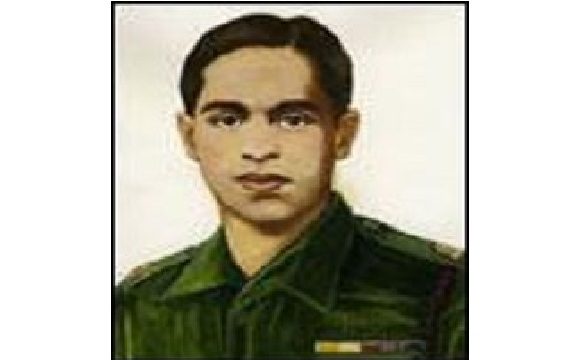

Service No : SS-14035
Date of Birth : October 31, 1924
Place of birth : Palghat Dist (Kerala)
Service : Army
Last Rank : Major
Unit : 3 Para
Arm/Regt : The Parachute Regiment
Awards : Maha Vir Chakra
Martyrdom : January 16, 1948
Major AK Ramaswamy MVC
Major Annavi Krishnaswamy Ramaswamy hailed from Ayilam village in the Palghat (Palakkad) district of Kerala, where he was born on 31 October 1924. His family later relocated and settled in South Malabar, Kerala, where he spent his formative years. Driven by a strong sense of duty and patriotism, he joined the Indian Army and was commissioned on 15 December 1946, at the young age of 22, into the 3rd Battalion of the Maratha Light Infantry Regiment (3 MLI). The Maratha Light Infantry Regiment traces its proud origins to 1768, when it was raised as the 103rd Maratha, making it the senior-most light infantry regiment of the Indian Army. Since 1922, its Regimental Centre has been located at Belgaum (Belagavi), Karnataka, which continues to serve as the cradle of the regiment’s traditions and training. The regiment’s stirring battle cry, “Bol Shri Chhatrapati Shivaji Maharaj ki Jai!” (Cry Victory to Emperor Shivaji!) is a tribute to the legacy, courage, and warrior spirit of the great Maratha ruler Chhatrapati Shivaji Maharaj. After India attained independence, the regiment was reorganised and reverted to its original strength of five battalions.
In a significant milestone in its history, the 3rd Battalion, The Maratha Light Infantry (3 MLI) was selected for conversion to the airborne role. This battalion was converted into a Parachute battalion in 1946 and allotted to the 77 Parachute Brigade, where it became known as the 3rd Parachute Battalion (Marathas). In later years, the unit was redesignated as the 2 Para (Maratha), a name by which it came to be widely recognised. Through dedication, discipline, and exemplary service, he steadily rose through the ranks. By 1948, he had already earned a reputation as a capable and committed officer and had been promoted to the rank of Major, reflecting the trust and respect he commanded within his unit.
Indo-Pak War (Naushera Sector): 16 Jan 1948
During the 1947–48 Indo-Pakistan War, 3 (Para) Maratha Light Infantry formed an integral part of the 50 Para Brigade, which was commanded by the gallant Brigadier Usman Mohammad. As the situation in Jammu and Kashmir grew increasingly critical, the battalion was airlifted from Amritsar to Jammu in December 1947 to reinforce the hard-pressed brigade and strengthen India’s defensive and offensive operations in the region. This deployment marked one of the earliest operational uses of airborne-trained troops in independent India and underscored the battalion’s readiness, adaptability, and commitment to frontline service under demanding conditions. The tribal raid launched by Pakistani raiders into Jammu and Kashmir in October 1947 continued relentlessly through the winter. On 24 December 1947, the enemy captured the strategically vital town of Jhangar. This success gave them a significant tactical advantage, opening the route for a possible advance towards Naushera and Poonch—both critical locations for India’s defensive posture in the region. Recognizing the grave threat posed by this development, the Indian Army accorded the recapture of Jhangar the highest operational priority in order to halt any further enemy advance towards Naushera.To achieve this objective, the Indian Army planned a coordinated two-brigade offensive along the Naushera–Jhangar axis. As part of this operation, two companies of 3 Maratha Light Infantry were tasked to act as the vanguard of 50 Parachute Brigade. Major AK Ramaswamy commanded one of these companies and led his men forward with determination and resolve.
On 16 January 1948, while deployed at Naushera, Major Ramaswamy was ordered to move forward and reinforce a company of his battalion that was pinned down under intense enemy fire. Demonstrating exemplary leadership, he personally led the reinforcement, successfully easing the pressure on the embattled troops and enabling the rest of the battalion to withdraw safely. Once the withdrawal of the main body was completed, Major Ramaswamy’s company began its own withdrawal. The route, however, was heavily exposed and swept by sustained enemy fire. During this critical phase, one of his soldiers was seriously wounded and left stranded in the open. Without a moment’s hesitation and with complete disregard for his own safety, Major Ramaswamy turned back into the fire-swept area to rescue the injured man. Even when the wounded soldier urged him not to risk his life, Major Ramaswamy remained undeterred. He lifted the soldier and carried him for nearly fifteen yards under a hail of bullets. In the process, Major Ramaswamy himself was grievously wounded. Despite efforts to evacuate him, he later succumbed to his injuries, laying down his life in the highest traditions of the Indian Army. Major Annavi Krishnaswamy Ramaswamy was a gallant soldier and a fearless officer who led from the front and embodied the true spirit of comradeship and sacrifice. In recognition of his extraordinary courage, leadership, and devotion to duty, he was posthumously awarded the nation’s second-highest gallantry award, the "Maha Vir Chakra".
iyer krishnan balasubramanian
2023 at 5:41 pmDear Sir
I belong to his family my name is iyer krishnan balasubramanian he is my grand uncle
Regards
Krishnan
M A Kothandaranan
2023 at 10:31 amI am also from Ayilam Village. The road leading to Ayilam Village is named after Major Ramaswamy road and is the gateway to the village.
M.A.Kothandaraman
Pawan Kumar pandey
2025 at 7:33 amSir
With regards I beg his family members contact number and mail ID so that v can contact his family .I am from his unit .