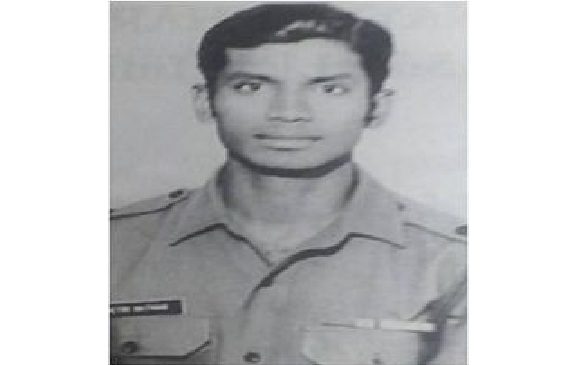

Service No : IC-13991X
Date of Birth : February 24, 1941
Place of birth : Mumbai Dist (Mah)
Service : Army
Last Rank : Major
Unit : 11 GR
Arm/Regt : 11 Gorkha Rifles
Operation : Indo-Pak War 1971
Awards : Vir Chakra
Martyrdom : December 6, 1971
Major Vetri Nathan VrC
Major Vetri Nathan hailed from Mumbai in Maharashtra and was born on 24 February 1941. He grew up in a family closely connected with the armed forces, being the son of an Indian Navy veteran, Commander NK Nathan. This environment deeply influenced his early years and instilled in him a sense of discipline, patriotism, and admiration for military service. Motivated by these values, he chose to join the Indian Army and pursue a life dedicated to the nation. At the age of 21, in December 1962, he was commissioned into the 2/11 Gorkha Rifles, a battalion of the illustrious 11 Gorkha Rifles Regiment, renowned for its unmatched bravery, professionalism, and battlefield honours. From the outset, he displayed strong leadership qualities and an unwavering commitment to his duties. Over the years, he evolved into a steadfast and dependable officer who earned the respect of both seniors and subordinates.
The second battalion of the 11 Gorkha Rifles had been raised recently on 11 January 1963, and Major Vetri was among the early officers to join it. His journey into active counterinsurgency warfare began when the battalion was deployed to Mizoram to contain the escalating Mizo uprising. The challenging terrain, guerrilla tactics of the insurgents, and hostile environment tested the endurance and skill of every soldier deployed there. However, Major Vetri Nathan distinguished himself through exemplary courage, tactical intelligence, and an unrelenting fighting spirit. During his tenure in Mizoram, he led numerous successful operations against insurgent strongholds and logistical networks, severely impacting rebel capabilities. His bold actions and unwavering resolve made him a formidable adversary in the eyes of insurgents. Such was the fear he instilled among the Mizo rebels that they referred to him as “The Black Pearl,” a name symbolizing his elusive presence, exceptional talent, and relentless pursuit. His effectiveness became so widely recognized that a large bounty was declared on his head by rebel forces.
Operation ‘Little John’ and the Mizo Hills (1966)
On 05 March, during Operation ‘Little John’, A Company of 2/11 Gorkha Rifles, commanded by Major Vetri Nathan, was placed in the vanguard of the advance. Demonstrating characteristic aggression and speed, Major Nathan pushed forward rapidly through difficult terrain. In the process, he temporarily moved out of communication with the rear—an ironic situation that did not go unnoticed by the Brigade Commander, who had only recently served as the Chief Signals Officer at Command Headquarters. Undeterred, Major Nathan bypassed the rear elements of a Sikh column at Kolosib and continued his advance. By 1500 hours, his company successfully established contact with the main column at Kawnpui, where troops were engaged in clearing Mizo National Front (MNF) hostiles from a nearby village that was obstructing the advance. With Chaltlang established as the firm base, the Sikhs and Gorkhas launched a coordinated move forward. By this time, the remaining companies of the battalion had joined up. Major Vetri Nathan’s A Company, along with C Company under Major Prem Kumar, led the advance. D Company (under N.P. Bhanot) remained in reserve, while B Company (under S.K. Datta) guarded the rear at Chaltlang. The operation was backed by MMGs, mortars, and artillery support.
Confronted by the swift and determined advance of Indian troops, the MNF hostiles fled, offering only limited resistance. The objectives were secured without casualties—an impressive outcome in what was the first-ever encounter of the Second Battalion. That very evening, All India Radio broadcast the news of the re-establishment of government authority at Aizawl, marking the lifting of the MNF siege. The Second Battalion, and Major Vetri Nathan in particular, played a decisive role in restoring control. Subsequent operations also led to the clearing of Champhai. The campaign was not without losses. On 30 March, a column under Captain Kuldip Chand clashed with MNF hostiles, suffering two fatalities and five wounded. Later, on 12 May, a jeep column commanded by Ajmer Singh was ambushed, resulting in the loss of six soldiers. Two days later, Major Vetri Nathan led a successful action that decisively retaliated against the hostiles, restoring morale and operational balance with considerable credit. By the time the Indo-Pak War of 1971 approached, Major Vetri K. Nathan had gained extensive operational experience and had firmly established himself as a battle-hardened soldier.
Kargil Sector (Indo- Pak War) : 06 Dec 1971
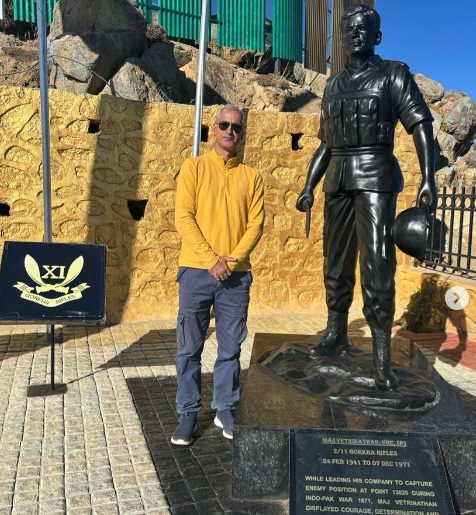
During the Indo-Pak War of 1971, Major Vetri Nathan’s battalion, 2/11 Gorkha Rifles, was deployed in the strategically vital Kargil sector of Jammu & Kashmir. The area was dominated by a series of high-altitude features overlooking the Srinagar–Leh highway, a lifeline for logistics and troop movement. Among these, Point 13620 stood out as a critical objective. Although the feature had been captured by Indian forces during the 1965 war, it was relinquished under the Tashkent Agreement of January 1966. With hostilities erupting again in 1971, Point 13620 re-emerged as a serious threat. Its recapture became operationally essential, and the formidable task was assigned to 2/11 Gorkha Rifles. The assault demanded a climb across steep, rugged slopes under harsh weather and intense enemy fire. On 06 December 1971, the attack was launched. Major Vetri Nathan, commanding one of the assault companies, led from the front with exemplary courage. His company successfully overran the first major enemy position, known as “Black Rocks.”
As the assault continued toward the summit, the advance was stalled by intense fire from a well-entrenched enemy Medium Machine Gun (MMG) bunker near the crest. Recognising the grave threat it posed to the entire operation, Major Nathan took an instant and fateful decision. With complete disregard for his own safety, he called for a hand-held rocket launcher, rose from cover under direct fire, and fired with deadly accuracy—destroying the MMG post. At that very moment, an enemy bullet struck Major Vetri Nathan in the head. He fell, having cleared the decisive obstacle, and made the supreme sacrifice in the finest traditions of the Indian Army. Inspired by the sight of their fallen commander, the Gorkhas surged forward with unmatched ferocity. Drawing their khukris, they charged uphill, overwhelming the remaining enemy positions. By first light, the enemy had withdrawn, abandoning the entire feature. Point 13620 was successfully recaptured. In honour of his fearless leadership and supreme sacrifice, the captured feature was named “Vetri Post.” For his exceptional bravery, resolute leadership, and ultimate sacrifice, Major Vetri Nathan was posthumously awarded the 'Vir Chakra'. He remains remembered as an officer who led from the front in peace and war alike—an embodiment of courage, duty, and the indomitable spirit of the 11 Gorkha Rifles.


13 Comments
« Previous 1 2
Anuprash
2025 at 2:53 pmMy father who fought this war with v Nathan always sharing his experience with us. My father always remember V Nathan. Hav Phurba of the same 2nd 11 was awarded with Veer chakra.
Jai Hind Jai Gorkha
Subramanian (Kumar)
2025 at 2:53 pmSalute the brave warrior. Nothing to match his strength and valour. A very true dedicated, brave son of India. Bow to him. Jai Hind. He is my Uncle and proud to have one in our family
Rayvathi subramaniam
2025 at 2:53 pmA dear ,much loved brother .To classes we walked together ,you always lightened the moment with your pithy wit . Large hearted and caring you showered your love on me . You missed my wedding and made a brief stop at my home on your way to your posting . Precious memories .