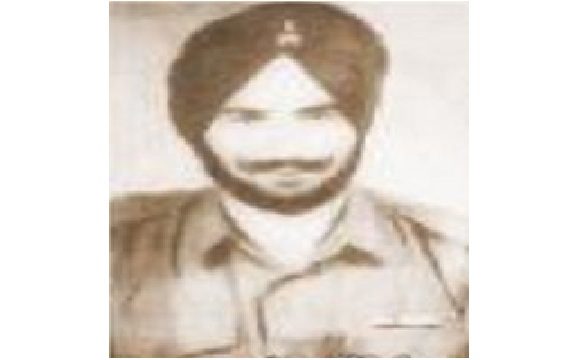

Service No : 3348614
Place of birth : Bathinda Dist (Pun)
Service : Army
Last Rank : Naik
Unit : 6 Sikh
Arm/Regt : The Sikh Regiment
Operation : Op Cactus Lily
Awards : Vir Chakra
Martyrdom : December 3, 1971
Naik Naib Singh VrC
Naik Naib Singh hailed from Maliwala village in the Bathinda district of Punjab, a region known for its deep-rooted tradition of patriotism and military service. From an early age, he displayed discipline, resilience, and a strong sense of duty—qualities that would later define his life as a soldier. After completing his school education, he was selected for service in the Indian Army and was recruited into the 6th Battalion of the Sikh Regiment. The Sikh Regiment is among the oldest and most distinguished regiments of the Indian Army, renowned for its fearless soldiers, rich martial heritage, and numerous battle honours earned across generations. Becoming part of such an illustrious regiment was both a matter of pride and responsibility, and Naik Naib Singh embraced this legacy with dedication and sincerity.
Within a few years of service, he married Ms Baljit Kaur, beginning a new chapter in his personal life. Even as he balanced family responsibilities with the demanding life of a soldier, his commitment to duty remained unwavering—a devotion that would ultimately define his legacy.
Battle of Poonch (Indo-Pak War): 03 Dec 1971
In 1971, Naik Naib Singh was serving with the 6 Sikh Battalion, deployed in the strategically sensitive Poonch sector of Jammu and Kashmir. As the situation in East Pakistan deteriorated and hostilities became inevitable, Pakistan adopted a dual-front strategy—while India’s main effort developed on the Eastern Front, Pakistan launched aggressive operations on the Western Front to divert Indian forces and create pressure. The Indo–Pakistan War of 1971 formally began on 3 December 1971, when Pakistan launched pre-emptive air strikes on eleven Indian airbases. Among its most critical engagements was the Battle of Poonch. The defence of the Poonch Sector was entrusted to 93 Infantry Brigade, commanded by Brigadier AV Natu, under 25 Infantry Division led by Major General Kundan Singh. Poonch was remote, difficult to supply, and extremely vulnerable—but its loss would have opened a dangerous corridor for enemy forces into Jammu. A vital lifeline for the brigade was the Kalai Bridge over the Poonch River, linking it with the divisional headquarters. Its protection was therefore essential to the survival of the entire sector. Anticipating conflict, the brigade had conducted extensive operational rehearsals in April–May 1971 in the Kandi Budhal area. By November, all formations were fully deployed for war. 6 Sikh was tasked with holding the crucial Banwat sector, which included a dominating hill complex comprising Piquet 405, 406, 406A, Tund, and Helipad. These features overlooked Poonch town itself—their loss would have left the town completely exposed to enemy domination.
On 03 December 1971, Pakistan opened the Western Front with widespread pre-emptive air strikes to create momentum for its planned ground offensives. At about 0500 hours, two Pakistani aircraft flew over Poonch and fired rockets at the administrative base of the 6 Sikh Battalion, causing damage and signalling the beginning of hostilities in the sector. Simultaneously, Pakistan’s 12 Infantry Division launched a major offensive against 93 Infantry Brigade, targeting the Durga, Banwat and Doda defences with the clear objective of capturing the strategically vital town of Poonch. Throughout the night of 03–04 December, intense enemy shelling pounded all forward picquets. Reports continuously poured in that posts were under heavy attack and that enemy troops were massing for assault. Isolated along a difficult line of communication, 93 Infantry Brigade could expect no immediate reinforcements. Nevertheless, its Commander, Brigadier AV Natu, had prepared the defences meticulously and placed complete confidence in the fighting spirit of his troops. A key feature of the Poonch defences was the Banwat Sector, whose hill complex dominated Poonch town. The security of this sector was essential to protect the town from assault from the East and North-East. The complex culminated at Piquet 405, including Tund and Helipad, the highest and most tactically significant features in the area. These positions, along with Piquets 406 and 406A, were classified as Grounds of Tactical Importance (GTI), and the responsibility for their defence was entrusted to the gallant soldiers of 6 Sikh Battalion. To provide depth to these defences, the 8 Jat Battalion was deployed to the south under the operational control of 93 Infantry Brigade from 26 November 1971.
From 03 December, the enemy subjected the Banwat defended area to relentless bombardment. Helipad and Tund were continuously shelled with medium-calibre artillery, severing all landline communications near the Brigade Signal Exchange and forcing units to rely solely on radio. Under the cover of this heavy fire, the Pakistan Army launched a determined, full-scale assault on Helipad and Tund between 0300 and 0600 hours on the night of 03/04 December 1971, employing three battalions—7 POK, 5 FFR and 14 POK. What followed was fierce, close-quarter combat, with brutal hand-to-hand fighting that continued for nearly two hours. Yet, the soldiers of the 6th Sikh steadfast at their posts, fought with exemplary courage and refused to yield ground. It was during this desperate battle that Naik Naib Singh, holding a defended locality in the western sector of the battalion area, displayed exceptional bravery. When the enemy launched a strong attack on his post on the night of 03 December 1971, Naik Naib Singh fearlessly exposed himself to motivate his men and skillfully directed their fire, ensuring that every round counted. As the battle intensified and his ammunition was finally exhausted, he did not withdraw. Instead, he closed in with the enemy and engaged in hand-to-hand combat, killing an enemy soldier with his bayonet. In the process, he sustained grievous injuries. Despite his wounds, his example inspired his comrades to hold firm. He later succumbed to his injuries, laying down his life in the finest traditions of the Indian Army.
In this action, Naik Naib Singh displayed conspicuous courage, indomitable determination, and supreme sacrifice. Along with him, seven other brave soldiers of the 6 Sikh Battalion also attained martyrdom while holding their ground against overwhelming enemy assaults: Sepoy Dilbagh Singh, Sepoy Charan Singh, Sepoy Karnail Singh, Sepoy Sukhdev Singh, Sepoy Dilbagh Singh, Sepoy Gurdial Singh, Sepoy Sohan Singh, Sepoy Gurmukh Singh. Together, these men formed a band of brothers who stood firm in the face of death, ensuring that the enemy was denied a breakthrough in the Poonch sector. Their collective sacrifice became a defining chapter in the proud history of the Sikh Regiment and a lasting symbol of the regiment’s motto—fearless in battle, steadfast in duty. Naik Naib Singh was given the gallantry award, “Vir Chakra” for his outstanding courage, unyielding fighting spirit, and supreme sacrifice.
Naik Naib Singh is survived by his wife, Smt Baljit Kaur.
Kamaldeep Singh
2026 at 11:58 amNaik Naib Singh is Real Hero of Indian Army
Naresh Chandra
2026 at 12:00 pmyou can visit vivek Ashram, vill mallewala, faridkot punjab. this is the place where this brave soul was born . there is a charitable trust in the village run by his family i his rememberence