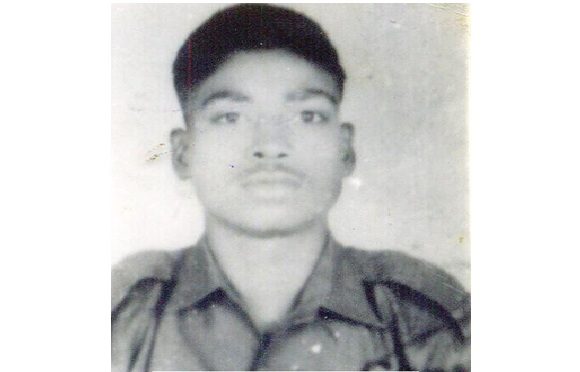
Sapper Jayavelu M hailed from Tiruvannamalai district in Tamil Nadu, a region known for its rich cultural heritage and resilient spirit. He was born on 25 November 1975 to Shri D. Masilamani, a retired soldier of the Indian Army, and Smt. Shanthi. He was the only son in the family and grew up with his three elder sisters—Jayanthi, Jayashree, and Jayalakshmi. Raised in a disciplined household with a strong military influence through his father’s service in the Army, Spr Jayavelu imbibed the values of patriotism, dedication, and responsibility from an early age. These values later inspired him to follow in his father’s footsteps and dedicate his life to serving the nation. After completing his school education, Spr Jayavelu pursued his dream with determination and successfully joined the Indian Army. He was recruited into the 2nd Engineering Regiment of the Corps of Engineers, one of the oldest and most distinguished arms of the Indian Army. The Corps of Engineers plays a vital role in strengthening the Army's operational capabilities. It comprises three major constituents: Combat Engineers, the Military Engineer Services (MES), and the Border Roads Organisation (BRO). In addition to these components, the Corps also provides officers to specialized institutions such as the Military Survey and the Defence Research & Development Organisation (DRDO), thereby contributing significantly to both operational and strategic domains of national defence.
As part of the Combat Engineers, Sapper Jayavelu belonged to the cutting edge of military operations. Combat Engineers are tasked with providing mobility to their own forces and counter-mobility to the enemy. They undertake critical tasks such as constructing bridges, laying and clearing mines, building tracks and helipads, and ensuring that troops and equipment can move swiftly and safely across challenging terrains. Their role is indispensable during both war and peace, as they enable operational success through technical expertise, courage, and unwavering commitment.
Op Vijay-Kargil War(Drass Sector) : 05 June 1999
During the Kargil conflict of 1999, the 2 Engineer Regiment, to which Sapper Jayavelu belonged, was functioning under the 3 Infantry Division, which in turn operated under the overall operational control of the 15 Corps (Chinar Corps) of the Indian Army. The formation was responsible for operations along the Line of Control (LoC) in the Kargil region of Jammu & Kashmir, an area that had become increasingly tense and volatile in the months leading up to the conflict. The Drass and Kaksar sectors, where the unit was deployed, were among the most strategically critical areas along the LoC. Characterized by towering mountains, narrow ridgelines, extreme weather conditions, and constant enemy observation, the terrain posed enormous challenges to the troops defending it. Ceasefire violations were frequent and unpredictable, requiring soldiers to maintain round-the-clock vigilance while operating with limited manpower across a vast and rugged landscape. In early May 1999, the situation escalated significantly when unusual enemy movements were detected in the Batalik–Yaldor sector. What initially appeared to be an isolated activity soon revealed a larger pattern of infiltration by enemy forces across the LoC. Recognizing the seriousness of the threat, Indian Army formations intensified patrols and reconnaissance within their Areas of Responsibility to ascertain the extent of intrusion and prevent the enemy from consolidating positions on dominating heights.
As operations commenced to evict the intruders and reclaim occupied positions, the role of the Corps of Engineers became crucial. Enemy forces had fortified their positions and laid extensive minefields and obstacles along the approaches to key heights. Before infantry troops could advance, combat engineers were required to detect and clear these mines, often under enemy observation and direct fire. This dangerous task demanded exceptional technical skill, composure, and courage. Serving with the 2nd Engineer Regiment, Sapper Jayavelu carried out his duties with dedication and determination. As a trained combat engineer, he was responsible for tasks such as clearing mines, removing obstacles, and ensuring safe passage for advancing troops. On 05 June 1999, during one such mine-clearing operation in the Kaksar sector, Sapper Jayavelu displayed outstanding courage while carrying out his mission under hazardous conditions. While performing his duty of clearing mines to enable further military operations, he laid down his life in the line of duty. For his conspicuous gallantry and supreme sacrifice at the age of 23 years, Sapper Jayavelu was posthumously awarded the Sena Medal, honouring his bravery, devotion to duty, and commitment to the nation.
Sapper Jayavelu M is survived by his father, Shri D. Masilamani, mother, Smt. Shanthi and three sisters—Smt Jayanthi, Smt Jayashree, and Smt Jayalakshmi.

Prasanth Kumar S
2020 at 1:29 amHi Sir/Madam,
Please be informed that I am the nephew of Kargil War hero M.Jayavelu ( MEG Indian Army). He is the only son of Mrs. Shanthi and D.Masilamani ( Retired Indian Army). He has three elder Sisters named Jayanthi, Jayashree and Jayalakshmi. He is the inspiration for my family and still we believe that he is alive somewhere. We salute for his braveness and love towards our Indian Country. As a part of the army family we would request you to honour him on his birthday 25th November 1975 and will also be happy if we get any gratitude like employment opportunities for us as he is only my maternal uncle and we miss him a lot.
Sameer
2026 at 9:58 amPlease listen to Brigradier Surinder Singh’s podcast which is available on youtube and his writ petition filed in the supreme court to get full account of the fate of this soldier. His bravery has not been recognized which is shameful as a nation.
Sameer
2026 at 10:09 amAs per his account, he was from engineering unit and made charges for infantry soldiers. He was not supposed to go to the frontline in battefield but he went because he considered it will be very hard for infantry soldiers to set the charges and they may not be able to do it properly. When he did not return, people said he ran away or something but later his body was found on an enemy bunker and hand stretched in setting up charges. His bravery and sacrifice gave me teary eyes when I listened to this account by retd. Brigadier Surinder Singh. Please do contact him, he can connect you with other soldiers who might be able to give complete details.