
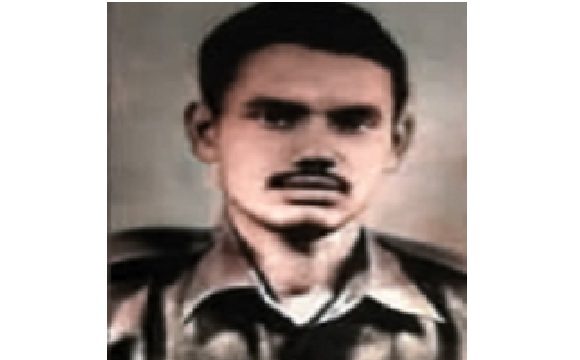
In 1965, during the escalation of hostilities between India and Pakistan, Second Lieutenant Kotnis was serving with 14 Field Regiment. During the Indo–Pakistan War of 1965, the Chhamb–Jaurian sector emerged as one of the most critical and fiercely contested theatres on the western front. Owing to its strategic location astride the Akhnoor–Rajauri axis and the challenging terrain configuration, Chhamb assumed immense operational importance. Pakistan, fully aware that control of this sector could threaten India’s lines of communication to Jammu, committed substantial forces to the battle. At the outbreak of hostilities in early September 1965, Indian forces deployed in the sector were centred around 191 Infantry Brigade, supported by armoured and artillery elements. Among the artillery units deployed was the 14 Field Regiment, with which Second Lieutenant Prakash Narayan Kotnis was serving. The Indian order of battle in that sector included 15 Kumaon, C Squadron of 20 Lancers, 14 Field Regiment, and a medium battery from 39 Medium Regiment, tasked with providing critical fire support to the infantry and armour.
In the early hours of 7 September 1965, well before dawn, Pakistani forces opened a massive and sustained artillery and mortar bombardment. Brigade headquarters, infantry concentration areas, tank harbours, artillery gun positions, and battalion headquarters—particularly that of 6 Sikh Light Infantry near Chhamb village—came under intense shelling. Border outposts stretching from Burejal to west of Dewas were subjected to relentless fire. The bombardment, which lasted nearly eight hours, was clearly intended to soften Indian defences before the launch of a major armoured thrust. Under the cover of this heavy artillery fire, Pakistani armour began closing in on Indian forward positions. By around 0900 hours, it became evident that the Pakistani attack was developing along three distinct axes, with two Patton tank squadrons advancing from the south and west, and another armoured column pushing in from the north near Dewas. Indian armour responded by repositioning to cover the southern approaches, the Munawar Tawi river crossing, and the western axis, while Indian artillery—including 14 Field Regiment—engaged enemy armour and infantry concentrations with sustained and accurate fire.
Despite stout resistance, Pakistani forces succeeded in crossing the Munawar Tawi at several points. 191 Infantry Brigade held on west of the river until late into the night, but was eventually ordered to fall back towards Akhnoor via Jaurian to prevent encirclement. Throughout this withdrawal, Indian artillery units played a decisive role in delaying the enemy advance, breaking up armoured thrusts, and enabling the infantry to disengage in good order. It was during these critical and fluid phases of the battle, marked by constant movement, intense enemy fire, and repeated Pakistani armoured assaults, that Second Lieutenant Prakash Narayan Kotnis of 14 Field Regiment displayed exemplary courage and devotion to duty. As a young artillery officer, he was responsible for maintaining fire support under extremely hazardous conditions, often operating forward of gun areas to ensure accuracy and continuity of fire. On 15 September 1965, while actively engaged in operations during the Battle of Chhamb, Second Lieutenant Kotnis laid down his life in the line of duty, making the supreme sacrifice. His steadfast commitment ensured that artillery support from 14 Field Regiment continued unabated at a time when it was vital for the survival of Indian infantry and armour in the sector.
Although the Battle of Chhamb witnessed intense fighting until 21 September 1965, with both sides committing large formations—including divisions, tank regiments, artillery, and infantry—the courage and professionalism of Indian soldiers and gunners blunted the Pakistani offensive. Despite initial Pakistani gains and momentary momentum, Indian forces succeeded in stabilising the front and inflicting significant losses on the enemy. The sacrifice of Second Lieutenant Prakash Narayan Shridhar Kotnis at the age of 26 years stands as a poignant reminder of the price paid by young officers and soldiers during the 1965 war. His gallantry and the resolute performance of 14 Field Regiment, exemplified the finest traditions of the Regiment of Artillery and contributed meaningfully to India’s determined defence of the Chhamb sector.
Kedar Agarkar
2025 at 8:39 amLt. Prakash Kotnis was alumnus of Dadar, Mumbai’s Balmohan Vidyamandir school. Here is a first and rare article on him.
https://www.saamana.com/author-ramdas-kamat-article-on-lieutenant-prakash-narayan-sridhar-kotnis/
kedar.agarkar@gmail.com
Kedar Agarkar
2025 at 9:55 amThanks a lot Honourpoint.in for finding great amount of additional information for Lt Prakash Kotnis and updating here in a very detailed way. Great work.
Thanks again
Kedar