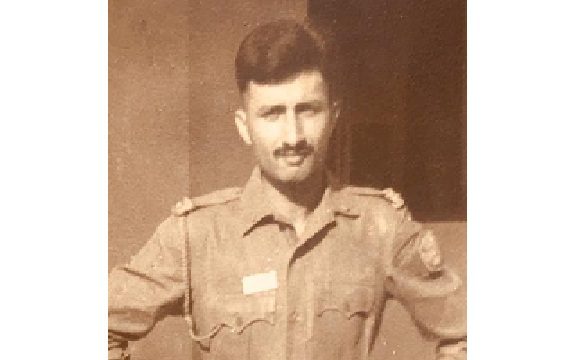

Service No : SS-23957
Place of birth : Delhi
Service : Army
Last Rank : Second Lieutenant
Unit : 87 Lt Regt
Arm/Regt : The Regiment of Artillery
Operation : Indo-Pak War 1971
Martyrdom : December 13, 1971
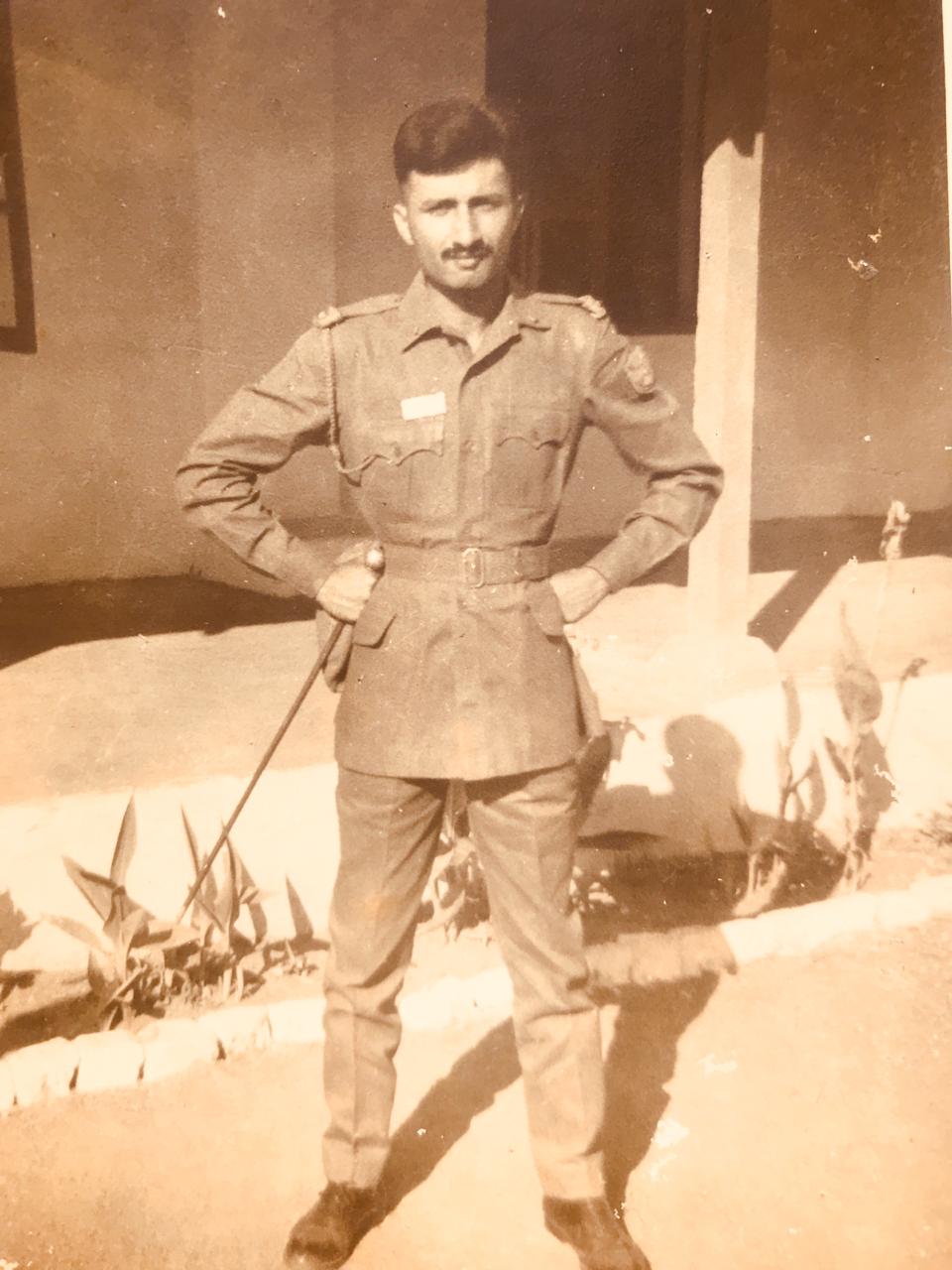
2nd Lt Sudhir Mohan Sabharwal
Second Lieutenant Sudhir Mohan Sabharwal hailed from Delhi and was the son of Shri OP Sabharwal. From an early age, he was drawn to the idea of serving the nation in uniform. What began as admiration soon grew into a resolute ambition—to join the Indian Army and don the Olive Green. With this goal firmly in mind, he began preparing for the Combined Defence Services Examination (CDSE). His hard work and determination paid off when he successfully cleared the examination and earned admission to the Officers Training Academy (OTA), Chennai. He joined the SS–10 Course, where he underwent rigorous physical conditioning, tactical training, and leadership development—training designed to transform young aspirants into capable and confident military officers. After months of demanding preparation, he passed out from OTA on 14 March 1971, proudly receiving his commission as a Second Lieutenant along with 337 course-mates. He was commissioned into the 87 Light Regiment of the Regiment of Artillery—an arm of the Indian Army known for its precision, technical proficiency, and crucial battlefield support role.
Committed to excellence in his profession, 2nd Lt Sabharwal soon proceeded to the School of Artillery, Deolali, where he completed the Young Officers’ Course (Field 578, ‘A’ Troop) from 29 March to 21 August 1971. This training further strengthened his expertise in artillery operations, fire control, and battlefield coordination. Barely months into his service, geopolitical tensions with Pakistan escalated rapidly. As the situation deteriorated, India stood on the brink of war. Still early in his military career but fully prepared to serve, 2nd Lt Sudhir Mohan Sabharwal moved with his regiment to the operational sector along the western front—ready to fulfil his duty to the nation as the 1971 Indo-Pak War became inevitable.
Indo-Pak War (Western Sector): 03-13 Dec 1971
During the Indo–Pak War of 1971, the overall responsibility for the defence of the western theatre was divided between Western and Southern Commands. Western Command was tasked with securing the territory from Ladakh down to Ganganagar in Rajasthan, while Southern Command oversaw the remaining areas of Rajasthan and Gujarat. At that time, Northern Command did not exist and was raised only in 1972 following the war. Under Western Command operated XV Corps, I Corps, and XI Corps. XV Corps was responsible for the defence of Jammu & Kashmir and consisted of 3, 19, 25, 10 and 26 Infantry Divisions — with 3 Infantry Division in Ladakh, 19 Infantry Division in the Kashmir Valley, 25 Infantry Division in the Punch-Jhangar region, 10 Infantry Division in the Akhnoor sector, and 26 Infantry Division in the Jammu area. Meanwhile, I Corps commanded 36, 39 and 54 Divisions and was tasked with the defence of the strategically important Samba–Pathankot–Gurdaspur axis. It was under this wider operational structure that 2nd Lt SM Sabharwal of 87 Light Regiment served in the high-altitude Kargil sector. His regiment was functioning under the 121 Infantry Brigade Group, which fell under 3 Infantry Division.
In Kargil, the enemy held several dominating heights overlooking the vital Srinagar–Leh highway. Among these, Point 13620 north of the Shingo River was one of the most significant. The mission of 121 Infantry Brigade was to capture the Brachil Pass–Hathi Matha area and clear enemy positions controlling the road. Given the formidable defences around Point 13620, planners decided to assault the position from the rear. On the night of 07/08 December 1971, troops of 2/11 Gorkha Rifles and 9 Jammu & Kashmir Rifles executed a surprise manoeuvre, capturing key enemy posts and isolating Point 13620. After sustained artillery and air support, the Gorkhas secured the objective by afternoon. Simultaneously, 18 Punjab launched a fierce assault on Brachil Pass, capturing it on 07 December after intense fighting.
In these operations, 2/Lt Sabharwal played a critical and highly hazardous role as a Forward Observation Officer (FOO) with ‘C’ Company, 18 Punjab. FOOs were responsible for observing enemy movement from forward positions and directing artillery fire with precision — often only metres away from the frontline infantry. This made their role indispensable, yet extremely dangerous. In the early hours of 07 December at 0430 hours, ‘C’ Company began its assault on enemy positions at Bahar, Hamid and Brachil Pass. As resistance intensified, artillery support was requested at around 0530 hours. Responding swiftly to 2nd Lt Sabharwal’s directions, 871 Light Battery and a troop of 872 Light Battery unleashed accurate fire that broke enemy resistance. By 0700 hours, the objectives were secured — a success made possible by close coordination between infantry and artillery, with Sabharwal at the heart of the operation.
Less than a week later, on 13 December 1971, 2/Lt Sabharwal again moved forward as FOO with another assaulting company of 18 PUNJAB, this time targeting Point 4910. The attack met fierce opposition, and Pakistani forces launched a determined counter-attack. Despite a courageous fight, the assault could not be sustained and was eventually forced to withdraw. In the chaos of battle, 2/Lt S. M. Sabharwal, his radio operator ORA Richard, and approximately eighteen soldiers of 18 Punjab went missing in action. His courage, calm under fire, and exemplary commitment to his duty as a Forward Observation Officer played a pivotal role in enabling successful operations in some of the most hostile and unforgiving terrain of the conflict.
With no confirmed information on his whereabouts, 2nd Lt SM Sabharwal remained officially listed as Missing in Action for years. After many years of uncertainty, he was eventually declared "Killed in Action" seven years later. In the years that followed, there were sporadic and unverified accounts from foreign sources suggesting that 2nd Lt Sabharwal may have been held in a Pakistani prison. To this day, the fate of 2nd Lt SM Sabharwal remains shrouded in mystery — a painful reminder of the unresolved stories of war. Presently, 2nd Lt SM Sabharwal’s name features on the official list of the ’54 Personnel Missing in Action’, tabled in the Lok Sabha in 1979 by the then Minister of State of External Affairs, Shri Samarendra Kundu.
2nd Lt Sudhir Mohan Sabharwal is survived by his brother Shri VK Sabharwal.

No Comments