
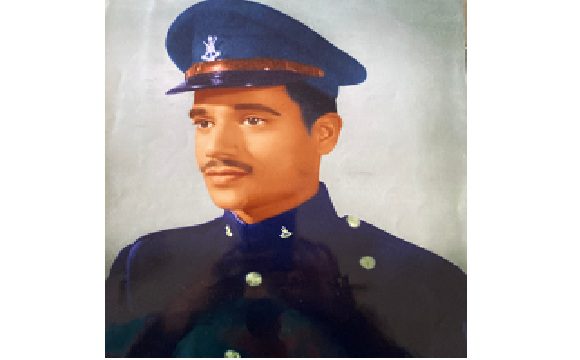
Service No : IC-12908
Date of Birth : August 14, 1940
Place of birth : Kakinada (AP)
Service : Army
Last Rank : Second Lieutenant
Unit : 4 Sikh LI
Arm/Regt : The Sikh Light Infantry
Operation : Indo-China War 1962
Martyrdom : November 21, 1962
Second Lieutenant Tulabandula Achyutha Rayalu
Second Lieutenant Tulabandula Achyutha Rayalu was born on 14 August 1940 in Vodresvar village of Kakinada district in Andhra Pradesh. He was the son of Shri Tulabandula Nageswara Rao and Smt Veera Raghavamma. Raised in a close-knit family, he grew up alongside his two elder sisters, two younger sisters, and a younger brother, in an environment that nurtured strong values of discipline, education, and perseverance. From an early age, he displayed academic brilliance and a keen sense of purpose. His primary education began at Rishi Valley School, known for its emphasis on holistic development. He later continued his schooling at Bala Bharat in Chennai (then Madras). His formative years were further shaped at the Lawrence School Lovedale, an institution renowned for its focus on discipline, leadership, and excellence in co-curricular activities, particularly military training and shooting. At Lovedale, he excelled academically and passed the Senior Cambridge examination with distinction. It was here that he developed a well-rounded personality and imbibed the enduring spirit of perseverance, guided by the motto “Never Give In.” These formative experiences laid a strong foundation for his future aspirations. He subsequently joined Ramjas College in Delhi, where he pursued his honours degree and again distinguished himself in academics.
During his time in college, he appeared for the Union Public Service Commission (UPSC) examination and was selected for a permanent commission in the Indian Army—an achievement that reflected both his intellectual calibre and his deep commitment to serve the nation. Following his selection, he underwent rigorous military training at the Indian Military Academy, Dehradun. Upon successfully completing his training in December 1961, he was commissioned as a Second Lieutenant into the 4 Sikh LI Battalion of the Sikh Light Infantry Regiment, a regiment well known for its gallant soldiers.
Indo-China War: 21 Nov 1962
At the onset of the 1962 Sino-Indian War, 2nd Lt Tulabandula Achyutha Rayalu's unit, the 4th Battalion of the Sikh Light Infantry (4 Sikh LI) under the command of Lt Col RB Nanda, was stationed at Ambala as part of the 17th Infantry Division. Following the sudden escalation of hostilities after the Chinese offensive in October 1962, the battalion was mobilised for deployment to the North-East Frontier Agency (NEFA). On 23 October 1962, just a day after the Chinese attack began, 4 Sikh LI moved out from Ambala. By 28 October, the battalion had reached Misamari, the railhead for Bomdila, and subsequently advanced to Bomdila, arriving there on 6 November 1962. From Bomdila, the battalion was detached and moved forward to the strategically vital Se La sector, where it came under the command of the 62 Infantry Brigade, led by Brigadier Hoshiar Singh. The brigade comprised several battalions, including 4 Garhwal, 1 Sikh, 2 Sikh Light Infantry, 4 Sikh Light Infantry, and 13 Dogra, forming a key defensive force in the region. By November 1962, as the operational situation evolved, 4 Sikh Light Infantry became part of the larger formation of the 4 Infantry Division, commanded by Major General AS Pathania, which was responsible for operations in this critical sector. Operating in extremely challenging terrain and under intense pressure from the advancing enemy, 4 Sikh LI played a vital role as part of the defensive grid in the Se La–Bomdila axis during one of the most difficult phases of the campaign.
In November 1962, during the intense operations in the Se La–Bomdila sector, 4 Sikh LI was tasked with holding critical defensive positions against the advancing Chinese forces. By mid-November, the situation had deteriorated rapidly. On 16 November, a large-scale movement of Chinese troops was detected along the Bhutan border, indicating a major build-up on the brigade’s flank. The enemy soon established a foothold on key approaches, threatening to outflank and isolate Indian positions. Despite the looming danger of encirclement, the brigade initially held its ground at Se La, while elements of 4 Sikh LI, including its companies deployed in the Two-Lake area, carried out fighting withdrawals under pressure. As the tactical situation worsened—with Chinese forces infiltrating through multiple axes and cutting off vital lines of communication—the brigade was eventually ordered to withdraw towards Bomdila. During this critical phase on the night of 17–18 November, confusion and breakdown of communications led to a premature and disorganised withdrawal from Se La. Crucially, 4 Sikh LI did not receive timely orders to withdraw, leaving the battalion isolated in its forward positions.
Soon after, the Chinese occupied vacated positions and launched repeated and intense attacks on the still-held localities of 4 Sikh LI, including the Battalion Headquarters. Surrounded, outnumbered, and under relentless enemy fire, the battalion fought with exceptional courage and determination. With no coordinated withdrawal possible, the Commanding Officer, Lieutenant Colonel RB Nanda, ordered his troops to break contact and withdraw in small groups. Amidst this chaotic and perilous situation, 2nd Lt Rayalu displayed exemplary courage and leadership. Leading his men through treacherous terrain and under constant enemy pressure, he continued to resist and attempt a breakout despite repeated ambushes by the Chinese forces. The withdrawing parties of 4 Sikh LI were engaged multiple times, suffering heavy casualties as they fought their way south of Se La. In the ensuing actions over the next few days, the battalion paid a very heavy price. On 21 November 1962, 2nd Lt Rayalu laid down his life in the line of duty, fighting gallantly alongside his comrades at the age of 22 years. In the same series of engagements, over 151 soldiers of 4 Sikh Light Infantry, including their Commanding Officer, Lt Col RB Nanda and several officers, made the supreme sacrifice. The actions of 2nd Lt TA Rayalu and his comrades at Se La continue to be remembered as an example of resilience and sacrifice in one of the most challenging chapters of Indian military history.
A total of 151 brave soldiers of the 4 Sikh Light Infantry laid down their lives during the operation. These included seven officers, seven Junior Commissioned Officers, and 137 Other Ranks. The names of these fallen heroes are given below:
| Sl No | Rank & Name | Service No |
|---|---|---|
| 1 | Lt Col R B Nanda | IC3534 |
| 2 | Maj S B Naidu | IC5519 |
| 3 | Maj S Rajan | IC7595 |
| 4 | Capt K L Shukla | IC10177 |
| 5 | Capt R D Rosario, Vrc | IC8228 |
| 6 | Lt Gurdip Singh | SL653 |
| 7 | 2 Lt T A Rayalu | IC12908 |
| 8 | Sub Natha Singh | JC59693 |
| 9 | Sub Mota Singh | JC2114 |
| 10 | Sub Rattan Singh | JC2092 |
| 11 | Nb Sub Gurdial Singh | JC15016 |
| 12 | Nb Sub Kehar Singh | JC16498 |
| 13 | Nb Sub Mohinder Singh | JC7129 |
| 14 | Hav Sarvan Singh | 3331828 |
| 15 | Cqmh Piara Singh | 4428316 |
| 16 | Chm Anokh Singh | 4428843 |
| 17 | Hav Gurdial Singh | 4429595 |
| 18 | Cqmh Shankar Singh | 4430077 |
| 19 | Hav Gurdas Singh | 4430224 |
| 20 | Hav Kehar Singh, Sc | 4430282 |
| 21 | Hav Mukhtiar Singh | 4430330 |
| 22 | Chm Banta Singh | 4431120 |
| 23 | Chm Sucha Singh | 4431166 |
| 24 | Hav Jai Singh | 4431469 |
| 25 | Hav Shamsher Singh | 4433910 |
| 26 | Hav Harbans Singh | 4436213 |
| 27 | Hav K R Sen Gupta | 7007668N |
| 28 | L Hav Pala Singh | 4432556 |
| 29 | Nk Mangal Singh | 7018143 |
| 30 | Nk Sadhu Singh | 4428491 |
| 31 | Nk Kishan Singh | 4430236 |
| 32 | Nk Amar Singh | 4430531 |
| 33 | Nk Arjun Singh | 4431398 |
| 34 | Nk Mal Singh | 4431438 |
| 35 | Nk Mohinder Singh | 4433455 |
| 36 | Nk Bhag Singh | 4434921 |
| 37 | Nk Dilbag Singh | 4434954 |
| 38 | Nk Karam Singh | 4435104 |
| 39 | Nk G S Chohan | 4436228 |
| 40 | Nk Ranjit Singh | 9318022 |
| 41 | Nk Kesar Singh | 4429107 |
| 42 | Nk Harvans Singh | 4429669 |
| 43 | Nk Sant Singh | 4433444 |
| 44 | L Nk Ajit Singh | 4430510 |
| 45 | L Nk Labh Singh | 4430585 |
| 46 | L Nk Mukand Singh | 4433177 |
| 47 | L Nk Swaran Singh | 4433460 |
| 48 | L Nk Charan Singh | 4434092 |
| 49 | L Nk Pritam Singh | 4436326 |
| 50 | L Nk Mohan Singh | 4436504 |
| 51 | L Nk Inder Singh | 7967542 |
| 52 | L Nk Gurdit Singh | 9000084 |
| 53 | Sep Jagat Singh | 4430128 |
| 54 | Sep Indar Singh | 4430551 |
| 55 | Sep Ralla Singh | 4433528 |
| 56 | Sep Dalip Singh | 4433586 |
| 57 | Sep Karnail Singh | 4433630 |
| 58 | Sep Piyare Lal | 4433714 |
| 59 | Sep Pritam Singh | 4433738 |
| 60 | Sep Sukhdeo Baitha | 4434226 |
| 61 | Sep Pritam Singh | 4434381 |
| 62 | Sep Bant Singh | 4434643 |
| 63 | Sep Punna Singh | 4435037 |
| 64 | Sep Ajmer Singh | 4435222 |
| 65 | Sep Harbhajan Singh | 4435257 |
| 66 | Sep Gian Singh | 4435354 |
| 67 | Sep Mehar Singh | 4435379 |
| 68 | Sep Darshan Singh | 4435384 |
| 69 | Sep Ran Singh | 4435492 |
| 70 | Sep Joginder Singh | 4435519 |
| 71 | Sep Rup Singh | 4435598 |
| 72 | Sep Maghar Singh | 4435653 |
| 73 | Sep Mohinder Singh | 4435668 |
| 74 | Sep Gian Singh | 4435995 |
| 75 | Sep Sarwan Singh | 4436062 |
| 76 | Sep Mohinder Singh | 4436128 |
| 77 | Sep Madho Singh | 4436148 |
| 78 | Sep Sawaran Singh | 4436176 |
| 79 | Sep Ram Singh | 4436177 |
| 80 | Sep Sohawa Singh | 4436224 |
| 81 | Sep Mota Singh | 4436227 |
| 82 | Sep Parsa Singh | 4436248 |
| 83 | Sep Surjan Singh | 4436270 |
| 84 | Sep Malkit Singh | 4436312 |
| 85 | Sep Buta Singh | 4436318 |
| 86 | Sep Harbhajan Singh | 4436353 |
| 87 | Sep Gurnam Singh | 4436390 |
| 88 | Sep Chhotu Singh | 4436431 |
| 89 | Sep Piara Singh | 4436694 |
| 90 | Sep Hardip Singh | 4436769 |
| 91 | Sep Darshan Singh | 4436826 |
| 92 | Sep Parkash Singh | 4436919 |
| 93 | Sep Malkit Singh | 4436935 |
| 94 | Sep Gurbachan Singh | 4437047 |
| 95 | Sep Chanan Singh | 4437056 |
| 96 | Sep Sohan Singh | 4437087 |
| 97 | Sep Gurbax Singh | 4437106 |
| 98 | Sep Jagir Singh | 4437120 |
| 99 | Sep Inder Singh | 4437132 |
| 100 | Sep Mehar Singh | 4437142 |
| 101 | Sep Gajjan Singh | 4437207 |
| 102 | Sep Mohinder Singh | 4437209 |
| 103 | Sep Lahori Ram | 4437323 |
| 104 | Sep Bhag Singh | 4437415 |
| 105 | Sep Gajjan Singh | 4437526 |
| 106 | Sep Sucha Singh | 4437618 |
| 107 | Sep Surjit Singh | 4437733 |
| 108 | Sep Ishar Singh | 4437734 |
| 109 | Sep Surjan Singh | 4437782 |
| 110 | Sep Prem Chand | 4437797 |
| 111 | Sep Mohan Singh | 4437811 |
| 112 | Sep Surjit Singh | 4437934 |
| 113 | Sep Gurdas Singh | 4437938 |
| 114 | Sep Karnail Singh | 4437963 |
| 115 | Sep Amar Singh | 4437998 |
| 116 | Sep Hardev Singh | 4438008 |
| 117 | Sep Sadhu Singh | 4438051 |
| 118 | Sep Darshan Singh | 4438184 |
| 119 | Sep Manjeet Singh | 4438280 |
| 120 | Sep Rur Singh | 4438347 |
| 121 | Sep Balbir Singh | 4438365 |
| 122 | Sep Amrik Singh | 4438401 |
| 123 | Sep Nishan Singh | 4438403 |
| 124 | Sep Mohinder Singh | 4438406 |
| 125 | Sep Sadhu Singh | 4438411 |
| 126 | Sep Gurdas Singh | 4438425 |
| 127 | Sep Harbans Singh | 4438427 |
| 128 | Sep Inder Singh | 4438441 |
| 129 | Sep Inder Singh | 4438443 |
| 130 | Sep Amar Singh | 4438454 |
| 131 | Sep Kaka Singh | 4438487 |
| 132 | Sep Gurmit Singh | 4438494 |
| 133 | Sep Mohinder Singh | 4438507 |
| 134 | Sep Barkat Singh | 4438512 |
| 135 | Sep Hargopal Singh | 4438528 |
| 136 | Sep Bakhsish Singh | 4438536 |
| 137 | Sep Karam Singh | 4438537 |
| 138 | Sep Gurnam Singh | 4438561 |
| 139 | Sep Jagtar Singh | 4438562 |
| 140 | Sep Udham Singh | 4438597 |
| 141 | Sep Nirmal Singh | 4438640 |
| 142 | Sep Harbans Singh | 4438642 |
| 143 | Sep Harphul Singh | 4438715 |
| 144 | Sep Ram Singh | 4438717 |
| 145 | Sep Bhajan Singh | 4438732 |
| 146 | Sep Sant Singh | 4438761 |
| 147 | Sep Diwan Singh | 4438785 |
| 148 | Sep Sawinder Singh | 4438801 |
| 149 | Sep Hardev Singh | 4438859 |
| 150 | Sep Amrik Singh | 4435511 |
| 151 | Sep Birsa Singh | 4435513 |
Profile Maintenance
This profile is currently being maintained by www.honourpoint.in. However, we would invite the family members, unit/formation or former colleagues of this brave soldier to contribute additional information and maintain this memorial site as well, thereby assisting us in our endeavour to spread awareness about this great Indian and inspire future generations.
Contribute
- If you find any information that is incorrect or inappropriate or have additional information about the soldier that can be added to his memorial site, please contact us by using the tab given below.
Contact Us
Source
- https://nationalwarmemorial.gov.in/roll-of-honours/details/3989
- https://veekay-militaryhistory.blogspot.com/2016/01/chapter-4-sino-indian-conflict-1962.html
- https://veekay-militaryhistory.blogspot.com/2016/01/chapter-4-sino-indian-conflict-1962.html
- Contents contributed by the family members.
Disclaimer
Honourpoint.intakes utmost precaution towards factual correctness of the uploaded data and makes sure that the data is from a credible source. However, we do not take responsibility for authenticity of the content and Honourpoint.inor any of its members cannot be held responsible for any misappropriation of the uploaded content.
No Comments