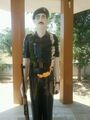
Sepoy Banwari Lal Bagaria was born on 15 July 1977 to Shri Bhanwar Lal Bagaria and Smt. Chawli Devi in Sigdola Chhota village of Sikar district, Rajasthan — a region well known for its strong tradition of military service and deep-rooted patriotism. He completed his school education in his native area, where he developed discipline, resilience, and a hardworking outlook from an early age. Growing up in an environment that respected the armed forces and honoured soldiers, he was inspired to dedicate his life to the service of the nation. Driven by a strong sense of duty and commitment, he chose to pursue a career in the Indian Army after completing his studies. He was recruited into the 4th Battalion of the Jat Regiment, one of the Indian Army’s most distinguished infantry regiments, renowned for its valour, professionalism, and an impressive record of battle honours earned over decades of operational service.
During his initial years in uniform, Sepoy Banwari Lal Bagaria underwent rigorous military training that prepared him physically and mentally for the demanding role of an infantry soldier. He adapted quickly to the challenges of military life and earned the trust and respect of his seniors and fellow soldiers through his sincerity, discipline, and unwavering dedication to duty. His early service years reflected his strong character and firm resolve to uphold the finest traditions of the regiment and the Indian Army. After serving for some time, he entered married life and was wedded to Ms Santosh Devi. Even while balancing his family responsibilities, he remained committed to his military duties, upholding the highest traditions of the regiment and the Army.
Kargil War (Op Vijay): May-June 1999
During 1999, Sepoy Banwari Lal Bagaria was serving with the 4th Battalion of the Jat Regiment, which was deployed in the Kargil sector of Jammu & Kashmir during the period that led to the Kargil War. The sector was marked by extremely rugged high-altitude terrain, sparse habitation, and heavy winter snow cover, making surveillance and domination of heights both difficult and operationally critical. In early May 1999, unusual movements were observed in the Batalik–Yaldor sector. These signs raised suspicion of possible infiltration across the Line of Control (LoC). In response, Indian Army units intensified surveillance and began aggressive patrolling throughout their Areas of Responsibility (AORs). The objective was to verify ground conditions after winter, detect any intrusion, and assess whether forward summer posts could be safely reoccupied as the snow started receding. During the first two weeks of May 1999, multiple patrols were launched in the Kaksar–Langpa area of Kargil district for reconnaissance and domination. These patrols were tasked with physically checking forward features, routes, and posts for signs of enemy presence. On 15 May 1999, a patrol was organised to move toward Bajrang Post in the Kaksar sector. The patrol was led by Capt Saurabh Kalia and included Sepoy Banwari Lal Bagaria along with four other soldiers — Sep Arjun Ram Baswana, Sep Naresh Singh, Sep Bhikha Ram, and Sep Mula Ram. The team moved into the high-altitude area as part of its assigned reconnaissance and verification task.
During the patrol, the team came under intense crossfire from Pakistani forces positioned across the LoC and from intruders occupying dominating heights. Despite resisting firmly and returning fire, the patrol party eventually ran low on ammunition. They communicated their situation to the base and requested reinforcements. However, before support troops could reach their location, they were surrounded by a larger group of Pakistani personnel and were captured alive after being overpowered. When the patrol did not return and communication ceased, the battalion dispatched another patrol to trace them. Follow-up operations in the area led to the shocking discovery that large numbers of well-armed infiltrators had already established fortified positions on multiple heights well inside the Indian side of the LoC, supported by organised supply arrangements from across the border. This discovery became one of the early confirmations of the scale and seriousness of the intrusion. Sepoy Banwari Lal Bagaria and his fellow soldiers, including Capt Saurabh Kalia, remained in captivity from 15 May to 7 June 1999 — about twenty-two days. Their mortal remains were handed over on 9 June 1999. Post-mortem examinations revealed extensive injuries and confirmed that severe torture had been inflicted before death, in violation of accepted international conventions governing the treatment of prisoners. Sepoy Banwari Lal Bagaria displayed steadfast courage and devotion to duty under the most adverse circumstances. He made the supreme sacrifice before he could turn 22 in the line of duty, upholding the highest traditions of the Indian Army.
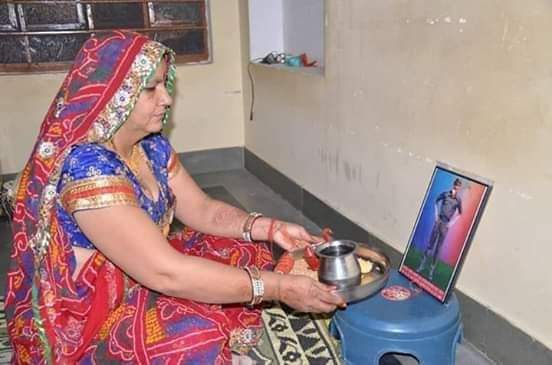
Sep Banwari Lal Bagaria is survived by his father, Shri Bhanwar Lal Bagaria, mother, Smt. Chawli Devi and wife Smt Santosh Devi.



No Comments