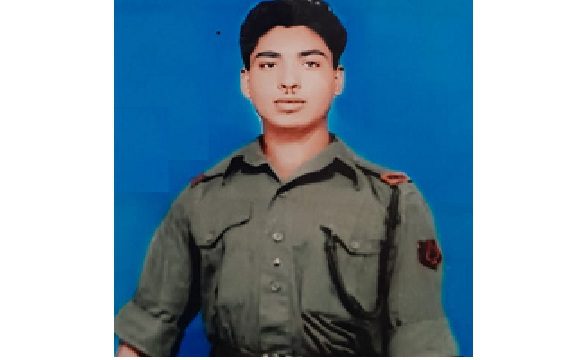

Service No : 2547455W
Date of Birth : July 1, 1936
Place of birth : Kolar Dist (Kar)
Service : Army
Last Rank : Sepoy
Unit : 18 Madras
Arm/Regt : The Madras Regiment
Operation : Indo-Pak War 1971
Martyrdom : December 16, 1971
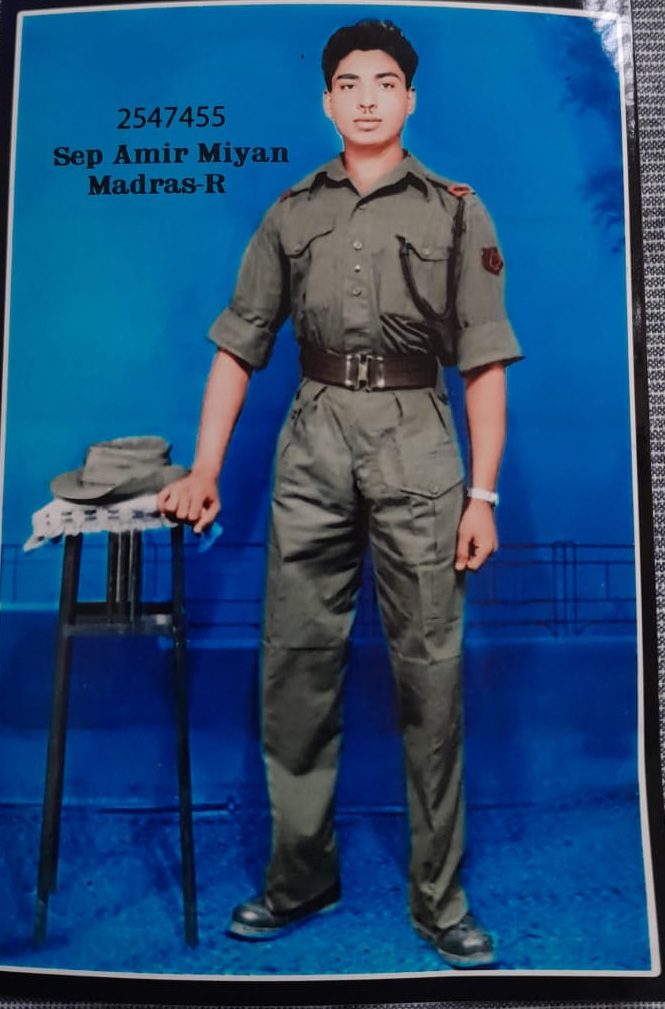
Sepoy Amir Miyan
Sepoy Amir Miyan was born on 01 July 1936 in Chintamani village, located in the present-day Kolar district of Karnataka. Growing up in a region known for its strong martial ethos, discipline, and patriotic fervour, he was deeply influenced by the values of courage, resilience, and service to the nation from an early age. These formative influences shaped his character and instilled in him a strong desire to serve the country in uniform. Answering his calling, he joined the Indian Army on 14 January 1958 at the age of 22 years. He was recruited into the 18 Madras Battalion of the Madras Regiment, one of the oldest and most decorated infantry regiments of the Indian Army. The Madras Regiment is renowned for its fearless soldiers, steadfast discipline, and a rich legacy of valour earned across multiple wars and operations. Becoming part of this illustrious regiment was both an honour and a responsibility, which Sepoy Amir Miyan embraced with pride and dedication. During the 1971 Indo-Pak War, 18 Madras was deployed in the Nayachor–Umarkot sector on the western front—an area of significant strategic importance where Pakistani forces sought to exert pressure through offensive actions. The terrain, climate, and persistent threat of enemy engagement made operations in this sector particularly demanding. In these challenging conditions, the battalion played a vital role in containing and blunting Pakistani attacks, effectively denying the enemy any meaningful breakthrough and contributing to the stabilisation of the sector.
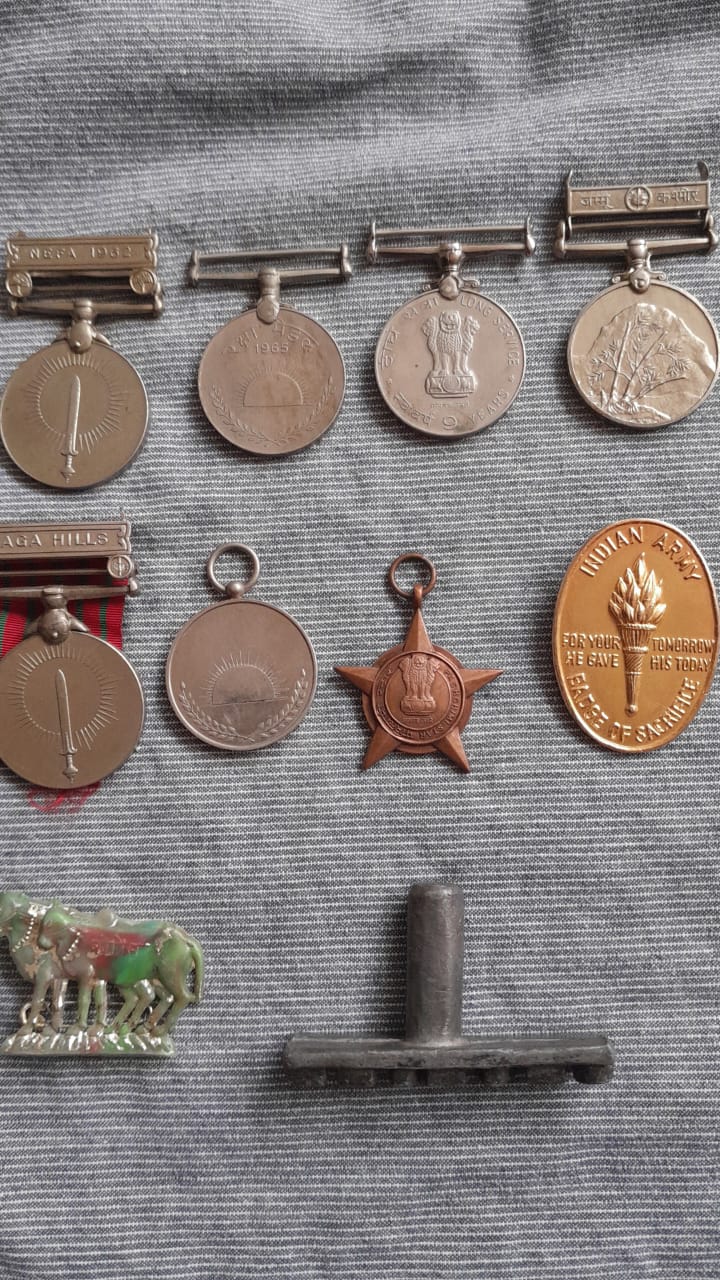
Operating under the constant threat of enemy fire, the soldiers of 18 Madras were required to demonstrate exceptional endurance, sharp tactical awareness, and unwavering courage. As a member of this hard-fighting battalion, Sepoy Amir Miyan gained invaluable combat experience and discharged his duties with dedication, professionalism, and quiet resolve. His steadfast service, alongside that of his comrades, contributed significantly to the successful accomplishment of assigned missions and upheld the finest traditions of the Madras Regiment. During his career, he served in several operational areas and participated in several important operations. In recognition of his service, he was awarded the General Service Medal 1947 with clasp “Naga Hills” and the Raksha Medal for the 1965 conflict.
Indo-Pak War: 16 Dec 1971
In 1971, Sepoy Amir Miyan’s unit, 18 Madras, was deployed in the southern Rajasthan sector during a period of grave national crisis. India was compelled to go to war with Pakistan following the brutal genocide perpetrated by the Pakistani Army in its eastern wing, which led to an unprecedented influx of millions of refugees into India. The sheer scale of this humanitarian catastrophe made armed conflict unavoidable. India was thus drawn into a two-front war—on the eastern front, which ultimately culminated in the liberation of Bangladesh, and simultaneously on the western and northern fronts to counter Pakistani military offensives. On the western front, the Rajasthan sector assumed critical strategic importance. Here, the Indian Army deployed the 11 Infantry Division and the 12 Infantry Division, while opposing Pakistani forces comprised their 18 Infantry Division, reinforced by an additional brigade and paramilitary elements. Indian operational planning envisaged a bold double thrust in this sector: the 12 Infantry Division advancing along the Longewala–Rahim Yar Khan axis, and the 11 Infantry Division advancing along the Barmer–Naya Chor axis. However, these plans were disrupted when Pakistan launched a major armoured assault on Longewala on the night of 3 December 1971. The attack was decisively blunted by resolute Indian ground defence, supported by devastating tactical air strikes from the Indian Air Force. The Pakistani forces suffered crippling losses—approximately 24 tanks and around 150 vehicles—effectively neutralising their offensive capability in the sector and decisively turning the tide of battle in India’s favour.
During the war, Sepoy Amir Miyan’s unit, 18 Madras Battalion, was functioning under the operational control of 11 Infantry Division. On 4 December 1971, the battalion launched aggressive offensive operations, swiftly overrunning Pakistani border posts. Maintaining relentless momentum, the unit advanced nearly 45 kilometres into Pakistani territory and established contact with the Naya Chor defences by 11 December. By 16 December 1971, after a gruelling advance of over 40 miles across harsh desert terrain under constant threat of enemy fire, 18 Madras reached positions at Hingora Tar, barely two kilometres short of Umarkot. At this decisive stage, Captain Shankar Shankhapan Walkar, serving as the battalion’s Mortar Officer, played a pivotal role in sustaining the unit’s combat effectiveness. Sepoy Amir Miyan was an integral part of this forward deployment. On 16 December 1971, as the battalion consolidated its positions at Hingora Tar, it came under intense and sustained enemy shelling. Amid this fierce exchange of fire, Sepoy Amir Miyan continued to perform his duties with exceptional alertness, courage, and dedication. During the heavy bombardment, he was struck by an enemy mortar round and sustained grievous injuries. Despite all efforts to save him, he later succumbed to his wounds and was martyred in the line of duty.
Sepoy Amir Miyan exemplified the finest traditions of the Indian Army—steadfast courage, discipline, and unwavering devotion to duty. At the young age of 35 years, he made the supreme sacrifice while defending the nation under hostile and extremely challenging conditions. During these operations, 18 Madras suffered heavy casualties. Along with Captain Walkar and Sepoy Amir Miyan, 21 other brave soldiers of the battalion laid down their lives, including: Sub AP Sreedhara Dass, Nb Sub N N Krishnan, Hav A P Ponnappan, L/Nk S A Narayan, L/Nk M Mani, L/Nk Panoly Govi, Sep M Muthaiah, Sep G V Pillai, Sep Rajan, Sep N C M Appachu, Sep Sampathu, Sep R G Krishna Kurup, Sep Gajendran, Sep Shaik Mahaboob, Sep M A Kasinathan, Sep Arasan Raju, Sep Basav Rajappa, Sep J Ganesan, Sep C Kandasamy, Sep Revan Siddappa, and Sep V Somasekharan.
Sep Amir Miyan is survived by his wife, Smt Jakirunnisa and daughter Smt Anissa.
No Comments