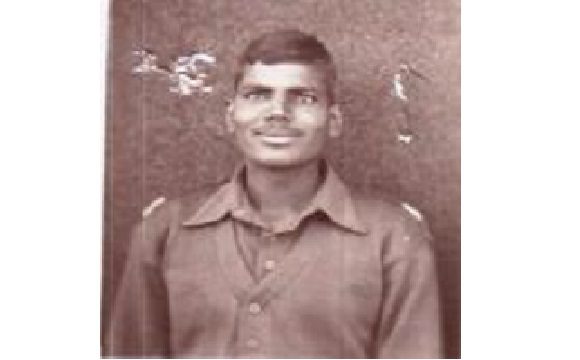
In June 1962, the 13 Kumaon Battalion, in which Sepoy Hari Ram was serving, was redeployed from Ambala to Baramulla in Jammu & Kashmir under the command of Lt Col H. S. Dhingra. As tensions along the northern borders intensified, the battalion was ordered in September to move to Leh at very short notice. Upon arrival, it came under the operational control of the 114 Infantry Brigade, commanded by Brigadier T. N. Raina—who would later serve as the Chief of Army Staff. The brigade was tasked with defending nearly 400 kilometres of the Indo–China border, including the strategically critical Chushul sector, and comprised experienced units such as 14 J&K Militia, 7 J&K Militia, 5 Jat, 1/8 Gorkha Rifles, along with 13 Kumaon. Sepoy Hari Ram served in ‘C’ Company of 13 Kumaon under Major Shaitan Singh. As per the brigade’s defensive plan, ‘C’ Company was deployed at Rezang La, a key position vital to the defence of Chushul. ‘A’ Company, commanded by Major G. N. Sinha, was held in reserve near the battalion headquarters, while ‘B’ and ‘D’ Companies, led by Captain R. V. Jatar, were positioned on Maggar Hill to strengthen the defensive layout.
By 26 October 1962, the troops at Rezang La had established well-prepared defensive positions in anticipation of an enemy offensive. ‘C’ Company was deployed across the forward slopes in a carefully structured formation. Platoon 7, under Jemadar Surja Ram, secured the northern approaches; Platoon 8, led by Jemadar Hari Ram, covered the approach to the pass; and Platoon 9, under Jemadar Ram Chander, defended the central sector alongside Company Headquarters. A mortar detachment under Naik Ram Kumar Yadav was positioned on the reverse slope to provide essential fire support. In the early hours of 18 November 1962, Chinese forces launched a coordinated offensive, coinciding with attacks at Sela in NEFA. The assault targeted both Gurung Hill and the positions at Rezang La, where ‘C’ Company formed a crucial defensive shield for the Chushul airfield. The initial attack at around 2:00 AM, directed towards Platoon 8, was detected in time and effectively repulsed. This was followed by successive waves at approximately 4:00 AM, 4:55 AM, 6:00 AM, and 6:30 AM, each met with determined and resolute resistance from the defenders.
Despite being heavily outnumbered and subjected to relentless enemy pressure, Sepoy Hari Ram and his comrades fought with exceptional courage and unwavering resolve. By the time the sixth assault was launched around 7:40 AM, the defenders had already sustained heavy casualties. At approximately 8:40 AM, the enemy deployed a 57 mm recoilless rifle, intensifying the attack and paving the way for the final assault at around 9:00 AM. Amid freezing temperatures, rugged terrain, and sustained enemy fire, Sepoy Hari Ram stood his ground with remarkable determination. He continued to fight valiantly until he was critically wounded and ultimately made the supreme sacrifice in the highest traditions of the Indian Army. The heroic stand of 13 Kumaon at Rezang La proved decisive in delaying the enemy advance and safeguarding the vital Chushul airfield. In the aftermath of the ceasefire, Rezang La remained silent under a blanket of snow. The mortal remains of Sepoy Hari Ram and his fallen comrades lay undisturbed for nearly three months before being discovered by a local shepherd—an enduring and poignant testament to their extraordinary bravery and supreme sacrifice.
Sepoy Hari Ram is survived by his wife, Smt. Murti Devi.

No Comments