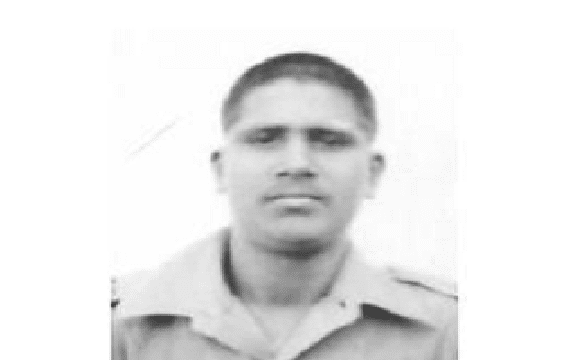

Service No : 4132273
Place of birth : Mahendragarh, (Har)
Service : Army
Last Rank : Sepoy
Unit : 13 Kumaon
Arm/Regt : The Kumaon Regiment
Operation : Indo-China War 1962
Martyrdom : November 21, 1962
Sepoy Kalu Ram
Sepoy Kalu Ram was a native of Paiga village in Mahendragarh district, Haryana—an area known for its proud military tradition and deep-rooted commitment to serving the nation. Driven by a profound sense of duty and patriotism, he enlisted in the 13 Kumaon Battalion of the Kumaon Regiment, one of the Indian Army’s oldest and most distinguished infantry units. With a legacy dating back to the 18th century, the Kumaon Regiment is celebrated for its valor, professionalism, and distinguished service in numerous military engagements.
Throughout his service, Sepoy Kalu Ram demonstrated exemplary discipline, unwavering dedication, and a strong sense of responsibility. He took immense pride in donning the Kumaoni uniform and remained steadfast in upholding the regiment’s cherished values and traditions. By 1962, his battalion had been stationed in Ambala and was later deployed to Jammu & Kashmir, underscoring the confidence placed in their combat readiness and operational capability.
Battle of Rezang La (Indo-China War): 18 Nov 1962
In June 1962, Sepoy Kalu Ram’s unit—the 13 Kumaon Battalion, under the command of Lt Col H.S. Dhingra—was redeployed from Ambala to Baramulla in Jammu & Kashmir. With escalating tensions along the Indo-China border, the battalion received urgent orders in September to move to Leh. Once in Leh, 13 Kumaon came under the operational command of the 114 Infantry Brigade, led by Brigadier T.N. Raina (who would later rise to become the Chief of Army Staff). The brigade was tasked with defending nearly 400 kilometers of the Indo-China frontier, including the strategically critical Chushul sector. The 114 Infantry Brigade comprised five battalions: 13 Kumaon, 14 J&K Militia, 7 J&K Militia, 5 Jat, and 1/8 Gorkha Rifles. Sepoy Kalu Ram was part of ‘C’ Company (Charlie Company) of 13 Kumaon, commanded by the indomitable Major Shaitan Singh. As per the brigade’s defensive plan, Charlie Company was assigned to Rezang La—a vital mountain pass guarding the approach to Chushul. Alpha Company, under Major G.N. Sinha, was held in reserve near the battalion headquarters, situated on high ground. Meanwhile, Bravo and Delta Companies, led by Captain R.V. Jatar, were positioned along Maggar Hill, between Spanggur Gap and Rezang La.
By 26 October 1962, Sepoy Kalu Ram and his comrades had fortified their positions at Rezang La in accordance with the terrain and expected threat directions. The forward deployment included three platoons: Platoon 7, commanded by Jemadar Surja Ram, covered the northern flank; Platoon 8, under Jemadar Hari Ram, held the pass itself; and Platoon 9, led by Jemadar Ram Chander, was stationed near Company Headquarters. The mortar section, under Naik Ram Kumar Yadav, was placed on the reverse slope to provide indirect fire support. On 18 November 1962, the Chinese launched a major two-pronged offensive—one attacking Gurung Hill and the other aimed at Rezang La. The assault coincided with their broader offensive on Sela in the Northeast Frontier Agency (now Arunachal Pradesh). Rezang La, approximately 11 km south of Spanggur Gap, held immense tactical importance, as it overlooked the only road connecting Leh via Dungti—the lifeline for Indian forces in Chushul.
The first enemy assault commenced around 2:00 AM, advancing from the direction of Platoon 8. A column of approximately 30 Chinese soldiers was detected by the platoon’s Listening Post (LP). Naik Hukam Chand of Section-1 immediately alerted Jemadar Hari Ram, who informed Major Shaitan Singh and ordered the LMG detachment forward. When the enemy closed in to within 50 yards, Naik Hukam Chand gave the command to open fire—effectively repelling the initial wave. At 4:00 AM, a second attack was launched on Platoon 7’s position. Jemadar Surja Ram rapidly repositioned Section-Three and launched a counteroffensive using rifles, LMGs, and grenades. This attack, too, was decisively beaten back through coordinated action and sheer bravery, particularly from Naik Sahi Ram’s section. Undeterred, the Chinese launched successive attacks—the third, fourth, and fifth waves—at 4:55 AM, 6:00 AM, and 6:30 AM respectively. Each was met with unyielding resistance by the defenders, who were now suffering heavy casualties and severe strain on their limited resources. By 7:40 AM, during the sixth wave of assault, Sepoy Kalu Ram and his fellow soldiers were locked in a desperate battle amidst dwindling ammunition and mounting losses. The Chinese then deployed a 57 mm recoilless rifle at 8:40 AM, placing it visibly on a ridge to inflict maximum damage. The seventh and final assault began at 9:00 AM.
Despite the punishing odds—bitter cold, relentless enemy fire, and superior weaponry—Sepoy Kalu Ram and the men of Charlie Company fought with unmatched resolve and valor. Though grievously wounded during the intense combat, Sepoy Kalu Ram continued to fight. He later succumbed to his injuries and was martyred on 21st November 1962. Their courageous stand ensured that the Chinese advance towards the strategically vital Chushul airfield was halted. After the ceasefire, Rezang La became part of a disputed no-man’s land. Nearly three months later, a local shepherd stumbled upon the frozen bodies of Sepoy Kalu Ram and his fallen comrades—still in their defensive positions, having fought to the last breath. Their sacrifice remains one of the most heroic chapters in Indian military history.
Sepoy Kalu Ram is survived by his wife Smt Kalawati Devim, daughter Santosh and son Om Prakash.
No Comments