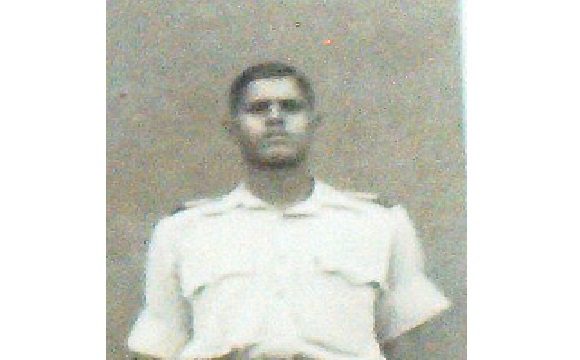

Service No : 4139579
Place of birth : Rewari Dist(Haryana)
Service : Army
Last Rank : Sepoy
Unit : 13 Kumaon
Arm/Regt : The Kumaon Regiment
Operation : Indo-China War 1962
Martyrdom : 18, 1962
Sepoy Lal Singh
Sepoy Lal Singh hailed from village Sadatnagar, district Rewari, Haryana—an area known for its proud martial tradition and steadfast devotion to the service of the nation. Inspired by a strong sense of patriotism, he enlisted in the 13 Kumaon Battalion of the Kumaon Regiment, one of the Indian Army’s oldest and most respected infantry formations. With roots reaching back to the eighteenth century, the Kumaon Regiment has built a distinguished legacy of courage, professionalism, and exemplary service across numerous military campaigns.
As a soldier, Sepoy Lal Singh embodied discipline, dedication, and an unwavering sense of duty. He wore the Kumaoni uniform with honour and faithfully upheld the customs and values of his battalion. By 1962, his unit was based in Ambala and was subsequently deployed to Jammu & Kashmir, a testament to the confidence placed in its readiness and operational capability.
Battle of Rezang La (Indo-China War): 18 November 1962
In June 1962, Sepoy Lal Singh’s battalion, the 13 Kumaon, commanded by Lt Col H.S. Dhingra, was redeployed from Ambala to Baramulla in Jammu & Kashmir. As tensions along the northern frontier intensified by September, the unit received urgent instructions to move to Leh. Upon reaching the area, 13 Kumaon came under the operational authority of the 114th Infantry Brigade, led by Brigadier T.N. Raina, who would later rise to become the Chief of Army Staff. The brigade was entrusted with the defence of nearly 400 kilometres of the Indo–China border, including the strategically crucial Chushul sector. The 114th Infantry Brigade consisted of five battalions: 13 Kumaon, 14 J&K Militia, 7 J&K Militia, 5 Jat, and 1/8 Gorkha Rifles. Sepoy Lal Singh served in ‘C’ (Charlie) Company of 13 Kumaon under Major Shaitan Singh. According to the brigade’s defensive scheme, Charlie Company was deployed at Rezang La, a vital mountain pass central to the protection of Chushul. Alpha Company, commanded by Major G.N. Sinha, was retained as the battalion reserve near headquarters on elevated ground overlooking Chushul, while Bravo and Delta Companies, led by Captain R.V. Jatar, took positions along Maggar Hill between Spanggur Gap and Rezang La.
By 26 October 1962, Sepoy Lal Singh and his comrades had completed the fortification of their positions at Rezang La, adapting their defences to the demanding terrain and tactical needs. Three platoons—7, 8, and 9—were placed on the forward slopes. Platoon 7, under Jemadar Surja Ram, guarded the northern flank; Platoon 8, led by Jemadar Hari Ram, covered the approach near the pass; and Platoon 9, commanded by Jemadar Ram Chander, held the central sector close to the Company Headquarters. A mortar detachment under Naik Ram Kumar Yadav was positioned on the reverse slope to provide supporting fire. In the pre-dawn hours of 18 November 1962, Chinese forces launched a coordinated, two-directional assault—one directed at Gurung Hill and the other at Rezang La. This offensive coincided with attacks at Sela in the Northeast Frontier Agency (now Arunachal Pradesh). Lying about 11 kilometres south of Spanggur Gap, Rezang La was of immense strategic importance, as it overlooked the only supply route linking Leh through Dungti, the lifeline of the Chushul garrison.
The first signs of enemy movement were detected around 2:00 AM by Platoon 8’s listening post, which reported approximately 30 advancing troops. Naik Hukam Chand, leading Section 1, immediately informed Jemadar Hari Ram, who alerted Major Shaitan Singh and ordered a Light Machine Gun (LMG) team into action. As the attackers closed to within 50 yards, Naik Hukam Chand gave the order to fire, forcing the enemy to fall back. At 4:00 AM, a second wave advanced from Platoon 7’s sector. Jemadar Surja Ram swiftly repositioned Section Three and engaged the attackers with coordinated rifle fire, LMG bursts, and grenades. Under the steadfast leadership of Jemadar Surja Ram and the bravery of Naik Sahi Ram’s men, this assault was also beaten back. Undeterred, the Chinese launched successive attacks at 4:55 AM, 6:00 AM, and 6:30 AM, each meeting fierce resistance from the entrenched defenders at Rezang La.
Despite rising casualties and dwindling ammunition, Sepoy Lal Singh and his fellow soldiers refused to give ground. By the sixth assault at 7:40 AM, the company had already suffered severe losses. At 8:40 AM, the enemy brought a 57 mm recoilless rifle into action, placing it on a nearby ridge to intensify the attack. The final, seventh wave struck at 9:00 AM. Amid freezing winds, relentless gunfire, and overwhelming odds, Sepoy Lal Singh and the men of Charlie Company displayed extraordinary courage and determination. Gravely wounded, Sepoy Lal Singh continued to fight until he made the supreme sacrifice in the service of the nation. The company held its position to the very end, preventing the enemy’s advance toward the strategically vital Chushul airfield.
Following the ceasefire, Rezang La became part of a contested no-man’s land. Nearly three months later, a local shepherd discovered the frozen bodies of Sepoy Lal Singh and his fallen comrades, still in their battle positions—an enduring and powerful symbol of their unmatched valour and selfless sacrifice.
Sepoy Lal Singh is survived by his wife, Smt. Sheu Bai.
No Comments