Sep Nain Singh is survived by his wife, Smt Janaki Devi.
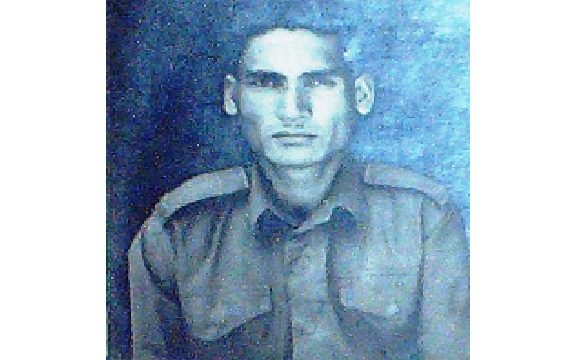

Service No : 4139507
Place of birth : Almora Dist (U'khand)
Service : Army
Last Rank : Sepoy
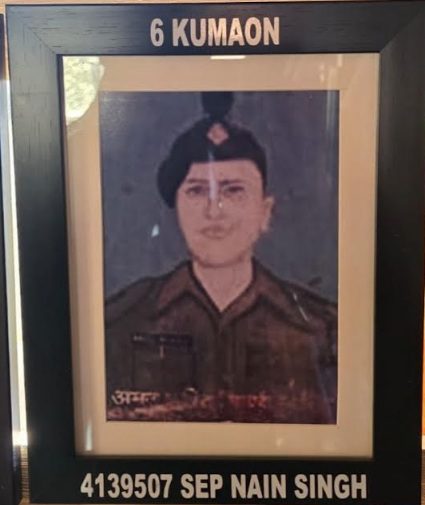
Unit : 6 Kumaon
Arm/Regt : The Kumaon Regiment
Operation : Indo-China War 1962
Martyrdom : November 16, 1962
Sepoy Nain Singh hailed from the serene Galey village in Almora district of Uttarakhand, a region renowned for its deep-rooted martial traditions and a long history of service to the nation. Growing up in this environment, he imbibed values of discipline, resilience, and patriotism from an early age. After completing his education, Sepoy Nain Singh made a conscious and courageous choice to don the olive green uniform of the Indian Army. He was recruited into the 6 Kumaon Battalion of the Kumaon Regiment, one of the most distinguished and battle-hardened infantry regiments of the Indian Army.
The regiment is celebrated for its fearless soldiers, exemplary discipline, and a glorious legacy of gallantry earned across numerous campaigns and conflicts. Serving in such an illustrious unit further strengthened his commitment to uphold its proud traditions through steadfast service and professional excellence. During his years in uniform, Sepoy Nain Singh proved himself to be a devoted and dependable soldier, respected by his comrades for his sense of responsibility and quiet determination. Amidst his military service, he also embraced family life and was married to Ms Janaki Devi, balancing his personal responsibilities with the demanding duties of a soldier.
During the 1962 Indo–China War, Sepoy Nain Singh was serving with the 6 Kumaon Battalion, which was deployed under the command of Lt Col CN Madiah, in the Siang Frontier Division, south of the McMahon Line. The Battle of Walong, fought during October–November 1962 in the remote eastern extremity of the then North-East Frontier Agency (NEFA), now Arunachal Pradesh, stands out as one of the fiercest and most resolute defensive engagements of the Indo–China War. Far removed from the main axes of Chinese advance, the Walong–Kibithu sector nevertheless witnessed some of the bloodiest fighting of the conflict, where Indian troops resisted overwhelming odds with extraordinary courage and determination. In the aftermath of early reverses suffered by Indian forces in October 1962, urgent organisational measures were undertaken to stabilise the situation in NEFA. A new formation, 2 Infantry Division, was raised under Major General MS Pathania and entrusted with the defence of most of the region. In the Walong sector, 11 Infantry Brigade, commanded by Brigadier NC Rawlley, assumed responsibility for holding the approaches along the Lohit River valley. Among the units tasked with this critical defence was the 6 Kumaon Regiment, which soon earned a reputation for steadfast resistance under extreme conditions.
Earlier in the campaign, elements of 6 Kumaon, led by Lieutenant Bikram Singh Rathore, had inflicted a sharp setback on Chinese forces at Namti Nallah through a well-conceived ambush. This success, however, was followed by a far more severe test. Recognising the tactical importance of dominating ground, Delta Company of 6 Kumaon was ordered to occupy and hold West Ridge, a key feature overlooking Walong. The orders were unambiguous: the ridge was to be held at all costs, as its loss would open the way for a deeper Chinese penetration into the sector. On the morning of 16 November 1962, at approximately 0830 hours, Chinese forces launched a massive frontal assault on West Ridge. Nearly 300 enemy troops, supported by heavy machine-gun and mortar fire, advanced against barely 120 soldiers of Delta Company. Platoons under Lieutenant Bikram Singh manned their bunkers with grim resolve as repeated waves of enemy infantry surged forward under intense fire.
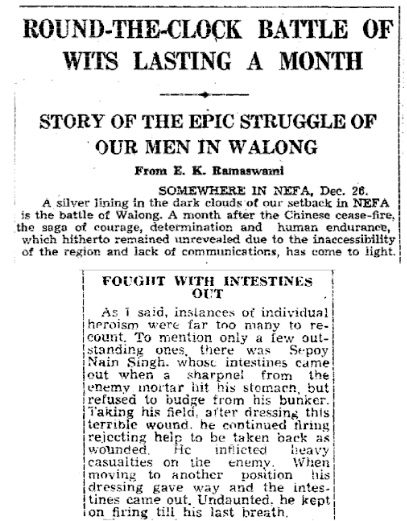
It was during this savage and unequal engagement that Sepoy Nain Singh emerged as a symbol of indomitable courage. Positioned in his bunker, he was caught in a heavy mortar bombardment when a shell exploded nearby. Shrapnel ripped into his abdomen, causing catastrophic injuries and leaving his intestines exposed. Despite the severity of his wounds, Sepoy Nain Singh refused to abandon his post. With remarkable presence of mind, he hastily dressed the wound himself, rejected all attempts to evacuate him, and continued firing at the advancing enemy. Even in this grievously wounded state, he maintained accurate and effective fire, inflicting significant casualties and contributing materially to the blunting of the Chinese assault. When ordered to shift to another position, the makeshift dressing came loose, and his intestines spilt out once again. Fully conscious of his condition and fate, Sepoy Nain Singh nonetheless continued to engage the enemy, holding them at bay until he collapsed at his post. He laid down his life fighting, exactly where he stood, refusing to yield even in the face of certain death. Sepoy Nain Singh was a brave and committed soldier who laid down his life in the line of his duty. Along with him, 117 other brave soldiers laid down their lives during these operations. Among them were two officers, Lieutenant Bikram Singh, Second Lieutenant PK Jindal, and six Junior Commissioned Officers: Subedar Govind Singh, Subedar Deb Singh, Naib Subedar Trilok Singh, Naib Subedar Mohan Chandra, Naib Subedar Joga Singh, Naib Subedar Man Singh and 109 ORs(Other Ranks). Their supreme sacrifice stands as an enduring testament to courage, honour, and devotion to duty.
No Comments