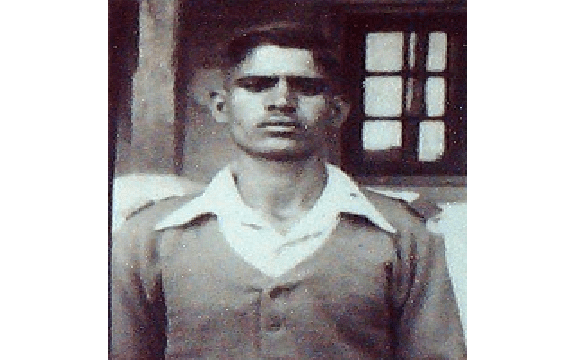

Service No : 4143147
Place of birth : Gurgaon, (Har)
Service : Army
Last Rank : Sepoy
Unit : 13 Kumaon
Arm/Regt : The Kumaon Regiment
Operation : Indo-China War 1962
Martyrdom : November 18, 1962
Sepoy Ranjit Singh
Sepoy Ranjit Singh hailed from Nawda village in Haryana’s Gurgaon district, a region known for its rich martial heritage and deep-rooted tradition of patriotism and national service. Inspired by a strong sense of duty from a young age, he joined the Indian Army and was inducted into the 13 Kumaon Battalion of the illustrious Kumaon Regiment. Among the oldest and most decorated infantry regiments of the Indian Army, the Kumaon Regiment traces its origins back to the eighteenth century and has earned a distinguished reputation for its valour, professionalism, and exemplary service in numerous military campaigns.
During his service, Sepoy Ranjit Singh embodied the finest qualities of a soldier—discipline, courage, and unwavering dedication to duty. He carried out his responsibilities with sincerity and commitment, contributing to the honour and proud legacy of his battalion and regiment. Known for his steadfast nature and strong sense of responsibility, he earned the respect of both his peers and superiors. Beyond his life in uniform, Sepoy Ranjit Singh was a devoted family man. He was married to Smt. Phoolvati Devi, who stood as a constant source of strength and support throughout his journey in the Army, sharing in both the challenges and pride of his service to the nation.
Battle of Rezang La (Indo-China War): 18 Nov 1962
In June 1962, the 13 Kumaon Battalion, in which Sepoy Ranjit Singh served, moved from Ambala to Baramulla in Jammu & Kashmir under the command of Lt Col H. S. Dhingra. As tensions between India and China intensified later that year, the battalion received urgent orders in September to move to Leh. Upon reaching the region, it came under the operational control of the 114th Infantry Brigade commanded by T. N. Raina, who would later rise to become the Chief of Army Staff. The brigade was entrusted with the formidable task of defending nearly 400 kilometres of the Indo–China border, including the strategically important Chushul sector. Its formation included several distinguished units such as 14 and 7 J&K Militia, 5 Jat, 1/8 Gorkha Rifles, and 13 Kumaon. Sepoy Ranjit Singh served in ‘C’ Company of 13 Kumaon, commanded by the legendary Major Shaitan Singh. As part of the defensive deployment, ‘C’ Company was positioned at Rezang La, while ‘A’ Company was placed near the battalion headquarters at Chushul and ‘B’ and ‘D’ Companies occupied defensive positions at Maggar Hill.
By 26 October 1962, Sepoy Ranjit Singh and his comrades had strengthened their defensive positions at Rezang La in preparation for an impending Chinese attack during the Sino-Indian War. ‘C’ Company’s platoons were carefully deployed along the forward slopes to cover key approaches to the pass. Platoon 7, under Jemadar Surja Ram, guarded the northern flank; Platoon 8, commanded by Jemadar Hari Ram, defended the pass itself; and Platoon 9, along with the Company Headquarters, was led by Jemadar Ram Chander. A mortar detachment under Naik Ram Kumar Yadav was positioned on the reverse slope to provide fire support. On 18 November 1962, the Chinese launched a major offensive that coincided with their broader attacks in the NEFA region. Rezang La, which guarded the vital approach to the Chushul airfield, soon became the focus of a fierce two-pronged assault—one thrust directed towards Gurung Hill and the other aimed directly at the positions of ‘C’ Company.
The first wave of the Chinese attack began at about 2:00 AM, advancing towards Platoon 8. Their movement was detected by a Listening Post, and Naik Hukam Chand quickly alerted Jemadar Hari Ram, who ordered his men to prepare for immediate engagement. As the enemy drew closer, Indian troops opened intense fire, successfully repelling the initial assault. Around 4:00 AM, a second wave approached from the northern side. Jemadar Surja Ram and Naik Sahi Ram led a determined defence using rifles, grenades, and light machine guns. Though vastly outnumbered, the defenders fought with exceptional courage and refused to yield their positions. The enemy launched further attacks at 4:55 AM, 6:00 AM, and again at 6:30 AM, yet Sepoy Ranjit Singh and his fellow soldiers continued to resist with extraordinary determination.
By the time the sixth wave of attack began at about 7:40 AM, the defenders were severely depleted and exhausted after hours of relentless fighting. At 8:40 AM, the Chinese brought forward a 57-mm recoilless rifle, signalling preparations for a final assault that commenced at around 9:00 AM. Amid freezing temperatures, rugged terrain, and overwhelming enemy numbers, Sepoy Ranjit Singh displayed remarkable courage and steadfast devotion to duty. During this fierce battle, he was grievously wounded and ultimately laid down his life in the service of the nation. The heroic stand of ‘C’ Company at Rezang La proved decisive. Their fierce resistance not only delayed the Chinese advance but also helped safeguard the strategically vital Chushul airfield. After the ceasefire, the battlefield remained a disputed no-man’s land, and the bodies of Sepoy Ranjit Singh and his fallen comrades lay buried under snow for nearly three months until they were discovered by a local shepherd—an enduring and poignant reminder of their extraordinary bravery and sacrifice.
Sepoy Ranjit Singh is survived by his wife, Smt. Phoolvati Devi.
No Comments