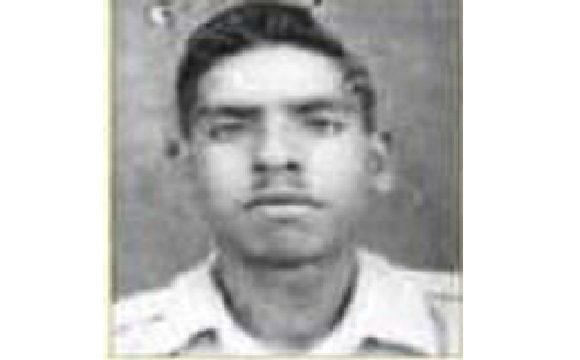

Service No : 4147173
Place of birth : Meerut (UP)
Service : Army
Last Rank : Sepoy
Unit : 13 Kumaon
Arm/Regt : The Kumaon Regiment
Operation : Indo-China War 1962
Martyrdom : November 18, 1962
Sepoy Shri Kishan
Sepoy Shri Kishan hailed from Kotla village in Meerut district of Uttar Pradesh, a region known for its proud tradition of sending courageous sons to serve the nation. Driven by a deep love for his country and a strong sense of duty, he enlisted in the 13 Kumaon Battalion of the Kumaon Regiment—one of the most historic and highly decorated infantry regiments of the Indian Army. Established in the 18th century, the regiment has earned lasting distinction for its gallantry, discipline, and outstanding service in numerous operations and difficult battle conditions.
As a soldier, Sepoy Shri Kishan was admired for his sincerity, discipline, and unwavering devotion to duty. He wore the insignia of the Kumaon Regiment with great honour and faithfully upheld the proud customs and ethos of his battalion. In 1962, after being stationed in Ambala, his unit was deployed to Jammu & Kashmir—an assignment that reflected the Army’s strong faith in their operational readiness, reliability, and fighting spirit.
Battle of Rezang La (Indo-China War): 18 November 1962
In June 1962, the 13 Kumaon Battalion, led by Lt Col H.S. Dhingra, was relocated from Ambala to Baramulla in Jammu & Kashmir. By September, as the situation with China rapidly worsened, the unit was ordered to move to Leh at very short notice. Once in Ladakh, 13 Kumaon came under the operational control of the 114 Infantry Brigade commanded by Brigadier T.N. Raina, who would later rise to become the Chief of the Army Staff. The brigade was responsible for defending nearly 400 km of the Indo-China frontier, including the strategically vital Chushul sector. Along with 13 Kumaon, the brigade also included 14 J&K Militia, 7 J&K Militia, 5 Jat, and 1/8 Gorkha Rifles. Sepoy Shri Kishan served in Charlie Company under the leadership of Major Shaitan Singh. According to the brigade’s defensive plan, Charlie Company was assigned the critical task of holding Rezang La. Alpha Company under Maj G.N. Sinha remained as battalion reserve at the headquarters near Chushul, while Bravo and Delta companies, commanded by Capt R.V. Jatar, were positioned on Maggar Hill between the Spanggur Gap and Rezang La. By 26 October 1962, Sepoy Shri Kishan and his fellow soldiers of ‘C’ Company had fully prepared and strengthened their defensive positions.
The deployment of troops at Rezang La was carefully planned to exploit the terrain while countering potential threats. Platoons 7, 8, and 9 occupied the forward slopes: the 7th Platoon, led by Jemadar Surja Ram, was placed on the northern flank; the 8th Platoon under Jemadar Hari Ram held the pass itself; and the 9th Platoon under Jemadar Ram Chander manned the central position, with the company headquarters close by. The mortar section, commanded by Naik Ram Kumar Yadav, was stationed on the reverse slope for fire support. The Chinese assault in this sector began on 18 November 1962, coinciding with their offensive at Sela in NEFA. A two-directional attack was launched on the Chushul defences—one prong targeting Gurung Hill and the other directed straight at Charlie Company at Rezang La. Located about 11 km south of Spanggur Gap, Rezang La dominated the supply route from Leh via Dungti, making it vital for the survival of the Chushul garrison. The first enemy wave advanced around 2:00 AM, approaching from the direction of Platoon 8. Their movement was detected by the Listening Post, and Section Commander Naik Hukam Chand immediately alerted Jemadar Hari Ram, who in turn informed Maj Shaitan Singh. Acting swiftly, Jemadar Hari Ram ordered an LMG detachment forward. When the enemy closed in to about 50 yards, Naik Hukam Chand gave the command to open fire, catching the attackers completely off guard and forcing them to retreat.
The second attack followed at around 4:00 AM from the 7th Platoon’s side. Responding quickly, Jemadar Surja Ram repositioned his third section to an alternate firing spot and unleashed a fierce counterattack with rifles, LMGs, and grenades. The second wave too was beaten back due to the determined stand of his section, reinforced by the efforts of Naik Sahi Ram. However, the intensity only grew. The enemy launched successive attacks at 4:55 AM, 6:00 AM, and 6:30 AM. Sepoy Shri Kishan and the men of Charlie Company held firm despite mounting casualties and damaged equipment. By the sixth wave at 7:40 AM, their strength had significantly dwindled. For the first time, the Chinese deployed a 57 mm recoilless gun, positioning it openly on a ridge by 8:40 AM. The seventh wave followed at 9:00 AM. Despite the brutal cold, harsh terrain, and overwhelming enemy firepower, Sepoy Shri Kishan and his comrades of Charlie Company fought with extraordinary bravery, determined to exact a heavy toll for every inch of Rezang La. During the fierce exchange of fire, Sepoy Shri Kishan sustained grievous injuries and made the supreme sacrifice. The men of 13 Kumaon continued fighting until the very last man and the very last bullet, preventing the Chinese from advancing toward the Chushul airfield.
Following the ceasefire, Rezang La remained in a desolate no-man’s land, contested by both sides. For nearly three months, the bodies of the brave soldiers—including Sepoy Shri Kishan—lay frozen where they had fallen until a shepherd discovered them. Their heroic last stand remains one of the most remarkable episodes of courage in the history of the Indian Army.
Sepoy Shri Kishan is survived by his mother, Smt. Bhagwati Devi.
No Comments