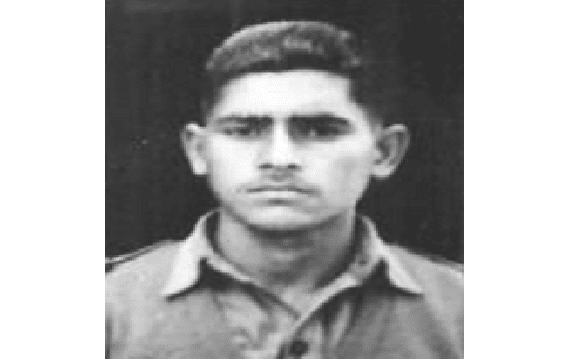

Service No : 4145587
Place of birth : Etawah, (UP)
Service : Army
Last Rank : Sepoy
Unit : 13 Kumaon
Arm/Regt : The Kumaon Regiment
Operation : Indo-China War 1962
Martyrdom : November 18, 1962
Sepoy Sultan Singh
Sepoy Sultan Singh hailed from Nagla Dariya village in the Etawah district of Uttar Pradesh—a region known for its enduring spirit of patriotism and strong martial traditions. He was the son of Shri Bhagwan Din and, from a young age, was guided by a deep sense of duty and devotion to the nation. Inspired by these values, he chose a life of service and joined the Indian Army. He was inducted into the 13th Battalion of the Kumaon Regiment—one of the Army’s oldest and most distinguished infantry regiments, renowned for its rich legacy of valour, discipline, and exemplary service. He was married to Mrs. Ganga Devi. During his service, Sepoy Sultan Singh exemplified the finest qualities of a soldier—discipline, dedication, and unwavering commitment to duty. He wore the uniform of the Kumaon Regiment with pride and consistently upheld its highest traditions with honour and integrity. By 1962, his battalion was stationed at Ambala and was subsequently deployed to Jammu & Kashmir amid rising tensions along the northern frontiers. This deployment reflected the immense trust placed in the battalion’s operational readiness and fighting spirit, as it was entrusted with the defence of strategically vital and challenging regions of the country.
Battle of Rezang La (Indo-China War): 18 November 1962
In June 1962, the 13 Kumaon Battalion, with Sepoy Sultan Singh in its ranks, was redeployed from Ambala to Baramulla in Jammu & Kashmir under the command of Lieutenant Colonel H. S. Dhingra. As the situation along the northern borders grew increasingly tense, the battalion received orders in September to move to Leh at very short notice. Upon its arrival, the unit came under the operational control of the 114 Infantry Brigade, commanded by Brigadier T. N. Raina. The brigade was entrusted with the daunting responsibility of defending nearly 400 kilometres of the Indo–China border, including the strategically critical Chushul sector. It comprised experienced and battle-hardened units such as 13 Kumaon, 14 J&K Militia, 7 J&K Militia, 5 Jat, and 1/8 Gorkha Rifles. Sepoy Sultan Singh served in ‘C’ (Charlie) Company of 13 Kumaon, led by the courageous and resolute Major Shaitan Singh. As part of the brigade’s defensive strategy, Charlie Company was assigned the vital position at Rezang La—a high-altitude mountain pass that formed a crucial line of defence for the Chushul sector. ‘A’ Company, under Major G. N. Sinha, was positioned in reserve near the battalion headquarters at Chushul, while ‘B’ and ‘D’ Companies, commanded by Captain R. V. Jatar, were deployed along Maggar Hill to provide depth and reinforcement to the defensive positions.
By 26 October 1962, Sepoy Sultan Singh and his fellow soldiers had meticulously prepared and fortified their defences at Rezang La, anticipating an imminent enemy offensive. The deployment of ‘C’ Company was tactically organised across the rugged forward slopes. Platoon 7, under Jemadar Surja Ram, secured the northern approaches; Platoon 8, led by Jemadar Hari Ram, guarded the pass; and Platoon 9, under Jemadar Ram Chander, held the central sector along with the Company Headquarters. A mortar detachment under Naik Ram Kumar Yadav was strategically placed on the reverse slope to provide essential fire support during battle. In the early hours of 18 November 1962, Chinese forces launched a coordinated and determined assault on both Gurung Hill and the Rezang La positions, coinciding with major attacks at Sela in NEFA. Rezang La held immense strategic importance, as it overlooked the key approach to the Chushul airfield via the Dungti axis. The initial attack began around 2:00 AM, targeting the position held by Platoon 8. A Chinese patrol was detected in time, and swift action by the defenders enabled them to open accurate fire, forcing the enemy to withdraw.
However, the enemy quickly regrouped and launched successive waves of attacks at approximately 4:00 AM, 4:55 AM, 6:00 AM, and 6:30 AM. Each assault was met with fierce resistance from the determined defenders. Despite being heavily outnumbered and facing relentless enemy pressure, Sepoy Sultan Singh and his comrades held their ground with remarkable courage and tenacity. Even as casualties mounted and ammunition began to dwindle, their resolve remained unshaken. By the time the sixth assault was launched around 7:40 AM, the intensity of the battle had reached its peak. At approximately 8:40 AM, the enemy brought a 57 mm recoilless rifle into action, significantly intensifying the attack. The final and most ferocious assault commenced around 9:00 AM, with the defenders facing overwhelming odds in extremely harsh conditions.
Amid freezing temperatures, rugged terrain, and continuous enemy fire, Sepoy Sultan Singh fought with extraordinary bravery and determination. Even after being grievously wounded, he refused to abandon his position and continued to engage the enemy until he made the supreme sacrifice in the line of duty. His courage and devotion epitomised the highest traditions of the Indian Army. The heroic stand of ‘C’ Company, 13 Kumaon, at Rezang La proved decisive in halting the enemy’s advance and safeguarding the strategically vital Chushul airfield. In the aftermath of the ceasefire, Rezang La lay silent beneath a blanket of snow—a desolate battlefield that bore witness to unmatched valour. Nearly three months later, the mortal remains of Sepoy Sultan Singh and his fellow soldiers were discovered by a local shepherd, still in their battle positions—an enduring and poignant testament to their extraordinary courage, sacrifice, and unwavering devotion to the nation.
Sepoy Sultan Singh is survived by Smt Ganga Devi.
No Comments