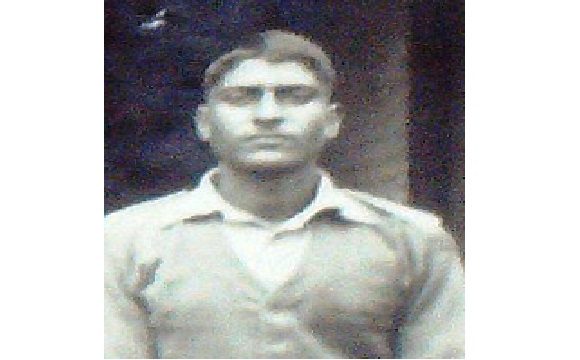

Service No : 4143499
Place of birth : Varanasi Dist(UP)
Service : Army
Last Rank : Sepoy
Unit : 13 Kumaon
Arm/Regt : The Kumaon Regiment
Operation : Indo-China War 1962
Martyrdom : November 18, 1962
Sepoy Suraj Nath Singh
Sepoy Suraj Nath Singh hailed from Parasrampur village in Varanasi district of Uttar Pradesh, a region known for its proud martial heritage and long tradition of producing brave soldiers for the nation. Motivated by this spirit of service, he joined the 13 Kumaon Battalion of the Kumaon Regiment, a battle-hardened infantry unit renowned for its exceptional bravery and distinguished record in numerous military operations.
As a dedicated and disciplined soldier, Sepoy Suraj Nath Singh upheld the proud traditions and legacy of his regiment, earning the admiration and respect of his comrades and superiors through his unwavering commitment to duty. Beyond his military life, he drew great strength and encouragement from his family, especially his wife, Smt Bachni Devi, who stood firmly by his side and supported him throughout the challenges of military service.
Battle of Rezang La (Indo-China War): 18 Nov 1962
In June 1962, the 13 Kumaon Battalion, in which Sepoy Suraj Nath Singh served, was moved from Ambala to Baramulla in Jammu and Kashmir under the command of Lt Col H. S. Dhingra. A few months later, in September 1962, as tensions between India and China rapidly escalated, the battalion received orders to move to Leh at short notice. The battalion was placed under the operational control of the 114 Infantry Brigade commanded by Brigadier T. N. Raina, who later went on to become the Chief of the Army Staff. The brigade was responsible for defending nearly 400 kilometres of the Indo-China border, including the strategically important Chushul sector. Along with 13 Kumaon, the brigade also had four other battalions under its command: 14 J&K Militia, 7 J&K Militia, 5 Jat, and 1/8 Gorkha Rifles. Sepoy Suraj Nath Singh served in the 3-inch mortar section of the 9th Platoon of Charlie Company, which was commanded by Major Shaitan Singh. As per the defensive plan of the 114 Infantry Brigade, Charlie Company of 13 Kumaon was deployed at Rezang La, a critical high-altitude pass guarding the approaches to Chushul. Alpha Company, led by Major G. N. Sinha, was kept in reserve at the battalion headquarters situated on high ground near Chushul. Meanwhile, Bravo and Delta Companies, under Captain R. V. Jatar, were deployed on Maggar Hill between Spanggur Gap and Rezang La Pass. By 26 October 1962, Sepoy Suraj Nath Singh and his comrades of Charlie Company had firmly established and fortified their defensive positions.
The platoons were deployed after careful consideration of terrain and potential enemy approaches to maximise tactical advantage. Platoons 7, 8, and 9 occupied the forward slopes of the hill. The 7th Platoon, commanded by Jemadar Surja Ram, guarded the northern flank, while the 8th Platoon, under Jemadar Hari Ram, held the pass area. The central position was defended by the 9th Platoon, commanded by Jemadar Ram Chander, with the company headquarters located nearby. The mortar section, led by Naik Ram Kumar Yadav, was positioned on the reverse slope to provide vital fire support. The Chinese offensive in this sector commenced on 18 November 1962, coinciding with a major attack on Sela in the North-East Frontier Agency (NEFA). The assault on the Chushul sector was launched in two directions. One thrust targeted Gurung Hill, while the other focused on Charlie Company’s positions at Rezang La. Located about 11 kilometres south of Spanggur Gap, Rezang La was of immense strategic importance as it overlooked the road linking Leh via Dungti — the crucial supply route for the Chushul garrison.
The first wave of the enemy attack began around 2:00 AM from the direction of Platoon 8, when a column of nearly 30 Chinese soldiers attempted to approach the position. Their movement was detected by the Listening Post (LP) of Platoon 8, and Jemadar Hari Ram was immediately informed by Section-1 commander Naik Hukam Chand. Acting quickly, Jemadar Hari Ram alerted Major Shaitan Singh and instructed Naik Hukam Chand to move forward with an LMG detachment to halt the advancing enemy. When the Chinese troops closed to within about 50 yards, Naik Hukam Chand ordered his men to open fire. The sudden and accurate fire caught the enemy by surprise and successfully repelled the first assault. The defenders, including the section posts and mortar teams, remained alert and prepared for further attacks. A second assault followed around 4:00 AM, this time from the direction of Platoon 7. Jemadar Surja Ram promptly repositioned Section Three to an alternate location and launched a fierce counterattack using light machine guns, rifles, and grenades. The determined resistance by Jemadar Surja Ram and the section led by Naik Sahi Ram forced the enemy to retreat once again. However, the Chinese continued to launch repeated attacks at regular intervals, each increasing in intensity. Despite mounting casualties and damage to their defences, Sepoy Suraj Nath Singh and his fellow soldiers, under the leadership of Jemadar Ram Chander, continued to hold their ground with exceptional courage until the sixth wave of attack at about 7:40 AM.
This final assault was supported by heavy mortar shelling and sustained fire from two medium machine guns positioned on different fronts. After devastating Section Three of Platoon 9, Chinese troops began advancing toward the company headquarters and the 3-inch mortar section manned by Sepoy Suraj Nath Singh, Lance Naik Sri Ram, Lance Naik Roshan Singh, and several other soldiers. As the enemy closed to within about 150 yards, the mortar section was compelled to fire at a steep angle of nearly 80 degrees to engage them at close range. While continuing to operate the mortar and provide crucial fire support to his comrades, Sepoy Suraj Nath Singh was struck by a splinter from enemy fire and was martyred in the line of duty.
Following the ceasefire, the Rezang La battlefield became a disputed no-man’s land between the two sides. The bodies of Sepoy Suraj Nath Singh and many other brave soldiers of 13 Kumaon remained frozen on the battlefield in the harsh Himalayan conditions. Nearly three months later, they were finally discovered by a local shepherd, bearing silent testimony to the extraordinary courage and sacrifice displayed during the historic Battle of Rezang La.
Sepoy Suraj Nath Singh is survived by his wife, Smt Bachni Devi.
No Comments