
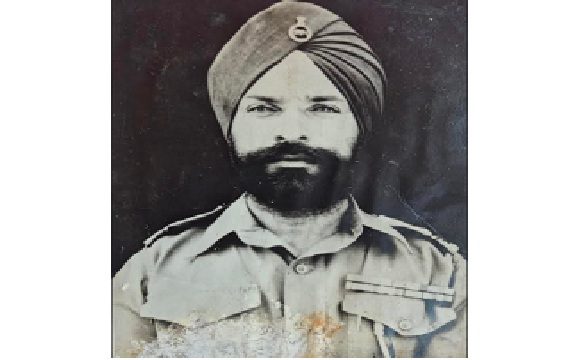
Subedar Kartar Singh hailed from Pangali village in Bhimber tehsil of Sialkot district (now in Pakistan). He was born on 19 May 1924 to Shri S. Karam Singh and Smt. Gur Kour. He grew up in a disciplined and hardworking family environment where values such as integrity, perseverance, and service were deeply ingrained from an early age. These formative influences played an important role in shaping his character and sense of responsibility. Motivated by patriotism and the aspiration to lead a purposeful life, he resolved to join the Army at a young age. Pursuing this goal with determination, he succeeded in realizing his dream of wearing the uniform when he was enrolled in the Indian Army on 24 November 1941 at just 17 years of age. Upon recruitment, he was inducted into the prestigious 4 Sikh Battalion of the Sikh Regiment— one of the oldest and most highly decorated infantry regiments of the Indian Army — widely known for its tradition of courage, battlefield excellence, and distinguished service record. Joining such a renowned regiment laid a strong professional foundation for his future military career and reflected his early commitment to a life of service and sacrifice.
From the very beginning of his military service, Subedar Kartar Singh displayed exceptional dedication, physical stamina, and strong leadership qualities, earning the confidence and respect of both his superiors and fellow soldiers. Over the years, he served in several operational and field areas, where he gained extensive combat and field experience while operating under demanding and often hazardous conditions. During his early years in uniform, he took part in operations connected with the Second World War and was awarded the 1939–45 Star for his service. His overseas operational contributions were further recognised with the Africa Star and the Italy Star. In addition, he was awarded the Defence Medal in acknowledgment of his wartime service and contributions. After serving for a few years, he married Ms. Karam Kour. The couple was later blessed with two sons, Gurnam Singh and Bharpur Singh.
Following Independence, he continued to serve in sensitive operational sectors. His recorded operational tenures included Jammu & Kashmir from November 1948 to April 1952 and again from October 1956 to June 1958, where the security environment required sustained vigilance and counter-infiltration duties. He later served in the Naga Hills from April 1962 to May 1964 during a period of intense counter-insurgency operations. He was again deployed in Jammu & Kashmir in August 1965 during heightened military activity preceding the 1965 conflict. In recognition of his post-Independence operational service, he was awarded the Jammu & Kashmir 1947–48 Medal (Ground Service) and the Sainya Seva Medal with clasp for Jammu & Kashmir. Through consistent performance, leadership in the field, and long years of meritorious service, he rose through the ranks to become a Subedar by 1965, serving as a dependable and experienced Junior Commissioned Officer. His long and varied operational career shaped him into a battle-hardened and resilient soldier, respected within his unit for professionalism and steadfast commitment to duty.
Battle of Barki (Indo-Pak War)- 06-10 Sep 1965
Subedar Kartar Singh was serving with the 4th Battalion of the Sikh Regiment (4 Sikh) during the Indo–Pak War of 1965. At the time of the Lahore-front offensive, 4 Sikh was functioning under 65 Infantry Brigade, which in turn was under 7 Infantry Division, and the Division operated under the overall control of 11 Corps. The battalion was commanded by Lieutenant Colonel Anant Singh, while 65 Infantry Brigade was commanded by Brigadier Lerb Ferris. Within this operational chain, 4 Sikh was assigned a decisive role in the capture of the heavily defended Pakistani position of Barki near the Ichhogil Canal. Following Pakistan’s offensive in the Chhamb–Jaurian sector in early September 1965, India launched major counter-offensives across the international border beginning 06 September to relieve pressure and seize the initiative. In the Punjab sector, the advance towards the Ichhogil Canal was a key operational aim, as the canal formed a major defensive barrier protecting Lahore. 7 Infantry Division advanced along the Khalra–Barki axis, overcoming successive defended localities despite demolitions, heavy fire, and stiff resistance.
Within this framework, the task of capturing Barki village — a fortified and tactically vital objective close to the canal — was assigned to 4 Sikh. The responsibility placed on the battalion was substantial, and the operation demanded precise coordination between infantry and armour, disciplined night fighting, and determined small-unit leadership — conditions in which JCOs like Subedar Kartar Singh played a crucial battlefield role. The attack plan for Barki was deliberate and innovative, designed in two phases.
Phase One – Night Assault on Barki:
The first phase called for the night capture of Barki by 4 Sikh. In an unorthodox and bold move, the Sherman tanks of Central India Horse (CIH) were to lead the assault in full view — advancing with all lights on and all weapons firing on targets. This shock tactic was intended to disorient and psychologically overwhelm the defenders. The tanks would dominate enemy firing points and create chaos, while the 4 Sikh battalion would follow closely behind, close in, and physically capture the village through a determined infantry assault.
Phase Two – Securing the Ichhogil Canal Line:
After Barki was secured, two companies of 16 Punjab were to pass through the captured objective and secure both banks of the Ichhogil Canal in the area. Thereafter, a third company was to cross the canal bridge, establish a bridgehead on the far side to block enemy counterattacks, then demolish the bridge. After demolition, the troops were to swim back across the canal to Barki, bringing back wounded personnel if possible. This phase aimed to deny the enemy immediate counter-attack routes and consolidate the tactical gain.
On the night of 10 September 1965, after a heavy preparatory artillery bombardment, the assault was launched as planned. The illuminated, firing Sherman tanks of the Central India Horse advanced aggressively, creating confusion among Pakistani defenders who were unprepared for such a night manoeuvre. The continuous armour fire and bold forward thrust achieved the intended shock effect. Taking full advantage of this disruption, the companies of 4 Sikh moved in behind the tanks and pressed the assault with determination. The fighting involved close-range engagements under intense fire. Maintaining assault momentum in darkness against fortified resistance required firm leadership at the company and platoon level. Junior leaders and JCOs — including Subedar Kartar Singh — were critical in keeping assault elements aligned on objectives, reorganising under fire, pushing forward through resistance pockets, and ensuring that no pause allowed the enemy to recover.
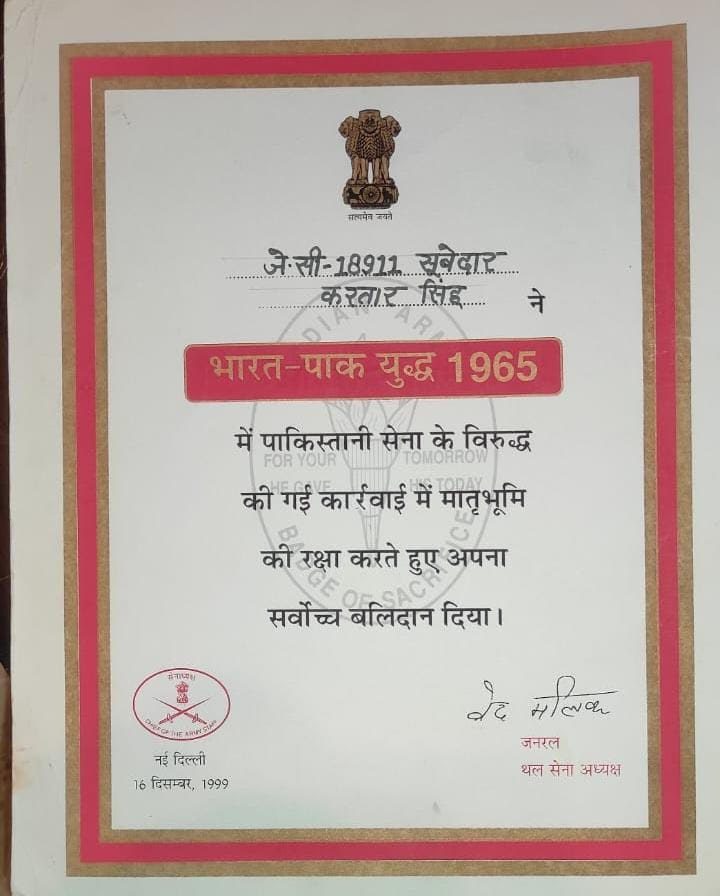
Through grit, cohesion, and aggressive infantry action, 4 Sikh successfully captured Barki within hours. Enemy troops, shaken by the combined night assault of armour and infantry, abandoned their positions after suffering significant casualties. With the objective secured, Phase Two operations were set in motion, with elements of 16 Punjab moving forward to secure the canal banks and establish the planned bridgehead measures to block counterattacks and deny crossing facilities to the enemy. The capture of Barki was a major tactical success for 65 Infantry Brigade, 7 Infantry Division, and 11 Corps. It brought Indian forces up to the Ichhogil Canal line and intensified pressure on Lahore’s defensive system. The action demonstrated effective brigade–division level planning and bold execution at the battalion level. The performance of 4 Sikh, under JCOs like Subedar Kartar Singh — steadying troops under fire, driving the assault forward, and ensuring objective capture — was central to the battalion’s success. He laid down his life in the line of duty at the age of 41, exemplifying courage, leadership, and unwavering commitment to the nation.
Subedar Kartar Singh is survived by his son, Shri Bharpur Singh and grandson Shri Kamal Pal Singh.
Kamal Pal Singh
2026 at 3:24 pmI pay heart felt tribute to my Grand father
sub Kartar Singh
Kamal pal Singh
2026 at 3:38 pmI am grand son of sub. Kartar singh. I want to provide photo and history my contact no 9596033500