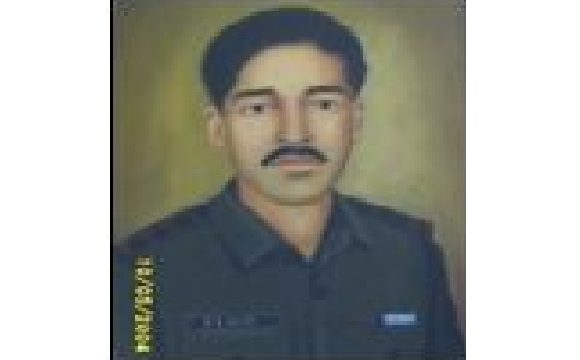

Service No : IC-44536W
Place of birth : Chandigarh, (Punjab)
Service : Army
Last Rank : Captain
Unit : 16 Raj Rif
Arm/Regt : The Rajputana Rifles
Operation : Op Pawan
Martyrdom : August 8, 1989
Captain KS Kang
Capt Karvinder Singh Kang, son of Shri BS Kang, hailed from Chandigarh, where he grew up in a close-knit family. Raised in a modest yet nurturing environment, he imbibed the values of discipline, hard work, perseverance, and a strong sense of responsibility from an early age. His upbringing played an important role in shaping his character and instilling in him a commitment to lead a purposeful and meaningful life. From his childhood, Capt Karvinder Singh was deeply inspired by the Indian Armed Forces and admired the courage, dedication and spirit of selfless service demonstrated by soldiers in safeguarding the nation. The aspiration to wear the uniform, serve the country and become part of an institution founded on the values of honour, courage and camaraderie gradually took shape as his life's ambition. Motivated by this dream, he remained determined to join the Indian Army and dedicate himself to the service of the nation.
His determination eventually led him to realise his childhood ambition, and he was commissioned into the 16th Battalion of the Rajputana Rifles, one of the oldest and most distinguished infantry regiments of the Indian Army. The regiment, renowned for its illustrious history, battle honours and tradition of valour, provided him with an environment that further strengthened his military values and professional commitment. As an officer of the Rajputana Rifles, Capt Karvinder Singh Kang became part of a proud legacy of soldiers who have upheld the highest traditions of military service, courage and sacrifice.
Sri Lankan Operations(Op Pawan) – 08 Aug 1989
Following the induction of the Indian Peace Keeping Force (IPKF) in Sri Lanka in July 1987, the LTTE was expected to surrender its weapons in accordance with the terms of the Indo-Sri Lanka Accord. However, the situation soon took a dramatic turn when the LTTE reneged on its commitment and launched an armed campaign against the Indian forces. What was initially intended to be a peacekeeping mission gradually escalated into a full-fledged military conflict. Initially, the 54 Infantry Division was inducted into Sri Lanka, but as the intensity and geographical spread of the operations increased, additional formations, including the 3, 4 and 57 Infantry Divisions, were deployed to reinforce the Indian forces. By August 1989, the IPKF had conducted numerous operations against the LTTE, but the conflict remained far from over. The militants continued to operate through guerrilla tactics, taking advantage of the difficult terrain, dense vegetation and extensive network of coastal areas. Capt Karvinder Singh Kang's unit, 16 Rajputana Rifles (16 Raj Rif), was actively involved in Operation Pawan, the military campaign undertaken by the IPKF against the LTTE.
On 08 August 1989, Capt KS Kang and his men were assigned a search-and-destroy mission as part of an operation involving the deployment of 16 Raj Rif in the Puttur area of the Jaffna Peninsula. Capt Kang was leading an assault team tasked with locating and engaging LTTE militants operating in the area. The mission demanded exceptional alertness and combat readiness, as the militants frequently moved in small groups, using the thick vegetation and difficult terrain to their advantage. During the operation, Capt Kang and one of his men were positioned behind a cluster of bushes, keeping a close watch on a track through which militant movement was suspected. While maintaining their concealment, they spotted two LTTE cadres approaching on a bicycle. Recognising them as potential targets, Capt Kang decided to engage the militants. He was determined to neutralise both of them with a carefully aimed single burst of fire, demonstrating his confidence and instinctive approach to combat.
In an attempt to obtain a clear line of sight, Capt Kang moved out of the cover of the bushes into the open track and prepared to take his shot. However, unknown to him, two more LTTE cadres were following the first pair on another bicycle. The LTTE militants were known to operate in pairs and small groups, with members providing mutual protection and covering one another's movements. This arrangement allowed them to maintain vigilance against possible ambushes and respond quickly to any threat. Before Capt Kang could take aim and open fire at the two militants ahead, the accompanying LTTE cadres from behind spotted him and opened fire. Caught in the sudden exchange, Capt Kang was hit by the militants' gunfire before he could engage his intended targets. His attempt to eliminate the enemy and protect his men thus turned into a sudden and deadly encounter. He eventually succumbed to his injuries. Capt Kang was a committed soldier and gritty officer who led from the front and laid down his life in the line of duty.
Col Vijay Kumar Sharma
2026 at 10:22 amAs told to me. Capt Karvinder and one of his men were hiding behind bushes when they saw two LTTE men going in front on a bicycle. He wanted to kill both of them with one round aimed shot. Usko normal kaam.main maza nahi aata. So he came out of the bushes in open on track and was aiming to fire at both of them. But there were two more LTTE men coming from behind on bicycle who shot him before that. LTTE men used to operate in pairs and buddy system, one taking care of the other.
IMA teaching of one bullet one man. He wanted to change the teaching to one bullet two men.