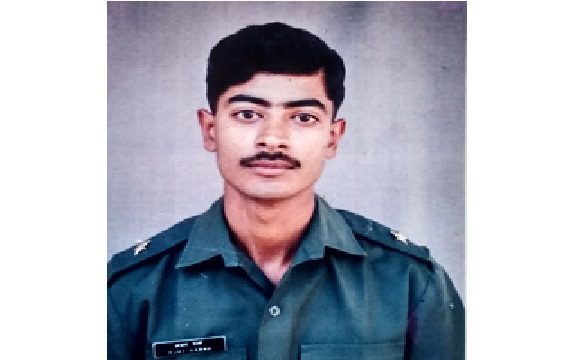

Service No : IC-52477K
Place of birth : Patna Dist (Bihar)
Service : Army
Last Rank : Lieutenant Colonel
Unit : 118 RCC (GREF)
Arm/Regt : The Corps of Engineers
Operation : CI & IS Ops
Martyrdom : June 13, 2008
Lt Col Ajay Verma
Lieutenant Colonel Ajay Verma hailed from Patna, Bihar, a city with a rich legacy of courage, patriotism, and service to the nation. From an early age, he was driven by a deep sense of discipline and an unwavering desire to wear the olive green uniform. Choosing the path of military service was not merely a career decision for him—it was the fulfilment of a lifelong dream to dedicate himself to the defence of the nation. After successfully completing his military training, he was commissioned into the Corps of Engineers, one of the oldest and most distinguished arms of the Indian Army. With a glorious history dating back to the days of the East India Company, the Corps of Engineers has played a pivotal role in every major military campaign, undertaking tasks ranging from combat engineering and battlefield mobility to bridge construction, road development, mine warfare, and disaster relief. Becoming part of this elite arm meant embracing some of the Army's most demanding and technically challenging responsibilities.
He was subsequently posted to 118 RCC (GREF), a unit of the General Reserve Engineer Force (GREF) under the Border Roads Organisation (BRO). The organisation is entrusted with the crucial responsibility of constructing and maintaining strategic roads, bridges, tunnels, and other infrastructure in some of the most inhospitable and remote border regions of India. Serving in GREF demanded far more than engineering expertise—it required exceptional physical endurance, mental resilience, and the courage to work in extreme terrain where landslides, avalanches, harsh weather, and difficult living conditions were part of everyday life. Lt Col Ajay Verma quickly immersed himself in the demanding environment of field service. Rather than merely leading from behind, he believed in sharing every hardship with his men. Whether supervising challenging engineering tasks, planning critical infrastructure projects, or operating in difficult operational areas, he displayed remarkable commitment and professionalism. More importantly, he won the affection and respect of the soldiers under his command. Every assignment strengthened his resolve and deepened his commitment to the ideals of the Indian Army—Service Before Self. Each road built, each bridge constructed, and each mission accomplished contributed not only to India's strategic preparedness but also to the lives of countless civilians living in remote border regions who depended on this vital infrastructure.
Project Beacon (J&K): 13 Jun 2008
In 2008, Lieutenant Colonel Ajay Verma was commanding 118 Road Construction Company (RCC) under Project Beacon of the General Reserve Engineer Force (GREF), an integral part of the Border Roads Organisation (BRO). His unit was deployed in the rugged mountains of Kishtwar district, Jammu & Kashmir—a region where every road was more than an engineering project; it was a strategic lifeline for the nation's security. Kishtwar lay close to the Line of Control (LOC) and bordered the militancy-affected districts of Doda and Anantnag. During that period, the area remained under constant threat from cross-border infiltration, with heavily armed terrorists frequently attempting to enter the region under the cover of dense forests and treacherous mountain terrain. Ceasefire violations were common, and every journey through the narrow winding roads carried an element of danger. For Lt Col Ajay Verma, however, duty never yielded to fear.
An officer known for leading from the front, he believed that leadership meant sharing every hardship with his men. Rather than supervising from a safe distance, he personally visited forward work sites, encouraged his teams, and ensured that critical infrastructure projects continued uninterrupted despite the hostile environment. Under his leadership, roads being carved through the mountains were not merely connecting villages—they were strengthening India's defensive posture along its vulnerable borders. On 8 June 2008, security agencies received credible intelligence about the presence of heavily armed terrorists who had infiltrated into the Kishtwar sector. The region was already on high alert. That evening, at around 5:30 PM, Lt Col Ajay Verma, accompanied by an officer, their driver, and two armed security personnel, was returning to Kishtwar after inspecting the under-construction Chhatroo–Simthan Road, one of the strategically significant projects undertaken by Project Beacon.
As their vehicle approached the remote Watsar stretch—a lonely mountain road flanked by dense forests—the silence of the valley was suddenly shattered. Terrorists concealed in the surrounding heights launched a well-planned ambush, opening indiscriminate automatic fire on the vehicle from hidden positions. The attack came with devastating speed, leaving little opportunity for the occupants to respond amid the narrow mountain pass. In those fateful moments, Lt Col Ajay Verma, along with an officer and three other soldiers, made the supreme sacrifice in the service of the nation, remaining steadfast in their duty until their last breath. After carrying out the cowardly attack, the terrorists disappeared into the thick forests, attempting to exploit the difficult terrain. The moment the ambush was reported, troops from nearby Army formations and security forces rushed to the scene. A large-scale search operation was immediately launched across the surrounding mountains and forests to track down the fleeing terrorists. The news of Lt Col Ajay Verma's martyrdom cast a deep shadow over 'Project Beacon', the 'Border Roads Organisation', and the Indian Army. Yet his legacy could never be erased. He represented a rare blend of soldier and engineer—a leader who understood that safeguarding India's borders was not only about fighting wars but also about building the roads that enabled soldiers to reach the frontlines, civilians to remain connected, and the nation to stand stronger in its most remote frontiers.
Every kilometre of road his men built through unforgiving mountains bore witness to his vision, courage, and commitment. He chose to walk the difficult path alongside those he commanded, proving that true leadership is measured not by rank alone, but by the willingness to share risk with one's men. Though Lt Col Ajay Verma fell on a lonely mountain road in Kishtwar, his legacy continues to travel every road built in the service of the motherland, inspiring generations of soldiers, engineers, and citizens alike to place duty above self and nation above all.
Lieutenant Colonel Ajay Verma is survived by his wife, Smt Nitu Verma, and two children.
Priya basin
2021 at 12:00 amNitu his wife of lft col Ajay Verma with two children is alive i pray he should be back people and Nation needs hum
ankurita chakraborty
2026 at 11:33 pmWell I hv been closely associated with Lt Col Ajay Verma a man holding from Patna. grt soldier a grt person for family my condolences are there with his wife Nitu Verma but the Baramula attack while he was posted in Udhampur a grt man a grt soldier our country lost I really pray if my post is ready by any one of Ajay is still alive I wish he is pls pray for this grt soldier ,time passes lines crossed but hope it continues
Rahul Biswari
2026 at 4:32 amI got to know about Ajay bhaiya when I was in my Engineering college (BIT Sindri) during 1991-95. His younger brother Sunil was my batchmate and a friend. Sunil’s father also worked in the Indian Army. I remember visiting their home in 1993 when I went to Patna to get my passport done at Biscomaun Bhavan. Great family.
Sunil is a wonderful friend and now lives in the US, as do I. We are in touch and I remember asking him once about his brother and got to learn about his story. Pained. Sincere respect & salute to Ajay bhaiya.I will always remain grateful to such a noble soul. May god bless his soul and his family always! Jai Hind!