

Service No : IC-14655
Date of Birth : August 3, 1941
Place of birth : Tarn Taran Dist (Pun)
Service : Army
Last Rank : Major
Unit : 18 Rajput
Arm/Regt : The Rajput Regiment
Awards : Maha Vir Chakra
Martyrdom : September 11, 1967
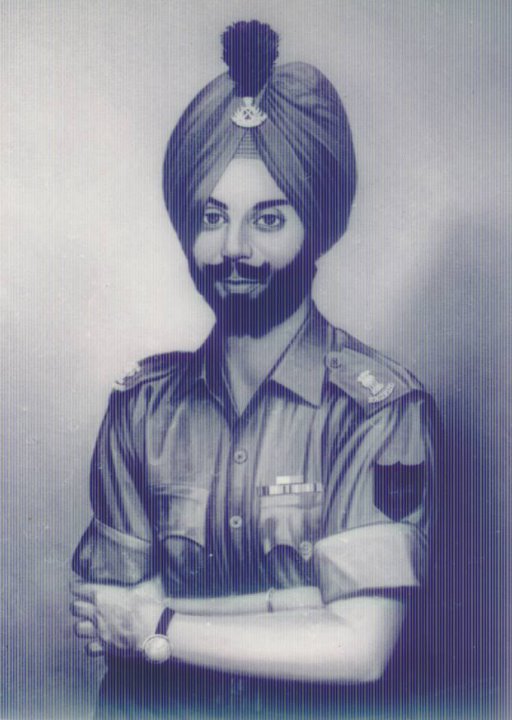
Major Harbhajan Singh MVC
Major Harbhajan Singh was born on 3rd August 1941 in the village of Bhatte Bhaini, situated in Patti tehsil of Tarn Taran District, Punjab. He was born into a family deeply rooted in patriotism and sacrifice. His father, Shri Assa Singh, was a freedom fighter who actively participated in the Gadar Movement during the late 1920s. His commitment to India’s independence led to his deportation from Shanghai, then a British enclave, highlighting the family’s legacy of courage and dedication to the nation. Major Harbhajan Singh received his early education at the village school in Bhatte Bhaini and later completed his matriculation from DAV High School in Patti. Inspired by his father’s example and driven by a sense of duty towards his country, he decided to join the armed forces at a young age. In June 1956, at just 15 years old, he enrolled as a boy soldier at the Army recruiting office in Amritsar and began his journey with the Corps of Signals.
His dedication, discipline, and exemplary performance in service paved the way for him to become a commissioned officer. On 30th June 1963, he was commissioned into the 18th Battalion of the Rajput Regiment, a distinguished infantry regiment renowned for its valor and numerous battle honors in various military operations. Through years of rigorous training and operational experience, Major Harbhajan Singh rose steadily through the ranks. By 1967, he had attained the rank of Major, having served in several key operational appointments, where he demonstrated leadership, courage, and unwavering commitment to his duties.
Nathu La Operation: 11 Sep 1967
Nathu La Pass, situated on the watershed that serves as a natural boundary, connects Sikkim with China’s Tibet Autonomous Region. This strategic pass held immense importance for the Indian Army, providing a tactical advantage for observation and fire. After the 1962 war, trade through this route had been closed. On 20th August 1967, India initiated the fencing of its border with three layers of barbed wire. This action was met with strong opposition from Chinese forces. On 23rd August 1967, Chinese soldiers advanced towards Nathu La, carrying rifles fitted with bayonets, and halted at the border. After an hour, they withdrew but soon returned, continuing their protests. In response, India began upgrading the barbed wire to a concertina coil on 5th September 1967. During this process, the Chinese political officer clashed verbally with the Commanding Officer of the local infantry battalion, Lt Col Rai Singh, causing a temporary halt in the work. Construction resumed on 7th September, provoking the Chinese Army further. Around 100 Chinese soldiers scuffled with Indian troops, but the Indian Army successfully repelled them. The fencing was scheduled for completion by 11th September 1967. During this period, army engineers were engaged in constructing the wire obstacle, with the 18 Rajput Battalion and the 2 Grenadiers Battalion assigned to protect them.
Major Harbhajan Singh of the 18 Rajput Battalion was appointed Officer in charge of a party tasked with strengthening the wire-laying team opposite the ‘North Shoulder’ at Nathu La. Simultaneously, Capt Prithvi Singh Dagar and his men from 2 Grenadiers secured the South Shoulder. At the time, Major Harbhajan Singh was commanding ‘A’ Company. At 0540 hours on 11th September 1967, the Indian engineers commenced construction of the wire obstacle. The Chinese forces, opposed to the wire obstacle, initiated hostilities. A scuffle ensued, followed by the Chinese opening fire from the front and flanks. The Rajput company and engineers were exposed in the open. Demonstrating exceptional courage, Major Harbhajan Singh shouted to his men to charge the enemy. He personally bayoneted three Chinese soldiers and advanced to silence a light machine gun that was firing upon Indian troops by throwing a hand grenade. During this act of valor, he was severely wounded. Despite his bravery, Major Harbhajan Singh succumbed to his injuries. Major Harbhajan Singh was a valiant soldier and a resolute officer who led from the front. At the young age of 26, he laid down his life in the service of the nation, epitomizing courage, dedication, and supreme sacrifice.
Major Harbhajan Singh was given the nation's second highest gallantry award “Maha Vir Chakra” on 26 January 1968 for his conspicuous gallantry, leadership and supreme sacrifice.



21 Comments
« Previous 1 2 3
H/Capt kulwant Singh(Retd)
2026 at 9:36 pmMaj Harbhajan Singh (MVC)Hero of the 18 Rajput battalion and always remember their war heros on 11 sept every year with wreath laying and Guard of Honor.
On same day wreath laying program in Maj Harbhajan Singh MVC villeage bhathe bhaini .
In Maj Harbhajan Singh MVC villeage three day program organised by villeage cometty
Akhand path
Wreath laying and culture program
Sports events
In respect of Maj harbhajan singh MVC
Preamary school name on saheed Maj Harbhajan Singh MVC
Stadium
Mela ground