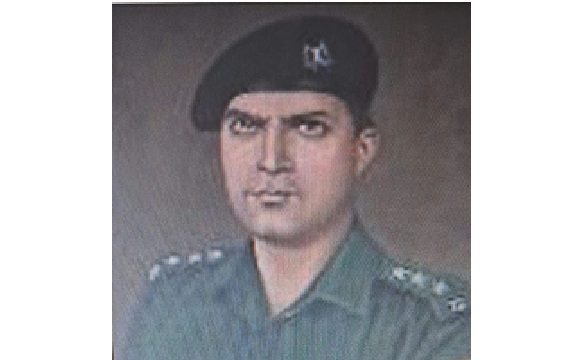

Service No : IC-12332
Place of birth : Panchkula Dist (Har)
Service : Army
Last Rank : Captain
Unit : 7 Cav
Arm/Regt : The Armoured Corps
Operation : Indo-Pak War-1965
Martyrdom : October 6, 1965
Captain DS Jaswal
Captain Daljit Singh Jaswal hailed from Panchkula in Haryana and was born into a family that upheld strong values of discipline, integrity, and service. He shared a close bond with his brother, Baljit Singh, and from an early age displayed sincerity in his studies along with a strong sense of responsibility. These qualities, coupled with the inspiring legacy of his father—a British-commissioned officer who served in North Africa and Burma during the Second World War—shaped his aspiration to serve the nation. Driven by this sense of purpose, he was commissioned into the 7th Light Cavalry on 18 December 1960. The 7th Light Cavalry traces its origins to 1784, when it was raised at Arcot near Madras from selected drafts of three regiments of local cavalry taken over by the East India Company. From its inception, the Regiment developed a reputation for professionalism and gallantry, serving with distinction both in India and overseas. During the pre-Independence era, the Regiment saw extensive active service. In the First World War, it operated in challenging theatres such as Persia, Russia, Transcaspia, and Afghanistan. In the Second World War, it played a notable role in the siege of Imphal and subsequently advanced through Burma, becoming the first cavalry regiment to reach Rangoon.
During his service, he saw active operations in Goa, where he displayed notable leadership and remarkable composure under pressure. He later served in challenging operational areas such as Nagaland and NEFA, where he continued to exhibit the same high standards of courage and professionalism. Captain Jaswal remained closely associated with his regiment throughout his career, except for a brief period of nine months when he was appointed as Aide-de-Camp (ADC) to the General Officer Commanding (GOC) of 2 Mountain Division. On the eve of the 1965 Indo-Pak War, the Regiment was in the process of converting to PT-76 tanks and, as per Army Headquarters’ policy, was not considered fully battle-ready. However, under the dynamic leadership of its Commanding Officer, Lt Col Dalip Singh Jind, the Regiment demonstrated exceptional determination. He successfully persuaded higher authorities to permit the unit to move to the concentration area with the available resources, continuing its training even while on the move—ensuring that the Regiment was prepared to meet the challenges of the impending conflict.
Indo-Pak War (Western Sector) : Sep 1965
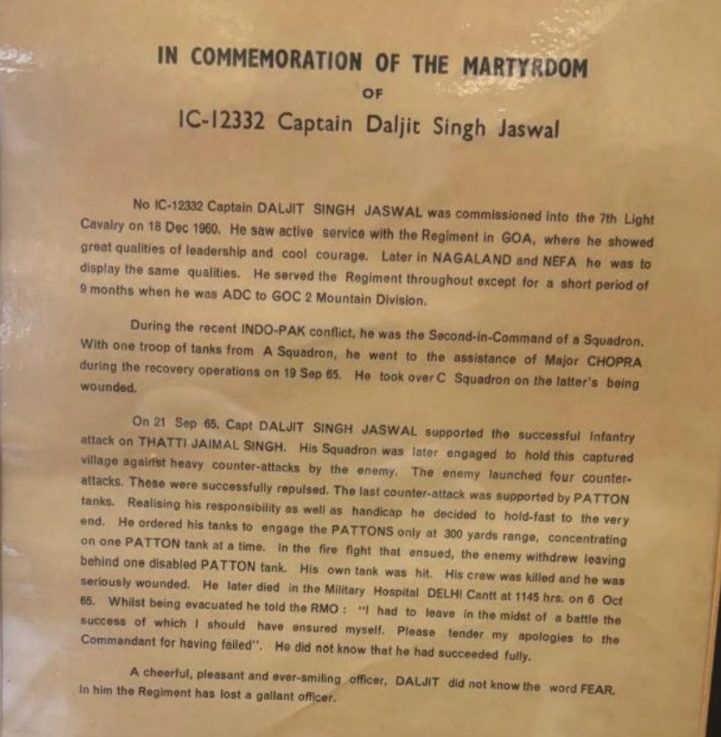
During September 1965, Captain DS Jaswal was serving with 7th Cavalry in the Western Sector during the Indo-Pak War. At the time, XI Corps under Lieutenant General JS Dhillon had been tasked with advancing towards the Ichhogil Canal and posing a threat to Lahore, while also countering Pakistani offensives into Punjab. Initial operations in early September saw Indian forces make rapid gains; however, the situation soon became intense and fluid, particularly in the Khem Karan–Asal Uttar sector, where the enemy launched powerful armoured counterattacks. In this demanding operational environment, 7th Cavalry played a vital role in supporting infantry operations, engaging enemy armour, and holding critical ground under heavy artillery fire and against well-prepared defences. Amid these operations, Captain Jaswal was serving as the Second-in-Command of a squadron. On 19 September 1965, with a troop of tanks from A Squadron, he moved forward to assist Major Chopra during recovery operations. When Major Chopra was wounded, Captain Jaswal took over the command of C Squadron, demonstrating prompt leadership in a critical situation.
On 21 September 1965, Captain Daljit Singh Jaswal led his squadron in support of a successful infantry attack on Thatti Jaimal Singh. Following the capture of the objective, his squadron was tasked with holding the village against determined enemy counterattacks. The enemy launched four successive counterattacks, all of which were successfully repulsed under his resolute leadership. The final assault was supported by Patton tanks, posing a serious threat to the defensive position. Fully aware of both the tactical situation and his limited resources, Captain Jaswal resolved to hold his ground at all costs. He instructed his tanks to engage the advancing Pattons at close range—within 300 yards—and to concentrate fire on one tank at a time. In the fierce engagement that followed, the enemy was forced to withdraw, leaving behind a disabled Patton tank. However, during the intense firefight, Captain Jaswal’s own tank was hit. His crew was killed, and he himself sustained grievous injuries. Despite his critical condition, his sense of duty remained foremost. While being evacuated, he remarked to the Regimental Medical Officer, “I had to leave in the midst of a battle the success of which I should have ensured myself. Please tender my apologies to the Commandant for having failed.” Unaware of his success, he succumbed to his injuries at the Military Hospital, Delhi Cantonment, at 1145 hours on 6 October 1965.
A cheerful, pleasant, and ever-smiling officer, Captain Daljit Singh Jaswal was fearless in the face of danger. The entire operation witnessed the ultimate sacrifice of nine other brave soldiers of 7 Cavalry, who laid down their lives alongside their comrades. These included: Major MS Bal, Major Man Mohan Chopra, Naib Risaldar Jagjit Singh, Lance Dafadar Bharath Singh, Lance Dafadar Jhanda Singh, Acting Lance Dafadar C. B. Shohu, Acting Lance Dafadar Sucha Singh, Sowar Chandan Singh and Sowar Bhale Ram. His actions in battle stand as a testament to his extraordinary courage, indomitable spirit, and unwavering devotion to duty. By taking command in the face of adversity and leading from the front under intense enemy fire, Captain DS Jaswal upheld the highest traditions of the Indian Army and made the supreme sacrifice in the service of the nation.
No Comments