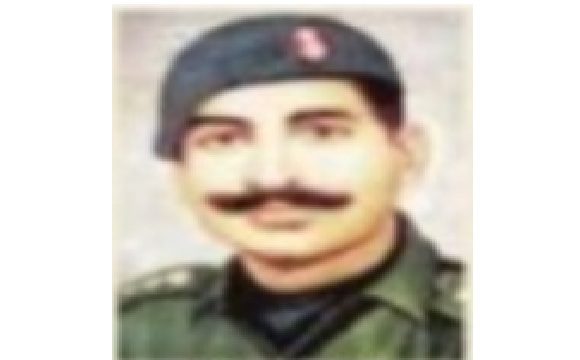

Service No : SS20987
Place of birth : Kangra Dist (HP)
Service : Army
Last Rank : Captain
Unit : 10 Bihar
Arm/Regt : The Bihar Regiment
Operation : Indo-Pak War 1971
Martyrdom : December 2, 1971
Captain KC Sharma
Battle of Akhaura (Indo-Pak War): Dec 1971
During the Indo–Pak War of 1971, Captain KC Sharma was serving with 10 Bihar Battalion, which was deployed in the Eastern Sector in the Agartala region of Tripura. The battalion operated under 311 Mountain Brigade, part of 57 Mountain Division, under IV Corps commanded by Lieutenant General Sagat Singh. The division itself was commanded by Major General BFGonsalves. Even before the formal outbreak of hostilities, Indian forces had begun preparatory offensive operations in the sector. As part of the divisional plan to secure key approaches towards Akhaura, 10 Bihar, along with 4 Guards, crossed the international border on 1 December 1971 and commenced a difficult cross-country advance into enemy territory. On 2 December 1971, during the initial phase of these offensive operations, Captain KC Sharma was actively leading his troops in the advance against well-prepared enemy positions. Displaying exemplary courage and leadership from the front, he played a crucial role in pressing the attack under challenging and hostile conditions. In the course of this action, while inspiring his men and maintaining momentum against the enemy, Captain KC Sharma made the supreme sacrifice. His leadership and gallantry in the opening phase of the operations set a high standard of determination and resolve for his battalion, contributing significantly to the success of subsequent actions.
The war formally commenced on 3 December 1971, when the Pakistani Air Force launched pre-emptive strikes in the western sector. By 4 December, Indian forces had initiated full-scale offensive operations in East Pakistan. In the Eastern Theatre, IV Corps was tasked with advancing towards the Meghna River and creating conditions for a decisive thrust towards Dhaka. Within this framework, 57 Mountain Division was assigned the critical task of capturing Akhaura, a heavily fortified and strategically vital border town. Akhaura had been developed by the enemy into a strong defensive position, with bunkers, trenches, minefields, barbed wire obstacles, and support from artillery and armour. It was also being used to shell Agartala and disrupt Indian positions. As part of this plan, 311 Mountain Brigade, including 10 Bihar, advanced towards Akhaura from the north. Building upon the initial gains—made at great cost, including the sacrifice of officers like Captain KC Sharma—the battalion successfully captured key positions such as Noapara and Lonasar, tightening the encirclement of enemy defences. The main assault on Akhaura was launched on the night of 4 December 1971, with 10 Bihar assigned the crucial objective of capturing the Akhaura Railway Junction, a key communication node.
Despite stiff resistance and intense fighting, the battalion pressed forward with determination. In the early hours of 5 December, after fierce combat, 10 Bihar captured Simrail. Simultaneously, 4 Guards established a vital block across the Titas River at Kodda, preventing enemy reinforcement and withdrawal. Continuing the offensive, 10 Bihar, in conjunction with other units including 18 Rajput, launched coordinated attacks on Akhaura. After heavy fighting, enemy defences were broken, and Akhaura, along with the railway bridge over the Titas River, was captured on the morning of 5 December 1971—a significant turning point in the sector. Following the capture of Akhaura, fresh intelligence indicated that the railway embankment towards Brahmanbaria could serve as a vital axis of advance towards Ashuganj and further to Dhaka. Seizing the opportunity, the divisional advance was rapidly reoriented. 311 Mountain Brigade, including 10 Bihar, advanced along the Akhaura–Brahmanbaria axis, while 73 Mountain Brigade moved along a parallel route. Between 7 and 8 December, Indian forces maintained relentless pressure. The brigade crossed the Titas River and continued its advance, outflanking enemy positions. Under sustained offensive action, Pakistani forces began withdrawing towards Ashuganj. By 8 December, key positions around Brahmanbaria had been secured, and the advance gained momentum. On 9 December, as Indian forces closed in, the enemy destroyed the Ashuganj bridge in a desperate attempt to delay the advance. However, the initiative had firmly passed to Indian forces. Pressing forward, Indian troops continued their advance, and Ashuganj was captured on 10 December 1971, as enemy forces withdrew in disarray across the Meghna River.
The operations of 10 Bihar Battalion, under 311 Mountain Brigade, played a decisive role in the capture of Akhaura and the subsequent advance towards the Meghna River. The battalion’s success was built upon the courage, leadership, and sacrifice displayed during the opening stages of the campaign. Captain KC Sharma’s supreme sacrifice on 2 December 1971, in the very early phase of operations, exemplified the highest traditions of the Indian Army. His leadership and devotion to duty inspired his comrades and contributed to the momentum that ultimately led to the success of operations in the sector. The Battle of Akhaura and the subsequent advance were among the most intense and decisive phases of the campaign. While the victory contributed significantly to India’s eventual triumph and the liberation of Bangladesh, it came at a heavy cost. During the course of these operations, besides Capt KC Sharma, two other officers—2nd Lt Mahendra Pal Singh Chaudhary, and 2nd Lt KK Majumdar, three Junior Commissioned officers and forty-five other ranks of 10 Bihar Battalion also made the supreme sacrifice in the line of duty.
dhananjay
2026 at 4:34 pmBattle of Akhaura 1971
Pakistani bunkers which had MMGs inside them, were constructed from date trees. They were really strong and to the utter shock of the men of the RCL gun detachment, the RCL gun shots ricocheted off from the bunker! Hence, they started aiming and firing at the bunker pits and this is when they started getting results. Now, they started facing the frontal Pakistani defenses in front of the Akhaura bridge.
Captain KC Sharma had led a Ghatak platoon to take over the bridge but the entire platoon suffered massive casualties, with many men and the Captain himself were never found.