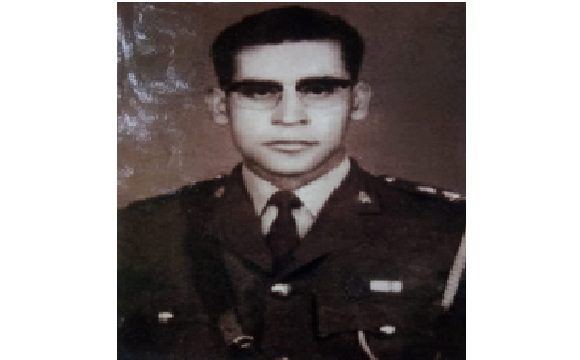

Service No : IC-10176
Date of Birth : September 24, 1936
Place of birth : Kolkata (WB)
Service : Army
Last Rank : Captain
Unit : 4 JAK Rif
Arm/Regt : The JAK Rif
Operation : Indo-Pak War-1965
Martyrdom : September 20, 1965
Captain Prabal Roy
Capt Prabal Roy hailed from Kolkata in West Bengal and was born on 24 Sep 1936 to Shri Nirode Kumar Roy and Smt Basanti Roy. He was the youngest among four brothers and also had one younger sister. Tragedy touched his life early when he lost his father at the tender age of 13. This loss brought financial hardship to the family, but it also forged in Capt Prabal a deep sense of responsibility, resilience, and inner strength—qualities that would come to define his character and life’s journey. He received his education at the renowned Tirthabati Institution in Kolkata, where he distinguished himself as a sincere student with a keen intellectual curiosity. During these formative years, he developed a deep love for literature. An avid reader, he built a personal library that included works by Thomas Hardy, John Galsworthy, Somerset Maugham, and much of the writing of Kahlil Gibran. The themes of human struggle, morality, compassion, and purpose found in these authors deeply influenced his worldview and shaped his philosophical outlook on life.
After completing his schooling, he pursued a Bachelor of Science (Honours) degree at Ashutosh College, Kolkata. Alongside his academic pursuits, his inclination toward discipline, service, and higher ideals continued to grow. He also belonged to a family with a proud tradition of military service, with several close relatives having served in the armed forces. This legacy, combined with his personal values and sense of duty, further strengthened his resolve to follow the path of the profession of arms. He joined the Indian Army and was commissioned into the 4 Jammu and Kashmir Rifles (4 JAK Rif) Battalion of Jammu and Kashmir Rifles Regiment—a regiment that has earned a formidable reputation for its bravery, resilience, and operational excellence in some of the most demanding environments in the country. He quickly adapted to the rigours of military life, and his performance stood out for his commitment, courage, and camaraderie with his fellow soldiers.
Battle of Chawinda: Indo-Pak War (Sep 1965)
At the outbreak of the 1965 Indo–Pakistan War, Capt Prabal Roy was serving as a Staff Officer at Army Headquarters in New Delhi—a position that ensured relative safety and distance from the battlefield. Yet, driven by an indomitable spirit and an unshakable sense of duty, he could not bring himself to remain in the comfort of the capital while his men faced the enemy. Without hesitation, he volunteered to rejoin his battalion and fight alongside his troops on the frontlines. At the time, his unit 4th Battalion, Jammu and Kashmir Rifles (4 JAK Rif), was operating under the 58 Infantry Brigade, which formed part of the 6 Mountain Division of I Corps. The formation was deeply involved in the intense fighting around Chawinda, one of the most fiercely contested sectors of the war. Following the Pakistani offensive in the Chhamb sector, India launched a counter-offensive in the Sialkot sector. The objective of I Corps under Operation Nepal was to isolate Sialkot from Lahore and ultimately capture Chawinda, a strategically critical town that served as the base for Pakistan’s powerful 6 Armoured Division. The capture of Chawinda was seen as essential to breaking the enemy’s armoured resistance in the sector.
By mid-September 1965, Chawinda had emerged as a heavily fortified stronghold. Pakistani forces had transformed the town into a defensive fortress, with tanks dug in as pillboxes and layered defences organised in depth. Indian formations, including the 6 Mountain Division, were tasked to mount repeated assaults under extremely difficult conditions, facing heavy artillery, armour, and entrenched opposition. Within this larger battle, 4 JAK Rif, as part of 58 Infantry Brigade, was committed to the fighting in and around the Chawinda sector. The brigade faced intense enemy artillery fire even before the assault could fully develop. Communication broke down, units became disoriented under shelling, and casualties mounted rapidly. Despite these conditions, soldiers of 4 JAK Rif continued to press forward under fire, attempting to hold ground and engage the enemy in close combat. It was in this atmosphere of chaos, confusion, and relentless bombardment that Captain Prabal Roy’s leadership came to the fore. Around this time, he had been promoted to the rank of Acting Captain. As enemy artillery intensified, the sector came under heavy shelling. Explosions tore through positions, and the air was filled with dust, smoke, and shrapnel.
Amidst this devastation, Captain Roy stood firm. Calm under pressure, he led from the front, moving among his men, encouraging them, reorganising defences, and ensuring that their fire remained effective despite the overwhelming conditions. His courage inspired his soldiers to hold on when morale could easily have collapsed. With shells exploding all around, he continued to direct fire and coordinate the defence, setting a powerful example of leadership by personal conduct. During one of the intense artillery barrages, an enemy shell exploded close to Captain Roy’s position. He was gravely wounded by shrapnel, sustaining severe injuries to his head and abdomen. The forward area had extremely limited medical facilities, and evacuation was difficult. Only a single vehicle was available to carry the wounded, and it could take only a few men at a time. When advised to be evacuated immediately due to the seriousness of his injuries, Captain Roy refused. In an extraordinary display of selflessness, he insisted that the more critically wounded soldiers under his command be evacuated first. He made it clear that he would leave only after ensuring that his men had been taken to safety. Despite his worsening condition and heavy loss of blood, he continued to direct the defence, encourage his troops, and remain at his post for several more hours. His determination did not waver, and his sense of duty remained unshaken even in the face of death. By the time the evacuation vehicle finally returned for him, it was too late. He had lost excessive blood, and despite efforts to save him, Captain Prabal Roy attained martyrdom on 20 September 1965.
Along with Captain Prabal Roy, 21 other brave soldiers of 4 JAK Rif also laid down their lives during the entire operation, making the supreme sacrifice in the service of the nation. The other fallen soldiers of the operation were: Naib Subedar Khajoor Singh, Havildar Motwar Singh, Lance Havildar Angrez Singh, Lance Naik Pritam Singh, Lance Naik Jagir Singh, Lance Naik Chaman Lal, Rifleman Sant Ram, Rifleman Chain Singh, Rifleman Mela Singh, Rifleman Gagan Singh, Rifleman Makhan Singh, Rifleman Hari Ram, Rifleman Surmukh Singh, Rifleman Karam Chand, Rifleman Gian Chand, Rifleman Parkash Singh, Rifleman Rup Lal, Rifleman Dalip Singh, Rifleman Kashmir Singh, Rifleman Amar Singh, and Rifleman Bakshish Singh. Together, these valiant men stood resolute in the face of danger and upheld the highest traditions of the armed forces through their ultimate sacrifice.
Capt Prabal Roy is survived by his sister Smt Pratima Som nee Roy.
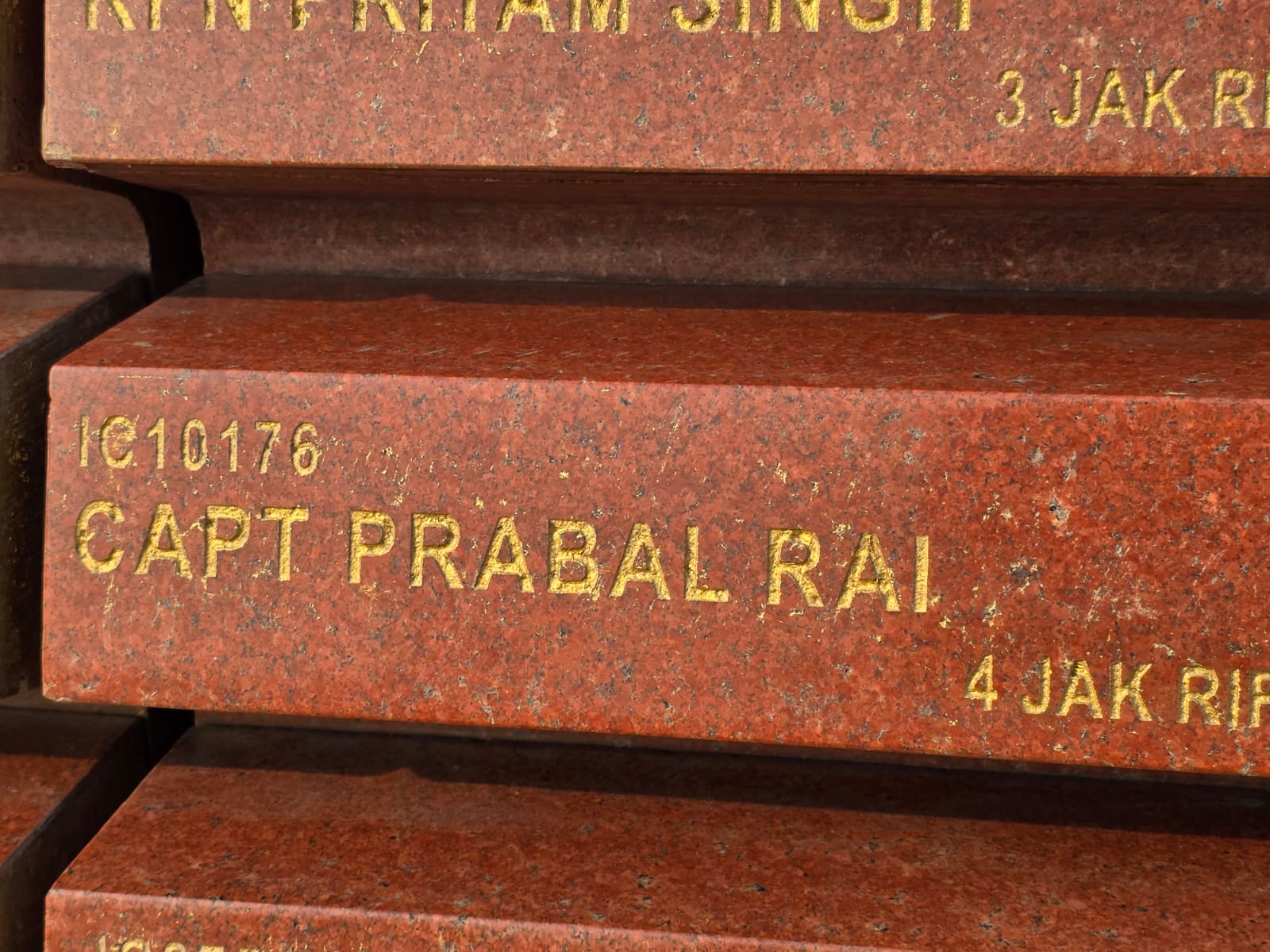
Madhusmita Som Ray
2026 at 4:15 pmHe was martyred in Sialkot sector on 20th September 1965 .
Srimanta Mukherjee
2026 at 6:33 amCan anyone confirm whether Captain Prabal Roy was resident of South Calcutta, Tollygunge, Russa Road South 2nd Lane or 3rd Lane and one of his sibbling was Mr Amit Roy. I vaguely remember as a child I saw his photo was decorated, garlanded and honoured in our Durga Puja Mandap – Hindusthan Pally Durga Puja organised by Tollygunge Place Club. I sincerely looking forward towards a confirmation.
Rgds