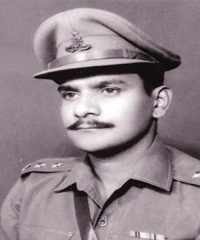

Service No : IC-21021
Date of Birth : October 31, 1937
Place of birth : Ahmednagar(Mah)
Service : Army
Last Rank : Captain
Unit : 67 Fd Regt
Arm/Regt : The Regiment of Artillery
Operation : Indo-Pak War 1971
Martyrdom : December 16, 1971
Captain VV Kulkarni
Captain Vishwanath Vasudev Kulkarni was born on 31 October 1937 in Ahmednagar district, Maharashtra, a land known for its tradition of valour and patriotism. He completed his primary education in Shevgaon and pursued his secondary education at the then Model High School of Hindu Sewa Mandal. A sincere student with an all-round personality, he went on to graduate in Economics from Ahmednagar College. During his college years, he actively participated in the National Cadet Corps (NCC), where his leadership qualities, commitment, and hard work earned him the distinction of being recognized as the Best Cadet. Initially, he served for a few years as a Physical Director, but his deep involvement in the NCC strengthened his desire to serve the nation in uniform. Inspired by military discipline and patriotic ideals, he joined the Indian Army in 1964, directly through his NCC background. Soon after his commissioning, the Indo–Pakistan War of 1965 broke out, providing him with early battlefield experience—experience that would later prove crucial during the 1971 Indo–Pakistan War and the Bangladesh Liberation War.
Captain Vishwanath Kulkarni spent a significant portion of his military career in Gorakhpur, where his unit functioned in close operational coordination with the Indian Air Force—a role that demanded precision, discipline, and seamless inter-service cooperation. He was posted to the 67 Field Regiment of the Regiment of Artillery, the formidable combat support arm of the Indian Army, renowned for its thunderous guns, technical expertise, and decisive battlefield impact. The regiment was entrusted with highly sensitive and critical responsibilities, including operational coordination, intelligence support, and internal security operations, such as countering Naxalite activities in disturbed areas. Amid these demanding operational commitments, Captain Kulkarni remained deeply committed to professional excellence. With unwavering focus, he continued to prepare for the promotion examination to the rank of Major, demonstrating both ambition and a strong sense of responsibility toward his career and his unit. He had formally taken leave to concentrate on these preparations. However, as the geopolitical situation deteriorated and the signs of impending war in 1971 became unmistakable, Captain Kulkarni once again revealed the depth of his character. Without hesitation, he cancelled his leave and immediately reported back for active duty, choosing the path of service over personal advancement.
Battle of Siramani (Indo-Pak War)- Dec 1971
As tensions mounted on India’s eastern front in 1971, Captain Vishwanath Kulkarni’s 67 Fd Regt under the command of Lieutenant Colonel Mohan Dutt Anand was deployed in Bongaon on the outskirts of Kolkata, close to the operational theatre of what would soon become the Bangladesh Liberation War. Much earlier, on 14 October 1971, Captain Kulkarni had already moved out from Deolali (Nashik) towards the war front, fully aware of the gravity of the mission that lay ahead. During the 1971 Indo–Pakistan War, the regiment was equipped with 25-pounder guns and operated under 9 Artillery Brigade, part of 9 Infantry Division of II Corps, in the South-Western Sector. The regiment played a crucial role in the operations leading up to the liberation of Bangladesh, though it paid a heavy price during the campaign. The 'Commanding Officer', Lt Col Mohan Dutt Anand, was tragically killed on 12 Dec 1971 by a freak bullet that entered the helicopter in which he was flying during a terrain familiarisation mission. Following his death, command of the regiment was taken over by Lieutenant Colonel JC Saxena. Despite this loss, the regiment continued to operate with determination, taking part in the Battle of Garibpur and subsequently advancing towards Khulna, where the decisive Battle of Siramani was fought.
By this stage, Indian forward elements were pressing hard on the outskirts of Khulna. The enemy had established a formidable defensive position at Siramani, astride a critical railroad crossing. Occupying high ground, the position offered excellent all-round observation and was heavily fortified. Chinese Heavy Machine Guns were sited to dominate the road and railway approaches, while other infantry weapons covered the intervening gaps. Although the monsoon had long receded, the surrounding terrain remained severely waterlogged, with water depths ranging from five to eight feet, rendering manoeuvre nearly impossible. Three battalions made repeated attempts to capture the position through frontal and outflanking attacks, but all were repulsed due to intense enemy fire and the impassable terrain. The only viable approach lay from the eastern side, through dense tree cover—an axis that offered concealment but posed serious challenges in navigation and target identification, especially by night. Determined to break the enemy’s resistance, the General Officer Commanding, Major General Dalbir Singh, insisted that Siramani be captured to deliver the final blow. Plans for the battle were finalised at Division Headquarters on 15 December. 13 Dogra Battalion was tasked to capture the objective in a daylight assault on 16 December, advancing from the eastern wooded approach.
The task of providing artillery support was assigned to 67 Field Regiment. The regiment was to register the objective and then progressively shift fire closer to the advancing infantry, allowing them to advance under a moving umbrella of artillery fire. The Affiliated Battery Commander, Major DS Kang, and an Observation Party led by Captain VV Kulkarni were designated to support 13 Dogras during the assault. On the morning of 16 December, artillery coordination was established from the forward defended localities of 26 Madras, the battalion holding the main Jessore–Khulna axis. At approximately 0900 hours, fire from all 18 guns of the regiment was brought down on the objective area and adjusted to ensure accurate coverage. The fire was then deliberately shifted in stages along a map line connecting the objective to the assaulting troops. Once visual confirmation was received that the infantry could see the shell bursts at a safe distance, the artillery fire plan was set. With the troops already at the start line and ammunition prepared, H-Hour was fixed for 0930 hours. There was no time for a formal fire plan—what followed was a flexible, observed barrage, executed in real time.
During the assault, radio communication between the Forward Observation Officer (FOO) and the gun area was disrupted due to dense foliage and intervening structures. This problem was overcome by relaying orders manually, ensuring uninterrupted fire support. To further disorient the enemy, a novel technique was employed: the rate of fire was deliberately varied, ranging unpredictably from intense bursts to slow, spaced-out fire. This kept the defenders constantly guessing, denying them any opportunity to regroup or counter-attack—a tactic later acknowledged by enemy troops as decisive. Amidst the ferocity of the assault, Captain VV Kulkarni, leading the Observation Party of 67 Field Regiment, was struck by a deadly burst of Chinese Heavy Machine Gun fire in the abdomen. Gravely wounded and bleeding profusely, he collapsed at his post. Yet, even in his final moments, Captain Kulkarni displayed exceptional courage and devotion to duty. Refusing evacuation, he urged his Technical Assistant and radio operator to leave him behind and continue supporting the attack, ensuring that the artillery fire remained effective until the infantry had secured the objective. Inspired by his resolve, the Observation Party carried on despite the loss of their leader and continued to provide critical fire support until 13 Dogra Battalion successfully captured and reorganised on the objective.
The capture of Siramani proved decisive, breaking the enemy’s last organised resistance on the Khulna axis. 67 Field Regiment’s accurate, innovative, and relentless fire support played a central role in the success of the operation. In addition to Captain VV Kulkarni, the regiment also lost Lt Col Mohan Dutt Anand and Naik Shambhu Nath Ram during the war. Among the regiment’s sacrifices, Captain VV Kulkarni’s gallantry stands out as a shining example of leadership, selflessness, and supreme sacrifice. He laid down his life ensuring mission success, embodying the finest traditions of the Regiment and the Indian Army. His courage and the steadfast performance of 67 Field Regiment remain etched in the annals of the Battle of Siramani and the victory of 1971.
Captain Vishwanath Vasudev Kulkarni is survived by his wife, Smt Rewatai Kulkarni; his daughter, Smt Sushma Deogaokar; his son, Dr Shirish Kulkarni, an anesthetist and his brother, Shri Dinubhau Kulkarni.
Dhananjay Sant
2026 at 1:02 pmHe was a resident of Ahmednagar now Ahilyanagar.. Residing at savedi road, Gulmohar bunglow. His son Dr Shirish is a anesthetist, daughter Sushma Deogaokar worked in a bank. His wife Smt. Revatai Kulkarni was a school teacher, now retired.