Colonel Hoshiar Singh Dahiya is survived by his wife, Smt Dhano Devi and three sons. Two of his sons followed in his footsteps into the Indian Army, joining the Grenadiers Regiment, the same unit their father heroically commanded during the war.


Service No : IC-14608
Date of Birth : May 5, 1937
Place of birth : Sonipat, Haryana
Service : Army
Last Rank : Colonel
Unit : 3 Grenadiers
Arm/Regt : The Grenadiers
Operation : Indo-Pak War 1971
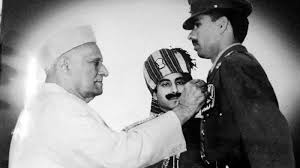
Awards : Param Vir Chakra
Martyrdom : December 6, 1998
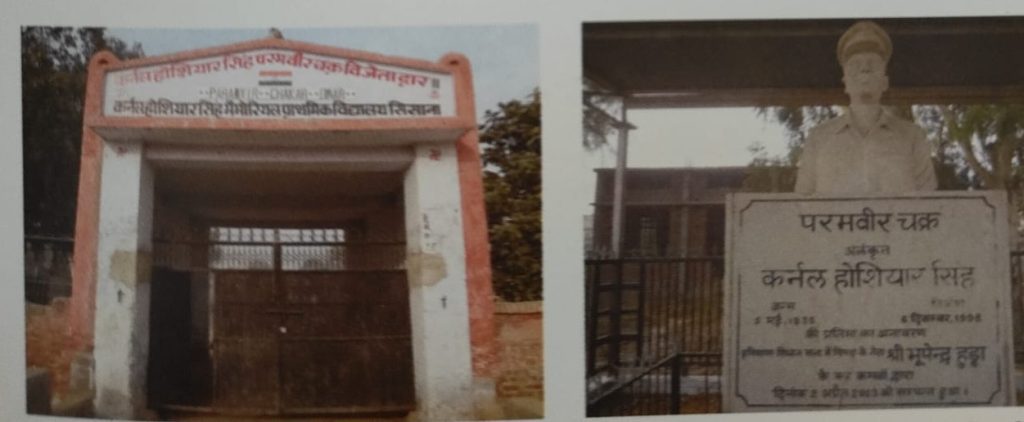
In the sun-baked village of Sisana in the Sonipat district of present-day Haryana, where fields stretched to the horizon, and life followed the rhythm of hard work and honesty, Colonel Hoshiar Singh Dahiya was born on 5 May 1937 into a Jat family. The son of Shri Chaudhary Hira Singh and Smt Mathuri Devi, he grew up in an environment that valued integrity, endurance, and self-respect—qualities deeply ingrained in rural Haryana and destined to define his character as a soldier. From a young age, he displayed a rare combination of intellect and resolve. At Jat Heroes Memorial High School, Rohtak, and later at Jat College, he was recognised as a bright and disciplined student, frequently standing first in his class. Equally at home on the sports field, he cultivated physical toughness alongside mental sharpness. Teachers and peers alike sensed that he carried within him a strong sense of duty—an instinct to shoulder responsibility rather than avoid it. Though a comfortable civilian life lay open before him, the call of service proved stronger. Inspired by ideals of honour and sacrifice, he chose the arduous path of the Indian Army—a decision that would shape not only his own destiny but also the military history of the nation.
His military journey began at the very grassroots—as a sepoy. This early experience among the ranks would later define his leadership style, grounding him firmly in the realities of a soldier’s life. His natural leadership, discipline, and determination soon stood out. Recognising his potential, the Army selected him for the Army Cadet College, where he underwent intense training designed to transform promising soldiers into officers. From there, he progressed to the Indian Military Academy, Dehradun, the crucible in which India forges its leaders. On 30 June 1963, he was commissioned into The Grenadiers, joining the 3rd Battalion—a unit renowned for its courage and battlefield legacy. His early postings took him to NEFA (North Est Frontier Agency), where extreme terrain and isolation tested his endurance and adaptability. These challenging conditions hardened him further, sharpening his understanding of both men and mountains.
The Indo-Pakistani War of 1965 marked his first major exposure to combat. Amid the chaos and uncertainty of war, Col Hoshiar Singh demonstrated calm courage and professional competence. His actions during this conflict earned him a Mention in Despatches, an early acknowledgement of gallantry that foreshadowed the extraordinary heroism yet to come. As years passed, he rose steadily through the ranks—Lieutenant, Captain, and then Major. Yet, promotion never created distance between him and his soldiers. He believed that authority was earned, not imposed. He led from the front, shared hardships without complaint, and stood shoulder to shoulder with his men in adversity. This deep bond of trust made him not just a commanding officer but a source of inspiration. By the time history called upon him during the 1971 Indo-Pakistani War, he was no longer merely an officer by rank—he was a leader forged by experience, discipline, and an unshakeable commitment to duty.
Battle of Basantar (Indo-Pak War): 15/16 Dec 1971
During the Indo–Pakistani War of 1971, the western front saw some of its fiercest and most decisive fighting in the Shakargarh sector of Punjab. This area held immense strategic value: control of the Shakargarh bulge could threaten India’s vital lines of communication to Jammu and Kashmir. Consequently, both sides concentrated major forces here, turning the sector into a focal point of intense and sustained military operations. Within this critical theatre, the Grenadiers Regiment played a leading role. The 3rd Battalion, The Grenadiers, commanded by Lieutenant Colonel VP Airy, was tasked with spearheading the Indian advance. By mid-December 1971, the battalion received one of the most demanding missions of the campaign—to establish and secure a bridgehead across the Basantar River, a formidable natural obstacle. The river approaches were heavily defended by Pakistani forces, with deep minefields laid on both banks and well-sited positions supported by artillery and machine-gun fire. Yet, the success of the Indian offensive hinged on crossing the Basantar and holding firm ground beyond it.
On 15 December 1971, the challenge became immediate and personal for Col Hoshiar Singh Dahiya, then serving as a Major and commanding Charlie Company, the left forward company of the battalion. His company was assigned the crucial task of capturing the enemy-held locality of Jarpal, an objective vital for consolidating the bridgehead and enabling the battalion to withstand inevitable counter-attacks. Leading from the front under relentless fire, Major Hoshiar Singh guided his men across mined terrain and through a storm of artillery and small-arms fire, pressing the attack with determination and clarity of purpose. The broader context of this battle had been set earlier in the war. Hostilities began on 3 December 1971, when Pakistan launched coordinated air strikes on Indian airfields and surveillance installations, followed by ground offensives in Jammu and Kashmir and Punjab. The responsibility for countering these thrusts and carrying the war into enemy territory rested with I Corps, comprising the 36, 39, and 54 Infantry Divisions. After meticulous mobilisation and concentration by late October, I Corps launched its offensive on 5 December, advancing across vast, heavily mined tracts under fierce resistance. Despite heavy casualties, Indian formations continued their advance, capturing one objective after another. Operating under 39 Infantry Division, the 3rd Grenadiers reached the Basantar by mid-December.
On 15 December, Major Hoshiar Singh led Charlie Company in the assault on Jarpal. The approach was swept by intense artillery fire and murderous machine-gun crossfire. Minefields, shell craters, and collapsing trenches turned the battlefield into a deadly maze. Undeterred, he spearheaded the attack himself. After savage close-quarter combat and bitter hand-to-hand fighting, his company overran the enemy defences and captured Jarpal. The capture of Jarpal, however, marked only the beginning of the ordeal. Through 16 December, Pakistani forces launched repeated counter-attacks, many supported by armour and heavy artillery, determined to destroy the newly established bridgehead. Amid exploding shells and the roar of tanks, Major Hoshiar Singh moved calmly from trench to trench, repeatedly exposing himself to enemy fire. He encouraged exhausted soldiers, reorganised shattered positions, and directed accurate anti-tank fire whenever enemy armour threatened a breakthrough. Inspired by his fearless leadership, Charlie Company repulsed each assault, inflicting severe casualties and holding firm against overwhelming odds.
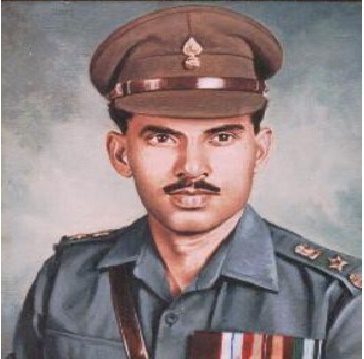
On 17 December, the enemy mounted a major battalion-level counter-attack, supported by intense artillery bombardment. During this critical phase, Major Hoshiar Singh was seriously wounded. Bleeding heavily and in great pain, he refused evacuation. Instead, he rallied his men once more and took personal charge of the defence. When an enemy shell knocked out a medium machine-gun post at a decisive moment, he crawled forward despite his injuries, manned the weapon himself, and poured devastating fire into the advancing enemy. The assault broke. The Pakistani force withdrew in disorder, leaving behind 85 dead, including their commanding officer and three other officers. Throughout the Battle of Basantar, Major Hoshiar Singh displayed gallantry of the highest order—an indomitable fighting spirit, unwavering leadership, and absolute devotion to duty. Despite grievous wounds, he remained with his men until the ceasefire was declared. The victory came at a heavy price: 33 soldiers of 3 Grenadiers laid down their lives, their sacrifice securing a decisive foothold across the Basantar and playing a crucial role in India’s success in the Shakargarh sector. For his most conspicuous bravery and outstanding leadership in the face of the enemy, Major Hoshiar Singh was awarded the “Param Vir Chakra”, India’s highest decoration for valour. The honour recognised not a single act, but days of unyielding courage under fire.
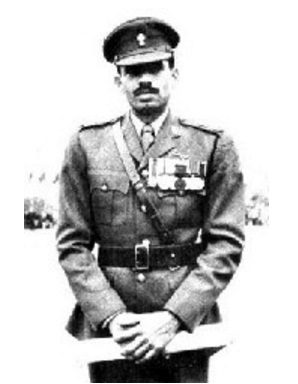
He was promoted to the substantive rank of Major on 30 June 1976, marking a new phase of responsibility and professional maturity in his military career. In this rank, he was selected for a two-year instructional tenure at the Indian Military Academy, Dehradun, where he played a vital role in shaping and mentoring future officers of the Indian Army. In recognition of his distinguished service record and leadership qualities, he was promoted to the rank of Lieutenant Colonel on 8 April 1983. Shortly thereafter, he was entrusted with the command of the 3rd Battalion of the Grenadiers, his parent unit—an honour that reflected the confidence placed in him by the Army’s leadership. He went on to attain the rank of full Colonel before reaching the age of superannuation, concluding a career marked by operational excellence, professional integrity, and commitment to soldiering. After completing 25 years of active service, he retired from the Indian Army on 31 May 1988. Settling in Jaipur, he embraced civilian life while remaining deeply connected to the armed forces ethos. He frequently visited his native village of Sisana, where he became a source of inspiration, motivating and guiding many young men to join the armed forces and serve the nation. He passed away following a cardiac arrest on 6 December 1998, at the age of 61. In recognition of his exemplary service and lifelong dedication to the nation, he was cremated with full military honours at Jaipur, bringing to a dignified close the life of a soldier who had served with distinction both in uniform and beyond.


AK Swami jaipur
2026 at 10:40 pmIn jaipur, queens road has been renamed in the memories of PVC Colonel hoshiar singh marg.
Dhanistha Choudhury
2026 at 10:40 pmA true hero
Dilawar Singh Sangwan
2026 at 10:41 pmA decent memorial in honour of one of he great warriors Brig Hoshiyar Singh. We salute him.
Dilawar Singh Sangwan
2026 at 10:42 pmA decent memorial is posted here remembering Brig Hoshiar Singh a great warrior of his times. We salute him.
Sudhir Choudhary
2026 at 10:44 pmAbove it says last rank was colonel, not Brigadier.
Devender Singh Dahiya
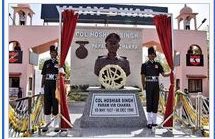
2026 at 10:43 pmA true hero. Yet there is no landmark related to him.
Ishwar Singh
2026 at 10:43 pmSalute to his bravery