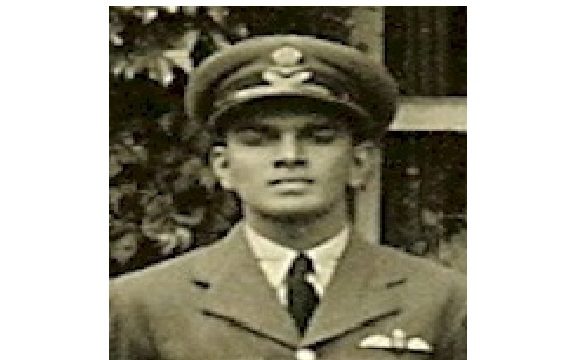

Service No : 1875 GD(P)
Date of Birth : October 20, 1921
Place of birth : Mumbai(Maharashtra)
Last Rank : Flight Lieutenant
Unit : 12 Sqn
Arm/Regt : Indian Air Force
Operation : Indo-Pak War 1947-48
Martyrdom : October 31, 1947
Flt Lt Clifford Joseph Mendoza
Flight Lieutenant Clifford Joseph Mendoza was born on 20 October 1921 in Dadar, Bombay (now Mumbai), Maharashtra, to Shri Charles Mendoza and Smt Grace Mendoza. He had three sisters—Estelle, Theresa and Phoebe (Estelle Mendoza Dias, Theresa Mendoza Athaide and Phoebe Mendoza Pimenta). Growing up in Bombay during the final decades of British rule, Clifford witnessed a period of significant change, marked by the global upheaval of the Second World War and the growing aspirations of India. Inspired by aviation and motivated by a desire to serve in uniform, he chose a career in military aviation and joined the Royal Indian Air Force (RIAF), becoming part of the pioneering generation of Indian military aviators. After completing his initial education, Clifford was selected for pilot training in the Royal Indian Air Force. He was commissioned as a Pilot Officer on 5 April 1942, at the young age of 21, during the height of the Second World War, when the RIAF was rapidly expanding to meet wartime requirements. He underwent rigorous training as part of the 12th Pilots' Course, qualifying as a fighter pilot. His training involved developing proficiency in flying, navigation, instrument flying and operating aircraft under demanding weather and operational conditions.
Upon earning his wings, Pilot Officer Mendoza commenced operational service with the Royal Indian Air Force. He was first posted to No. 9 Squadron in September 1944, serving there until December 1944. During this period, he gained valuable experience flying military missions that were vital to wartime logistics and operational support. In December 1944, he was transferred to No. 8 Squadron, where he continued serving until November 1945. His tenure with the squadron further strengthened his experience in military flying, preparing him for greater operational responsibilities. By this stage of his career, he had established himself as a capable and dependable pilot. In November 1945, Flight Lieutenant Mendoza was posted to No. 12 Squadron, which operated the dependable Douglas Dakota transport aircraft. The Dakota had become one of the most important military transport aircraft of the era, renowned for its versatility in carrying troops, supplies, ammunition, and evacuating casualties across difficult terrain. Flying the Dakota required sound judgment, precise navigation, and the ability to operate from makeshift airstrips under demanding conditions—qualities that Mendoza steadily developed through his service.
By the time India attained Independence in 1947, Flt Lt Clifford Mendoza had completed nearly five years of dedicated service in the Royal Indian Air Force. However, his experience would soon be tested under far more challenging circumstances. In October 1947, when Pakistan-backed tribal forces invaded Jammu and Kashmir, the newly independent Indian Air Force was called upon to undertake one of its most critical missions. As an experienced Dakota transport pilot with No. 12 Squadron, Flight Lieutenant Mendoza became part of the airlift operations that would prove decisive in defending Kashmir, carrying troops, equipment, and essential supplies into the conflict zone under hazardous operational conditions.
Air Transport Mission (Indo- Pak War): 31 Oct 1947
During 1947, Flight Lieutenant Clifford Joseph Mendoza was serving with No. 12 Squadron of the Indian Air Force, based at Air Force Station Agra. The squadron occupied a unique place in the history of the Indian Air Force. Raised in 1945 on Spitfire fighter aircraft under the command of Squadron Leader Syed Naseem Haider, it soon became the first Indian Air Force squadron to convert from fighters to transport operations. In August 1947, shortly after India's Independence, the squadron relocated to Agra and began operating Airspeed Oxford trainers and the versatile Douglas Dakota transport aircraft, which would soon play a decisive role in one of independent India's first military campaigns. Barely two months after Independence, Pakistan-backed tribal forces, supported by the Pakistani military, launched an invasion of the princely state of Jammu and Kashmir in October 1947. The sudden assault threatened Srinagar and the entire Kashmir Valley, compelling India to undertake an immediate military response. The Indian Air Force became the lifeline of these operations, executing continuous airlift missions to transport troops, weapons, ammunition, supplies, and reinforcements into the conflict zone. These operations, carried out under hazardous flying conditions over mountainous terrain, proved crucial in enabling the Indian Army to halt the advance of the invading forces.
No. 12 Squadron, commanded by Wing Commander Karori Lal Bhatia, became one of the principal transport units engaged in these operations. Flying repeated sorties between Agra, Jammu, Srinagar, and other forward locations, the squadron's Dakota aircraft operated with little margin for error amid unpredictable mountain weather, narrow valleys, and limited navigational aids. Among the experienced transport pilots entrusted with these demanding missions was Flt Lt Clifford Joseph Mendoza. On 31 October 1947, Flt Lt Mendoza was assigned one such vital operational sortie. He took off from Jammu in Dakota C-47 (MA-965) as part of an important transport mission supporting the ongoing operations in Kashmir. Serving alongside him were Flying Officer T. R. Peters, the co-pilot, and Flying Officer Umesh Sunder Thonse, the navigator. The remaining members of the aircrew included Warrant Officer Patrick Hart, Sergeant Om Prakash Kacker, Leading Aircraftman Madan Prakash, Leading Aircraftman Bal Krishna Bakshi, and Leading Aircraftman R. Singh. After departure, while flying through the formidable Pir Panjal mountain range between Jammu and Srinagar, the aircraft is believed to have developed a serious technical problem. Soon afterward, all communication with the aircraft was lost. Operating in one of the most inaccessible mountain regions of the Himalayas, the Dakota disappeared without a trace.
The disappearance immediately triggered an extensive search-and-rescue operation by the Indian Air Force. Aircraft repeatedly searched the mountains and valleys for signs of the missing Dakota, but the rugged terrain, dense forests, and adverse weather made the effort extraordinarily difficult. Despite every attempt, no trace of the aircraft could be found, and after several days, the search had to be called off, leaving the fate of the crew and passengers an enduring mystery. For nearly thirty-three years, the aircraft remained missing. In June 1980, walkers exploring an isolated part of the Pir Panjal mountains discovered the wreckage of the long-lost Dakota. Recovery teams subsequently reached the site, and some of the remains of the fallen air warriors were recovered during August 1980, finally bringing closure to one of the Indian Air Force's earliest wartime tragedies. The crash claimed the lives of 25 Indian Air Force personnel. Besides Flt Lt Clifford Joseph Mendoza, Fg Offr T. R. Peters, and Fg Offr Umesh Sunder Thonse, those who made the supreme sacrifice included Warrant Officer Patrick Hart, Flight Sergeant H. K. Singh, Sergeant Om Prakash Kacker, Sergeant John Stephen, Corporal I. S. Jesudasan, Corporal Huligole A. Srinivas, Corporal Kartar Singh, Leading Aircraftman Madan Prakash, Leading Aircraftman Bal Krishna Bakshi, Leading Aircraftman R. Singh, Leading Aircraftman K. S. Gandarde, Leading Aircraftman Srinivasan, Leading Aircraftman J. M. R. John, Leading Aircraftman S. Singh, Leading Aircraftman M. Singh, Leading Aircraftman Mohan Singh, Leading Aircraftman Suresh Jha, Leading Aircraftman R. Singh, Leading Aircraftman N. G. Chowdhury, Leading Aircraftman Jai Pal Singh, Leading Aircraftman Namburi Narayan, and Leading Aircraftman Om Prakash Sharma.
On 11 June 1981, after the recovery and identification process, a joint military funeral was conducted with full honours for the 25 Indian Air Force personnel, paying a long-overdue tribute to the brave air warriors who had remained missing for more than three decades. Flt Lt Clifford Joseph Mendoza was only 26 years old when he made the supreme sacrifice. A highly capable transport pilot and a dedicated air warrior, he laid down his life while carrying out a critical operational mission during the first India-Pakistan War of 1947-48.

Cherelyn
2026 at 10:52 amFlt Lt Clifford Joseph Mendoza Mother was Grace Mendoza & Father was Charles Mendoza.
He is my Uncle (mother’s brother)
He had 3 surviving sisters Estelle Mendoza Dias , My mother Theresa Mendoza Athaide and Pheobe Mendoza Pimenta .
& this give time ( 2026 ) all his sisters and their spouses have passed away .
Ltd Clifford Mendoza has nieces & nephews & grand nieces & nephews some of who to this day, live in Dadar Mumbai 400028 in Flt Ltd Clifford Mendoza hometown and the rest of the family scattered in different parts of the world ,we visit our ancestral home and keep in touch as a close knit family.
We are extremely proud of our Dearest precious Uncle who lost his life in the line of duty. My darling grandmother Grace Mendoza always hoped and prayed for her son our Uncle Clifford would return home some day .The search and rescue operation ,although all efforts were put into it was
unsuccessful, due mountainous region and snow capped rough terrain . Grandma Grace sadly passed away in 1965.
In 1981 the crash was found by a mountaineering expedition.
All efforts were made by our IAF to contact the families of the soldiers .A full honour’s funeral was held in Delhi 1981 where all the next of kin families of our great soldiers were present and their last rites were done in great honor and respect.
We are very proud of our Uncle Clifford and every single of his fellow soldiers who lost their lives as well as every other soldier who has laid their lives & fought for our country .
Jai Bharat ,