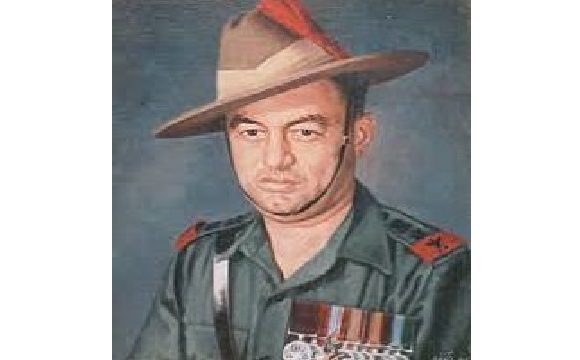

Service No : IC-7990
Date of Birth : April 28, 1928
Place of birth : Shimla, Dist (HP)
Service : Army
Last Rank : Lieutenant Colonel
Unit : 1/8 GR
Arm/Regt : 8 Gorkha Rifles
Operation : Indo-China War 1962
Awards : Param Vir Chakra
Lt Col Dhan Singh Thapa PVC
Indo-China War : Oct 1962
In 1962, against the backdrop of rising tensions that culminated in the Sino-Indian War, the Indian Army implemented a forward policy to assert its presence in strategically sensitive areas of Ladakh. As part of this policy, a series of isolated posts was established to monitor and counter increasing Chinese incursions. One such vital position was the Sirijap–1 post, located to the north of Pangong Lake. Its location made it crucial for the defence of the nearby Chushul airfield, a key logistical and operational hub. The Sirijap–1 post was manned by a small detachment from the 1st Battalion, 8 Gorkha Rifles, specifically ‘D’ Company. Due to the need to deploy troops across multiple forward positions, only 28 soldiers were stationed at Sirijap–1 under the command of Major Dhan Singh Thapa. Despite their limited strength and the exposed nature of their position, the troops remained resolute and prepared for any eventuality. In the early hours of 20 October 1962, the post came under a fierce and sustained assault by Chinese forces. The attack began with intense artillery and mortar bombardment that lasted for over two hours. The heavy shelling caused widespread destruction—communication lines were severed, bunkers were damaged, and the entire area was engulfed in flames. Amidst this devastation, Major Thapa and his men stood firm, returning fire with determination and inflicting significant casualties on the advancing enemy.
As the battle raged on, the situation at Sirijap grew increasingly dire. The relentless bombardment reduced the post to ruins, and many soldiers were killed or severely wounded. Despite witnessing heavy losses and the deteriorating condition of his defences, Major Thapa continued to inspire his men, urging them to hold their ground and fight with courage. Under his leadership, the Gorkha soldiers displayed extraordinary grit and resilience. Fighting with unmatched ferocity, they repulsed multiple waves of enemy attacks, often picking up the weapons of their fallen comrades and charging into battle with their regimental war cry, “Jai Mahakali, Ayo Gorkhali.” Undeterred by earlier setbacks, the Chinese launched a final, overwhelming assault, this time supported by tanks and superior numbers. By then, the defenders had exhausted most of their ammunition, and their positions had been severely weakened. Nevertheless, they continued to resist until they were completely overrun. Major Thapa and the few surviving soldiers were eventually captured and taken as prisoners of war. In the confusion and chaos of battle, he was initially presumed to have been killed in action. In recognition of his conspicuous bravery, indomitable leadership, and supreme sacrifice, he was awarded India’s highest gallantry award, the "Param Vir Chakra" posthumously.
During his captivity, Major Thapa was reportedly subjected to harsh treatment in violation of established norms governing prisoners of war. Despite facing considerable hardship and pressure, he refused to yield or make statements against his country. His steadfastness under such circumstances further underscored his exceptional character and devotion to duty. He was eventually repatriated in May 1963, after which it became known that he had survived the battle. He continued to serve the Indian Army with distinction, rising steadily through the ranks by virtue of his professionalism, leadership, and unwavering commitment to duty. He was promoted to the substantive rank of Major on 21 February 1964 and later elevated to the rank of Lieutenant Colonel on 28 February 1970. After a long and illustrious career in uniform, he retired from the Army on 30 April 1980. Following his retirement, he settled in Lucknow, where he remained actively engaged in civilian life. For a brief period, he served as a Director with Sahara Airlines, contributing his experience and leadership beyond military service. Deeply connected to the Armed Forces and the nation, Lieutenant Colonel Thapa maintained a lifelong association with military traditions. In a remarkable testament to his enduring spirit, he regularly attended the Republic Day Parade in New Delhi every year from 1962 to 2004, reflecting his unwavering bond with the Army and the country he had served with such dedication. On 5 September 2005, he passed away in Lucknow after battling kidney failure. He was 77 years old. His passing marked the end of a life devoted to service, honour, and the highest ideals of the Indian Army, leaving behind a legacy that continues to inspire generations.
Lieutenant Colonel Dhan Singh Thapa is survived by his three daughters—Ms Pamela, Ms Madhulika, and Ms Poornima—and his son, Param Deep Thapa.

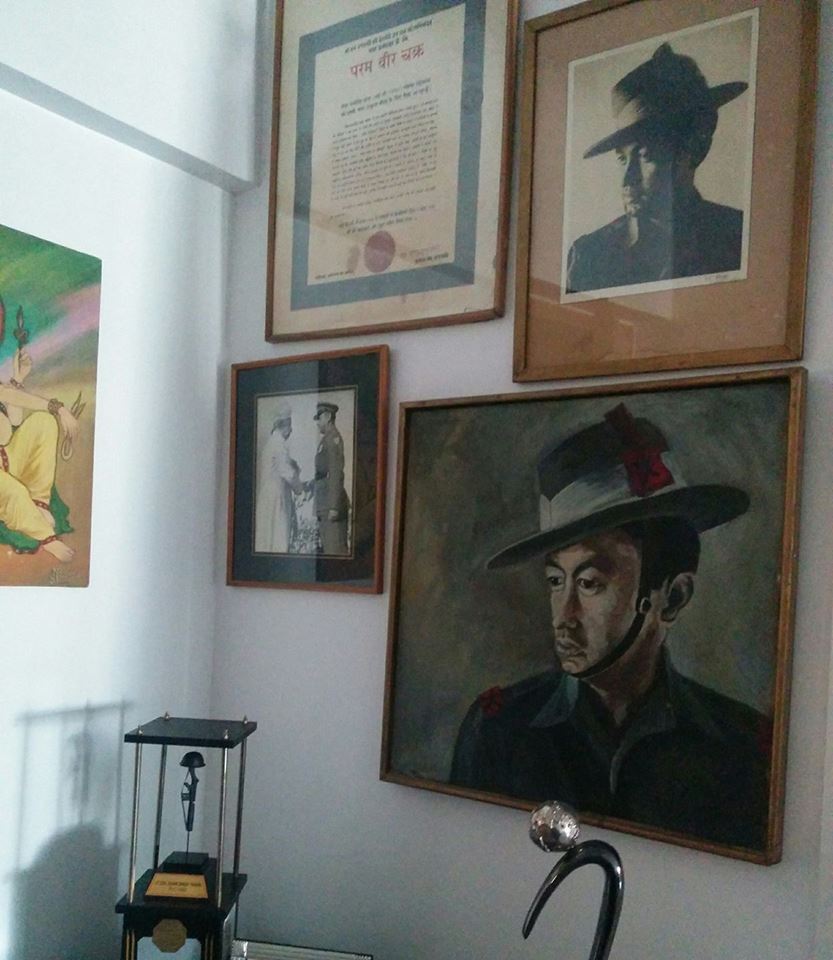



Col JP Singh
2026 at 1:35 pmHow can I contact Param Deep Thapa S/O Lt Col Dhan Singh Thapa PVc
Col( Dr) JP Singh
Chandra Bahadur Gurung
2026 at 1:39 pmIn fighting with the Chinese troops, Captain Dhansing thapa finally missed from the battlefield. The CO of 1/8th Gorkha Rifles recommended that ‘he was died while fighting with the enemy. But reason was not so. The action was wrongly reported. On the recommendation of Indian Ministry of Defense Thapa was posthumously awarded PVC (Param Bir Chakra), the highest gallantry of India. His wife was awarded the award on 26 January 1963, on the occasion of as a widow from the hand of the then President Dr. Sarbapalli Radha Krishnan.
However, when the POW (prisoners of war) were exchanged, Dhansing Thapa was seen alive. In the war to be POW is a crime. In the war one should do or die. It was fake news of the Indian Defense Ministry.
But the Indian government did not correct their mistake and written the history glorifying heroism of Gorkha regiment of the Indian army.
I would like to mention here a incident that happened in Kathmandu. On 5th. January 1994, I had arranged a program in honored of 13 Gurkha Victoria Cross recipient, the highest gallantry award of the British army. During the time there were still 7 VC recipient.
In the occasion there were 6 VC recipient of the WW 2, namely Hav. Gaje Ghale, Naik Agansing Rai, Rifleman Ganju Lama, Rifleman Tulbahadur Pun, Rifleman Bhanubhakta Gurung, Rifleman Lachhiman Gurung.
Post world war 2, Lance Corporal Ram Bahadur Limbu, awarded VC in Sarwak operation.
There was a huge pressure mounted on me from the Indian Embassy Kathmandu that Captain Dhansing Thapa also should have to include in the felicitation program. The VC Executive Committee decline the request on the ground that it was entirely VC felicitation program, so it would not fair to include Captain Dhansing’s name here. But in the same time we received the message that the Chief Guest for the program, the then Prime Minister Girija Prasad Koiral would not able to attend the program. Now the situation was that the schedule program would might cancel. So, on the Indian Embassy pressure we accepted.
The main reason was that the Indian Embassy intended to show that while fighting with China, Thapa was awarded the PVC.
Dhansing Thapa PVC attended the function. In the function I was the Master of Ceremony. In the huge crowd at Pragya Bhaban Kamaladi, I expressed him that ‘today Dhansing thapa as a person, we welcome him in this gathering. His wife posthumously awarded this award. A POW soldier cannot eligible for the award.
After the program next day Dhansing Thapa left Kathmandu and the Indian Embassy him India. He did not took part in Pokhara program.
This is a very simple example how Indian government plays role through embassy in Nepal.
Thanks reading the Indian army highest gallantry award Param Vir Chakra PVC.
Capt. Anupam K Choubey
2026 at 1:40 pmAn Honored Salute to you Col. Thapa . I wish I had my commission before 1980 to serve in your command. Even in 1983-84 you get the embedded bullets in trees in Twang
eastern sector area posts.
Sanjay
2026 at 1:41 pmJab tak Suraj Chand rahega, Dhan Singh Thapa tera naam rahega…. My respect & 1000 salute to the brave son of mother India
Rakesh Tokarkar
2026 at 1:41 pmI salute your secrifice for the sake of nation. You are real hero and ideal for everyone in India.
Subodha Dhiman
2026 at 1:41 pmYou always staying in my heart.
Respect
Glorie Mathew
2026 at 1:42 pmI salute your heroism and sacrifice. We shall forever remain indebted to you for your service to the nation. Jai Hind
Surajit Mohapatra
2026 at 1:42 pmWe salute Lt Col Thapa for his courage to fight Chinese army even when outnumbered by them. He has shown what Indian defense personal are made off. We must tell our kids these types of courageous acts of our true soldiers.