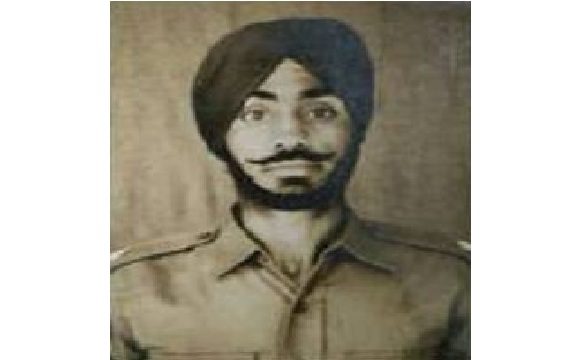

Service No : IC-26235K
Place of birth : Sangrur Dist (Punjab)
Service : Army
Last Rank : Major
Unit : 17 Punjab
Arm/Regt : The Punjab Regiment
Operation : CI & IS Ops
Awards : Kirti Chakra
Martyrdom : June 25, 1979
Major Sukhdev Singh KC
During June 1997, Major Sukhdev Singh's unit, 17 Punjab Battalion, was deployed in J&K and was engaged in operations against the militants regularly. The AOR(Area of Responsibility) of the unit comprises the Anantnag district, which was a hotbed of militant activities. Thus, the unit troops had to be on guard at all times and undertook counter-insurgency operations frequently. Based on intelligence inputs, the 17 Punjab Battalion was tasked to move into Bokaro in present-day Jharkhand state on the night of 24 June 1979 to deal with a grave internal security situation. A group of Central Industrial Security Force (CISF) personnel had defied government orders, seized control of the armoury, and entrenched themselves within the barracks. The seriousness of the situation was heightened by the large cache of weapons and ammunition under their control, which included approximately 400 rifles, 61 pistols, 24 privately owned weapons, and nearly 24,000 rounds of ammunition. Anticipating a confrontation, the defiant personnel had converted the barracks and armoury into a well-defended stronghold. The area was fortified with wire obstacles and ditches to impede movement, while sandbag bunkers had been constructed on rooftops and along first-floor windows, providing them with effective firing positions and clear fields of observation.
The battalion swiftly established a cordon around the complex to isolate the insurgent group and prevent any breakout. Major Sukhdev Singh, who was commanding a company assigned to the operation, took charge of efforts to secure a peaceful resolution. Displaying restraint and professionalism, he repeatedly called upon the CISF personnel to lay down their arms and surrender. However, his appeals were met with open hostility. Instead of complying, the occupants responded with a heavy volley of fire from the armoury and adjoining fortified positions. Undeterred, Major Sukhdev Singh continued to make repeated attempts to negotiate, prioritising the avoidance of unnecessary bloodshed. Each appeal, however, was answered with increasingly intense rifle fire. Even a final appeal made at 0430 hours was firmly rejected. In a defiant gesture, the armed personnel challenged him to attack and capture the armoury. With all avenues for a peaceful resolution exhausted, Major Sukhdev Singh was left with no option but to initiate an assault. He ordered his company to return fire and launched a carefully coordinated operation to seize the armoury and neutralise the threat. True to the highest traditions of military leadership, he chose to lead his men from the front, fully aware of the risks involved.
At approximately 0520 hours, as the assault gained momentum, Major Sukhdev Singh advanced with his troops towards the objective. In the face of intense enemy fire, he pressed on with determination and courage. During this advance, he was struck by a bullet and made the supreme sacrifice in the line of duty. Through his actions, Major Sukhdev Singh displayed conspicuous bravery, indomitable resolve, and an unwavering sense of duty. His leadership under fire and his willingness to place himself in harm’s way to accomplish the mission stand as a shining example of the highest standards of military service. Major Sukhdev Singh was given the nation’s second-highest peacetime gallantry award, “Kirti Chakra” for his outstanding bravery, fighting spirit, camaraderie and supreme sacrifice. Besides Major Sukhdev Singh, two of his comrades—Sepoy Manjit Singh and Sepoy Jaswinder Singh (who later succumbed to his injuries on 28 June 1979)—also made the supreme sacrifice during this operation. In recognition of their exemplary courage and devotion to duty, both soldiers were posthumously awarded the Shaurya Chakra.
Major Sukhdev Singh is survived by his son, Shri Sukhwant Singh Ghuman.
No Comments