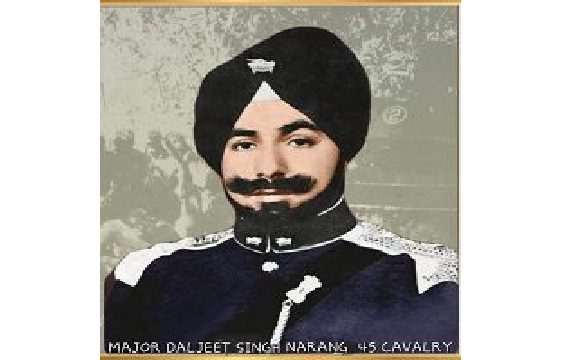

Service No : IC-8140
Date of Birth : May 20, 1935
Place of birth : Peshawar, Pakistan
Service : Army
Last Rank : Major
Unit : 45 Cavalry
Arm/Regt : The Armoured Corps
Operation : Op Cactus Lily
Awards : Maha Vir Chakra
Martyrdom : November 21, 1971
Major Daljit Singh Narag MVC
Major Daljit Singh Narag was born on 20 May 1935 in Peshawar (now in Pakistan). Drawn to a life of service from a young age, he joined the Indian Army on 9 December 1956, at the age of 21. On the same day, he was commissioned into the Deccan Horse (9 Horse), one of the most distinguished armoured regiments of the Indian Army, marking the beginning of a career defined by professionalism and dedication. Over the years, Major Narag steadily rose through the ranks, earning the respect and confidence of his superiors and men alike. Known for his leadership qualities, sound judgment, and unwavering commitment to duty, he proved himself both in training and operational assignments.
By November 1971, against the backdrop of escalating tensions on India’s eastern borders, Major Narag was serving with 45 Cavalry and was commanding ‘C’ Squadron in the Jessore sector. At that time, 45 Cavalry was based at Kanchrapara in the 24 Parganas district of West Bengal. The regiment was equipped with PT-76 amphibious light tanks of Russian origin, which provided a unique capability for operations in riverine and marshy terrain—an important factor in the eastern theatre. These tanks were later replaced by the more powerful T-55 Main Battle Tanks, significantly enhancing the regiment’s combat potential. As the situation in East Pakistan deteriorated in the lead-up to the Indo–Pakistan War of 1971, 45 Cavalry was deployed in the eastern sector to counter the growing military threat.
Eastern Sector (Indo–Pak War): 21 Nov 1971
Even before the formal outbreak of the Indo-Pak War of 1971, frequent clashes were taking place along the India–Pakistan border, particularly on the Eastern Front. One such critical area was Garibpur village, situated at a crucial crossroads that controlled the highway from India to Jessore. Securing this junction was vital for future operations. In November 1971, Major Daljit Singh Narag was commanding ‘C’ Squadron of 45 Cavalry, equipped with PT-76 tanks, operating in the Jessore sector. On 20 November, his squadron was tasked to establish a roadblock in the Garibpur–Chaugacha area, in coordination with 14 Punjab Battalion, to contain Pakistani intrusion into Indian territory. The squadron firmed up in the general area of Garibpur in preparation for the operation.
On the morning of 21 November 1971, Pakistani forces launched a strong counter-offensive. An enemy brigade, supported by an independent armoured squadron equipped with M-24 Chaffee light tanks, attacked the Indian positions with numerical superiority. Despite the odds, Major Narag deployed his squadron with great tactical skill, sending his tanks forward to ambush the advancing enemy while the infantry held defensive positions. A fierce tank battle ensued at very close quarters, fought under poor visibility due to dense fog. Standing fearlessly on the turret of his tank, Major Narag personally directed the battle, skilfully manoeuvring his squadron under intense enemy fire. When one of his squadron’s tanks was hit, he immediately rushed forward—at grave personal risk—to help the crew evacuate, before returning to his own tank and continuing to lead the engagement. Inspired by his extraordinary courage and leadership, the troops fought with exceptional determination. In the course of the battle, ‘C’ Squadron destroyed 10 enemy tanks and later knocked out four more, while losing three tanks of their own. The Pakistani armoured thrust was decisively blunted, inflicting heavy casualties and halting the enemy advance.
While leading his men in the thick of battle, Major Daljit Singh Narag was fatally hit by enemy machine-gun fire and attained martyrdom atop his tank. His heroic leadership and supreme sacrifice played a decisive role in one of the most remarkable armoured engagements of the war. About the battle for Garibpur fought by Major Daljit Singh Narag’s squadron, it is said that “there are a few parallels in the history of armoured warfare where one armoured squadron was engaged & annihilated by an armoured force of equal strength at such little cost in terms of tank and personnel casualties.” Throughout this action, Major Daljit Singh Narag displayed outstanding leadership, indomitable courage, and unwavering devotion to duty. His bravery and supreme sacrifice are in the finest traditions of the Indian Army.
Major Daljit Singh Narag was given the nation’s second highest gallantry award, “Maha Vir Chakra” for raw courage, unfaltering leadership and supreme sacrifice.
Sandeep kaushal
2025 at 4:38 pmMy Mama ji Retd. Capt. Prem Chand was his tank driver.
Mama ji still remember entire episode.
Jai Hind
Muhammad Mamunur Rashid
2025 at 4:39 pmSaulte to the Martyr Major Daljit Singh Narag who sacrificed himself for the liberation of Bangladesh on 21.11.1971. He did not return to his homeland, to his near and dear one alive. However, he definitely made Indians proud by embracing martyrdom.
Today is 22.11.2023. I am watching the Indian war movie Pippa 2023 in Amazon Prime OTT platform.
Movva. Lalitha Kumari
2025 at 4:39 pmI know Major Daljeet Singh Narang when I was eight years old. He was working in Guntur – Andhra Pradesh. He use to stay in our opposite house & we (we were six siblings) use to visit him very often. I remember he use to play with us & give chocolates. His death was great shock us then.
Dr Manish Bhatnagar
2025 at 4:40 pmGratitude
Ronie Bhasin.
2025 at 4:40 pmRespected Officers,
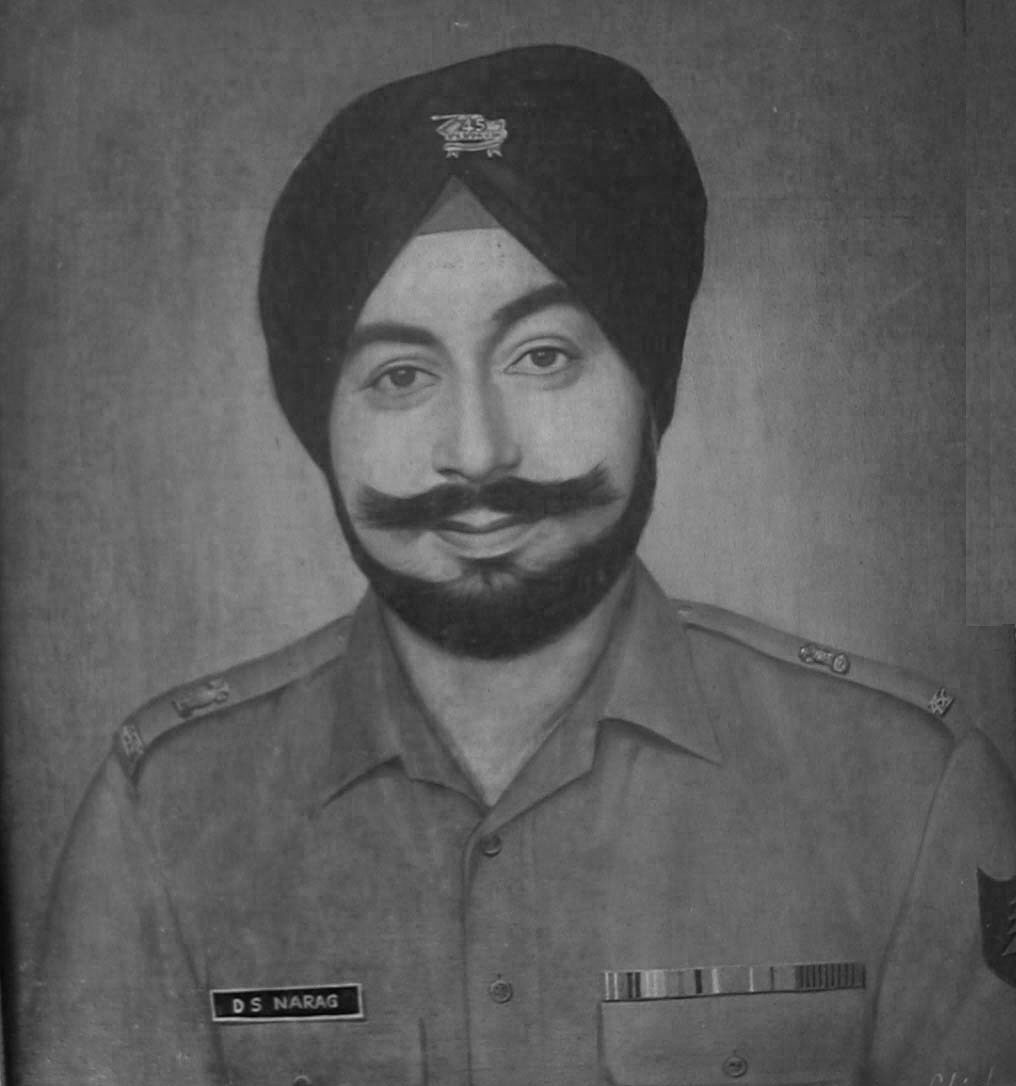
Would like to point out that the surname of the said person mentioned is not Narang but Narag. Please correct in the records.
Thanks and Salutations to the armed forces.
Regards/ Ronie Bhasin.
# 9810012696.
Dr.Tejwant Rajkhowa
2025 at 4:41 pmBe was my maternal uncle and the surname goes as Narag as has rightfully been pointed out by Mr.Ronnie Bhasin.Thank u
Poonam Coshic
2025 at 4:41 pmYou fought like a true son of the soil sir!!! My sincere gratitude to you and your family. Jai Hind