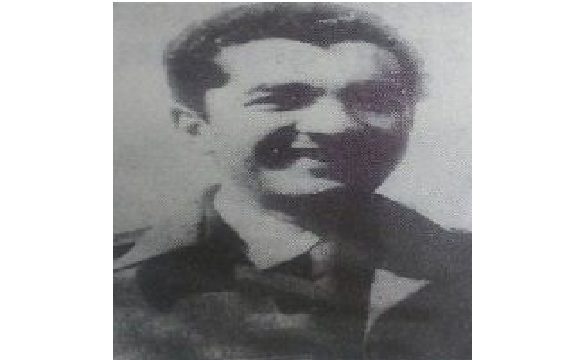

Service No : IC-6850
Date of Birth : March 6, 1931
Place of birth : Mangrol Dist (Guj)
Service : Army
Last Rank : Major
Arm/Regt : The Armoured Corps
Operation : Indo-Pak War-1965
Awards : Vir Chakra
Martyrdom : September 12, 1965
Major Mohammed Ali Raaz Sheikh VrC
Major Mohammed Ali Raaz Sheikh was born on 6 March 1931 in the Gandhinagar district of Gujarat. He hailed from a distinguished princely family of Mangrol, a background that instilled in him a deep sense of duty, discipline, and commitment to service from an early age. He received his early education in Rajkot, where he displayed notable qualities of leadership, determination, and a strong sense of purpose. Motivated by a desire to serve the nation, he qualified for admission to the prestigious Indian Military Academy at Dehradun, one of the foremost training institutions for officers of the Indian Army. Upon successfully completing his rigorous military training, he was commissioned as a Second Lieutenant on 6 June 1954. He was inducted into the 16th Light Cavalry, a distinguished regiment of the Armoured Corps—the principal combat arm of the Indian Army responsible for mechanised warfare and tank operations. In the course of his service, he underwent extensive training in armoured tactics, mobility, and battlefield coordination, gaining proficiency in operating a wide range of tanks and armoured vehicles. The 16th Light Cavalry has a long and illustrious history. Originally raised in 1776 as a cavalry regiment of the British Indian Army, it is among the oldest armoured regiments in India. Over the years, the regiment has participated in numerous campaigns, ranging from the Second Anglo-Mysore War to World War II. Following India’s independence, it was reconstituted as part of the Armoured Corps and continued to uphold a distinguished combat record. The regiment later earned several battle honours, including “Punjab 1965” during the Indo-Pakistani War of 1965, reflecting its enduring legacy of courage and operational excellence.
Over the next decade, Major Sheikh served in diverse operational environments, steadily building his experience and professional competence. His dedication, leadership qualities, and tactical acumen earned him steady promotions, and by 1965, he had risen to the rank of Major after more than ten years of distinguished service. By this time, he had established himself as a capable and dependable armoured corps officer, well-versed in the complexities of mechanised warfare and prepared to take on greater responsibilities in active operations.
Operation Nepal (Indo-Pak War) : 08 Sep 1965
During 1964–65, Major Mohammed Ali Raaz Sheikh was serving as the Aide-De-Camp (ADC) to General J N Chaudhuri, the Chief of Army Staff of the Indian Army. This appointment, reserved for officers of exceptional promise and reliability, provided him with valuable exposure to higher military leadership and strategic decision-making at the national level. However, as tensions between India and Pakistan escalated in 1965, Major Sheikh returned to his parent regiment, eager to rejoin his unit in the field as the nation prepared for impending conflict. With the outbreak of the Indo-Pak War of 1965, his unit the 16th Light Cavalry, was deployed along the western front as part of the Indian Army’s operational plan. Major Sheikh’s unit, 16 Cavalry, was part of 1 Armoured Brigade, which in turn functioned under Indian I Corps, the Army’s principal strike formation tasked with launching a decisive counter-offensive during the 1965 Indo-Pak War. In the larger operational context, Pakistan had initiated a two-phase strategy. Phase I, Operation Gibraltar, aimed at infiltrating battalion-strength groups of irregulars led by Pakistan Army officers into Jammu & Kashmir to incite insurgency and civil unrest. When this failed to achieve the desired uprising, Phase II, Operation Grand Slam was launched on 1 September 1965. This offensive, spearheaded by a division supported by two armoured regiments in the Chamb–Jaurian sector, made rapid gains—Chamb fell by 2 September, Pakistani armour crossed the Manawar Tawi on 3 September, and Jaurian was captured on 4 September. The strategic objective of Akhnoor, a critical communication hub, lay just 18 km away.
To counter this grave threat, the Indian Army decided to relieve pressure in the Akhnoor–Jammu sector by opening a new front. Accordingly, I Corps launched a major counter-offensive in the Shakargarh Bulge on the night of 7 September 1965. This operation, often referred to as Operation Nepal, was complemented by Operation Riddle in the Lahore–Kasur sector, thereby forcing Pakistan to divert its reserves. Within this framework, 1 Armoured Brigade, comprising elite regiments including 16 Cavalry, played a pivotal role. The brigade was tasked with advancing along the southern axis towards Phillora, a key objective that would disrupt Pakistani defensive depth and armour concentration. On the night of 7 September, Indian forces crossed the International Border. 6 Mountain Division secured initial bridgeheads, with formations like 99 Brigade capturing Charwa and 69 Infantry Brigade advancing through successive objectives including Maharajke, Niwe Wains, Unche Wains, and Bajragarhi. By midday on 8 September, a firm lodgement had been established, enabling the induction of armoured forces for breakout operations. It was at this critical juncture that 16 Cavalry, under 1 Armoured Brigade, was committed to battle.
Major Sheikh was entrusted with the command of ‘A’ Squadron at a critical juncture, when the regiment was tasked to spearhead the advance of the 1st Armoured Division into enemy territory. In the early hours of 8 September 1965, the regiment crossed the International Border and commenced its advance into Pakistan. Leading from the front, Major Sheikh displayed exceptional dash and determination as he guided his squadron forward with speed and precision. Overcoming scattered resistance and maintaining the momentum of the attack, his squadron, along with other elements of the regiment, reached the vicinity of Gadgor village by around 0900 hours. What followed was a prolonged and intense armoured engagement. Between 0930 and 1430 hours, fierce tank-to-tank battles were fought against well-entrenched enemy forces. The opposing troops, later identified as elements of Pakistan’s 25 Cavalry, had occupied well-concealed defensive positions around Gadgor, temporarily halting the Indian advance. Despite this tactical disadvantage, the 16th Light Cavalry pressed forward with determination. During the course of the battle, the regiment—including Major Sheikh’s squadron—inflicted heavy losses on the enemy, destroying eight Patton tanks, two recoilless (RCL) guns, and causing significant casualties among enemy infantry. As the engagement intensified, ‘B’ Squadron continued its frontal assault towards Phillora, while ‘A’ Squadron, under Major Sheikh, was tasked with executing a bold outflanking manoeuvre from the south-west. Fully aware of the risks, Major Sheikh chose to lead the manoeuvre personally from the front. In doing so, his tank was the first to draw enemy fire, and he was grievously wounded. Despite sustaining severe injuries to his neck and right shoulder, he refused to withdraw. Displaying extraordinary courage and steadfast resolve, he continued to command and direct his squadron, ensuring that the momentum of the attack was maintained. His leadership at this critical juncture proved instrumental in sustaining pressure on the enemy and enabling the regiment to continue its advance.
Major Mohammed Ali Raaz Sheikh is survived by his wife Smt Ayesha Sheikh.
Capt Padam Singh now living in the UK
2026 at 9:56 pmI was a troop leader in 16 Lught Cavalry, during the ’65 war with Pakistan and was wounded on 12th Srp at Maharajke. It was sad to lose Maj Sheikh. The same day we lost 2nd Lt V K Kaista, another daring officer right on the front line.
Jeetu
2026 at 9:57 pmHow do you know so much about the awardee.
S THANAPALAN
2026 at 9:57 pmI know very well above history
Ex Ris S THANAPALAN of 16cav
Charanjit Singh
2026 at 9:58 pmHe deserved Maha vir chakra .
Jones Joseph
2026 at 9:59 pmIn reply to V. Raj.
His wife and daughters are there as also grandchildren. Wife and daughter and grandson in Gandhinagar
V. Raj
2026 at 10:00 pmAny if his relatives still in mangrol Or elsewhere in India?
Ali Adil Mahmood
2026 at 10:00 pmDate of martyrdom is 12 Sep 65. Passed away in hospital because of wounds. Wounded earlier in battle (11 Sep 65, I suppose). 08 Sep was the date of first major battle at Gadgor when 16 Cav led the advance of the Armoured Division into Pakistan.
Aravind,karanam
2026 at 10:00 pmMy fathers Name K.V.SUBBARAO NO,1030110
Aravind,karanam
2026 at 10:01 pmMy father belonged to 16th light cavalry
Aravind,karanam
2026 at 10:01 pmMy father was belonged to 16 th light cavalry his tank name is ayyanna I think so