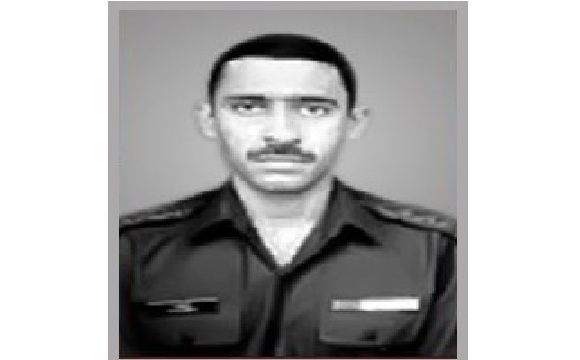

Service No : IC-55072K
Date of Birth : June 21, 1968
Place of birth : Hyderabad, Telangana
Service : Army
Last Rank : Major
Unit : 2 Raj Rif
Arm/Regt : The Rajputana Rifles
Operation : Op Vijay ( Kargil )
Awards : Maha Vir Chakra
Martyrdom : June 28, 1999
Major Padmapani Acharya MVC
Major Padmapani Acharya was born on 21 June 1968 into a distinguished Air Force family originally from Odisha, which later settled in Hyderabad, Telangana. He was the son of Wing Commander Jagannath Acharya (Retd.), a respected officer of the Indian Air Force who had actively served the nation during the 1965 and 1971 Indo–Pakistan wars, and Smt. Vimala Acharya. Growing up in a household deeply rooted in military values, he was profoundly influenced by his father’s service, discipline, and sense of duty. He shared a close bond with his brother, Padmasambhav Acharya, who would later also choose a life in uniform. From an early age, Maj Padmapani Acharya nurtured a strong aspiration to serve in the Armed Forces. This motivation steadily shaped his character as he grew up, instilling in him qualities of discipline, integrity, and commitment to the nation. Determined to follow his calling, he pursued his education with focus and, after completing his graduation, successfully cleared the rigorous selection process for the Officers' Training Academy (OTA), Chennai—one of the most prestigious training institutions of the Indian Army.
Major Acharya was commissioned as a Lieutenant after passing out from the 56th Short Service Commission (SS) Course. He was inducted into the 2nd Battalion of the Rajputana Rifles Regiment, a highly decorated and battle-honoured infantry regiment renowned for its operational excellence and valour. Upon joining his unit, he quickly proved himself to be a capable and resilient officer. Through professional competence, physical toughness, and an unwavering sense of responsibility towards his men, he earned their respect and trust. In 1998, Major Acharya married Ms Charulatha, beginning a new chapter in his personal life while continuing to serve with dedication. Around the same period, his brother Padmasambhav Acharya also joined the Indian Army and later participated in active combat operations during Operation Vijay, further reflecting the family’s enduring legacy of service to the nation. Beyond his professional life as a soldier, Major Padmapani Acharya was known for his intellectual depth. He was a voracious reader with a keen interest in a wide range of subjects, possessing a thoughtful and analytical mind. This blend of physical courage, professional competence, and intellectual curiosity distinguished him as a well-rounded officer and a true gentleman-soldier, embodying the finest traditions of the Indian Army.
Battle of Black Rock Complex (Kargil War): 28 June 1999
Major Padmapani Acharya was serving with the 2nd Battalion, Rajputana Rifles, commanded by M. B. Ravindranath, which formed part of 81 Mountain Brigade deployed in the Lolab Valley. In the early stages of the Kargil War, the battalion was inducted into the Drass sector on 04 June 1999. At the time, the battalion was operating under 56 Mountain Brigade, with overall operational control exercised by 8 Mountain Division, commanded by Mohinder Puri. In the aftermath of the Lahore Declaration (1999), the Pakistan Army surreptitiously occupied several winter-vacated Indian Army posts along the Line of Control. These intrusions were detected on 03 May 1999, prompting a swift and resolute response by India. On 26 May 1999, the Indian Air Force launched the first air-to-ground strikes, followed by Operation Vijay, aimed at evicting the intruders from Indian territory. The Indian Army rapidly mobilised its forces to regain control of the occupied heights. Following the successful capture of Tololing and Point 5140 by 20 June 1999, it became operationally imperative to sustain momentum and maintain pressure on the enemy. Detailed reconnaissance revealed that the capture of the ‘Three Pimples Ridge’, in conjunction with Point 4700, was essential in the first phase of operations. Thereafter, the capture of Point 5100 was required to dominate the Line of Control.
The Three Pimples Ridge, emanating from Point 5100 along the Marpo La ridgeline, dominated National Highway 1A, Drass town, and the Sando Valley. Its capture was crucial to pave the way for further operations towards Point 5100 and subsequently Point 5600, thereby isolating enemy intrusions east of Sando Nala. The complex—also known as the Black Rock complex—comprised Three Pimples, Lone Hill, Knoll, and Kajal, bifurcating into two distinct spur lines. The Point 4700 Ridge included Point 4700, Saddle, Tommy, Sangar, Rocky, and Junction Point. To achieve these objectives, a bold and carefully coordinated multi-directional attack, executed in two phases, was planned.
-
Phase I:
-
2 Rajputana Rifles was tasked to capture Knoll and Lone Hill, and establish contact with Junction Point by the early hours of 29 June 1999.
-
18 Garhwal Rifles was assigned the capture of Tommy, Saddle, and Point 4700 by the same morning.
-
-
Phase II:
-
2 Rajputana Rifles was to clear Three Pimples by midday.
-
16 Grenadiers was to exploit the gains and capture Junction Point by 30 June 1999.
-
Concurrently, 18 Garhwal Rifles was to capture Rocky and Sangar, and link up with 16 Grenadiers at Junction Point.
-
The coordinated assault by 2 Rajputana Rifles and 18 Garhwal Rifles commenced at 2030 hours on 28 June 1999. Soon after the attack began, the assault company of 2 Rajputana Rifles came under intense and accurate enemy artillery fire, resulting in heavy casualties. Major Padmapani Acharya, commanding ‘A’ Company, was entrusted with the formidable task of capturing a heavily fortified and strongly held enemy position, protected by minefields and covered by intense machine-gun and artillery fire. The success of the battalion and brigade operations depended critically on the early capture of this position. However, the attack nearly faltered at the outset when enemy artillery fire struck the leading platoon, inflicting severe losses. Demonstrating exceptional courage and leadership, and with complete disregard for his personal safety, Major Acharya took charge of the reserve platoon and personally led it forward through the relentless artillery barrage. Even as casualties mounted, he continuously motivated and inspired his men, charging up the steep, rocky face under withering fire. Undeterred by intense enemy resistance, he crawled forward towards the enemy bunker and lobbed grenades into the position at close quarters. During this daring assault, Major Acharya sustained grievous injuries. Despite being critically wounded and immobilised, he ordered his men to leave him behind and continue the assault, while he himself continued firing at the enemy to provide covering fire. Inspired by his indomitable spirit, the troops pressed on, overran the enemy position, and successfully secured the objective.
Major Padmapani Acharya, however, succumbed to his injuries and was martyred in action. Along with him, two other officers and ten soldiers of 2 Rajputana Rifles made the supreme sacrifice during the operation. The other fallen bravehearts were: Capt Vijayant Thapar, Capt Neikezhakuo Kenguruse, Hav SS Sengar, Hav Satyabir Singh, Nk Anand Singh, L/Nk Satpal Singh, L/Nk Vikram Singh, Rfn J S Shekhawat, Rfn Satyaveer Singh, Rfn Om Prakash, Rfn Jasvir Singh and Rfn Kanwar Pal Singh. For his extraordinary gallantry, inspiring leadership, and supreme sacrifice, Major Padmapani Acharya was posthumously awarded the nation’s second-highest gallantry decoration, the "Maha Vir Chakra", on 15 August 2000.
Major Acharya is survived by his father, Wg cdr Jagannath Acharya (Retd), his mother, Smt. Vimala Acharya, his wife, Smt. Charulatha Acharya and his daughter, Ms Aparijita. His life and sacrifice remain an enduring symbol of courage, selfless leadership, and unwavering devotion to the nation.






Subramanian Kavasseri
2024 at 3:49 pmToday I watched a youtube video of Maj Gen Mor interviewing Maj Padmapani Acharya’s daughter and Col Ashutosh Sharma’s brother.
It was touching to hear from the relatives of martyrs.
One small pointer to the admin of this site:
On the following webpage: https://www.honourpoint.in/kargil-vijay-diwas-1999-war/
in the Awardees link, it is wrongly mentioned that Col Ravindranath of 2 RAJ Rif was posthomously
awarded the Vir Chakra. He was very much alive after the victory at Tololing which was considered
the turning point of the Kargil war.
Saachi Shetty 4-A New
2024 at 3:52 pmSupreme salute to supreme sacrifice ..jai hind..
Mayra Asish, Roll No-14, New Horizon Gurukul
2024 at 3:55 pmDear Sir,
I am so proud that I come from the state of Odisha where you have your roots in. My mother read out your story to me and hope my words of gratitude reach you where ever you are right now.
People like you are the leading light for my generation and all the other many more after me. This Independence day I will raise my flag in your honour promising to live by the values that you have taught us. I had also the opportunity to read your last letter to your father. I live in the times when the art of writing letters is dying. The way describe the situation and your articulation of your thoughts is so inspiring.
I and my family will keep you and yours in our prayers.
Sathwik Gunta
2024 at 3:55 pmSalute to you Sir!!!
Riya Raj
2024 at 3:56 pmA big salute to real heroes “our soldiers” every Indian is proud of you.
Binay Kumar Sahu
2024 at 3:56 pmOur Armed Forces do not hesitate to sacrifice their lives to keep us safe in Cities , Towns , Villages , in the comfort zone of our houses . If only we the civilians perform our duties in our respective fields without fear or favour ; with out any discrimination against anybody on the basis of caste , creed, faith , language , region , social and economic status or blood relations that will be a fitting tribute to our WAR HEROES .
Are we prepared ?.
Binay Kumar Sahu
2024 at 3:57 pmIndian Armed Forces sacrifice their lives to keep our people safe in Cities ,Towns and Villages in the comfort Zone of our houses without any discrimination ; means safety and security for all irrespective of caste , creed , faith , occupation , language , social and economic status !
If our Civilians can perform just their duties without fear or favour , it will be a fitting tribute to our war heroes . Are we prepared?
Dev Akoijam.
2024 at 3:57 pmSalutations to this braveheart. We were next door neighbours at an Air Force Station called Mountain Shadow in Borjhar, Assam – near the Guwahati airport in the early 80s Padmapani – babloo – to us was 3 class junior to me in school. Got to know Padmapani’s father, Acharya uncle passed away on Dec 2017. RlP uncle.
Mamata Lakshmanna
2024 at 3:58 pmAmrapali thanks for the beautiful and touching story of your brother Major Padmapani Acharya , our Babloo. We all remember him and miss him. Our salute to the hero and his brave family.
Sunita dhonkaria sister of Kargil Martyr Capt Amit bhardwaj
2024 at 3:58 pmIt was great pleasure meeting the family of MAHAVEER ,few months back.The way legacy of the warrior is carried on is really commendable.Never felt met them for the first time,the love and affection we got from them.
It’s the great support of the family charu got to upbring bubbles..
Can never forget when I had goosebumps reading,amrapali holding bubbles just after her birth, wearing acharya’s uniform.
God bless you amrapali and other family members ,the way you look after charu and bubbles is really a inspiration and example for all of us.