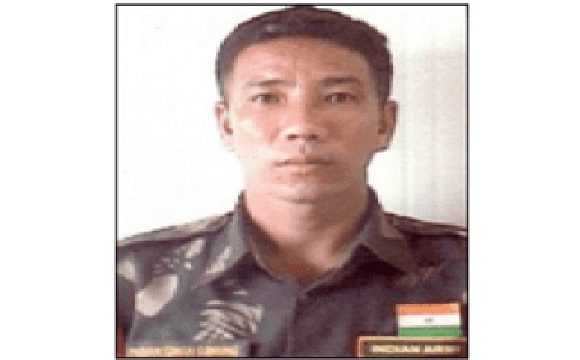

Service No : 5452070W
Place of birth : Kaski Dist (Nepal)
Service : Army
Last Rank : Naik
Unit : 1/5 GR(FF)
Arm/Regt : 5 Gorkha Rifles
Operation : UN Mission
Awards : Sena Medal
Martyrdom : January 26, 2007
Naik Mohan Singh Gurung SM
Naik Mohan Singh Gurung hailed from the serene village of Majuwa in the Kaski district of Nepal. After completing his early education, he chose the path of service and joined the Indian Army, determined to dedicate his life to duty and honour. He was recruited into the 4th Battalion of the 5 Gorkha Rifles (4/5 GR), one of the most distinguished and battle-hardened infantry regiments of the Indian Army, celebrated for its rich legacy of valour and sacrifice. The 5 Gorkha Rifles is renowned for its fearless soldiers, unshakeable loyalty, and a tradition of gallantry forged across numerous campaigns and battles. To serve in such a storied regiment was both a matter of great pride and a profound responsibility for the young Sepoy Mohan Singh Gurung.
After a few years of service, he was promoted to the rank of Naik. In recognition of his professionalism, discipline, and exemplary soldierly qualities, he was later attached to the 1st Battalion of the 5 Gorkha Rifles (1/5 GR) and selected to serve as part of the Indian contingent with the United Nations Peacekeeping Force in Sudan. This prestigious assignment reflected the trust placed in him by his superiors and underscored his commitment to serving not only his regiment and the Indian Army, but also the cause of international peace.
UN Operation: 26 Jan 2007
During 2013, Naik Mohan Singh Gurung of 1/5 Gorkha Rifles was serving with the Indian contingent of the United Nations Mission in the Republic of South Sudan (UNMISS). At the time, India had deployed nearly 2,200 Army personnel in South Sudan as part of its commitment to international peacekeeping efforts. His area of deployment was in the volatile Upper Nile region, along the border with Sudan. Although South Sudan had formally ended decades of civil war with Sudan in 2005 and had begun transitioning towards peace, the situation on the ground remained fragile. Several armed rebel groups continued to reject the peace process, leading to frequent clashes with government forces. Intense fighting was ongoing in regions such as Jonglei, while United Nations peacekeepers were tasked with the dangerous responsibility of patrolling buffer zones between the warring factions and protecting civilians. On 26 April 2013, Naik Mohan Singh Gurung was part of a three-vehicle convoy assigned to escort a team of de-miners along the road between Magwe and Opari, near the southern Sudanese town of Juba. The convoy was operating in the area of responsibility of a Bangladeshi battalion under the United Nations Mission. The route was known to be hazardous due to the presence of armed groups and the constant threat of ambush.
During the mission, the convoy came under attack. Naik Mohan Singh Gurung, who was driving the escort vehicle, was shot in the head. Despite immediate efforts, he succumbed to his severe injuries and was martyred in the line of duty. This tragic incident underscored the extreme dangers faced by Indian soldiers serving in United Nations peacekeeping operations, where they operate under a Chapter VII mandate of the UN Charter, which authorises peacekeepers to use force to protect themselves and civilians while enforcing peace in hostile environments. Naik Mohan Singh Gurung’s supreme sacrifice stands as a testament to his courage, dedication, and unwavering sense of duty. He laid down his life while protecting others and upholding the highest traditions of the Indian Army. In recognition of his exceptional bravery, devotion to duty, and supreme sacrifice, he was posthumously awarded the "Sena Medal".
Naik Mohan Singh Gurung is survived by his wife, Smt Bel Kumari Gurung.
Ben thapa
2026 at 9:47 amJai hind sir