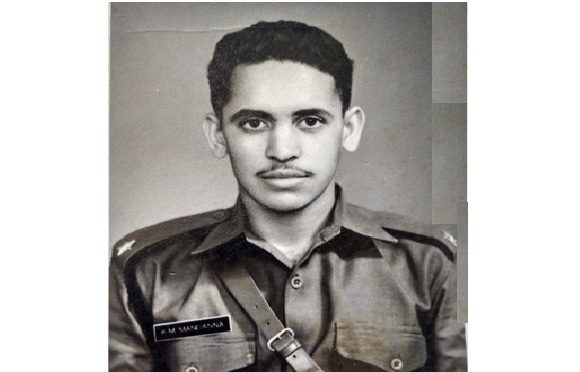

Service No : SS-24153H
Place of birth : Kodagu Dist (Kar)
Service : Army
Last Rank : Second Lieutenant
Unit : 9 Engr Regt
Arm/Regt : The Corps of Engineers
Operation : Indo-Pak War 1971
Martyrdom : December 17, 1971
Second Lieutenant KM Mandanna
Second Lieutenant KM Mandanna hailed from Kottoli village in Virajpet Taluka of Kodagu district, Karnataka—a land renowned for its proud martial heritage and traditions of military service. Born to Shri Konerira Muthanna Machiah, he was raised with values of discipline, courage and respect for duty, qualities that would later shape his journey as a soldier. Inspired by the Indian Armed Forces from a young age, he aspired to serve the country in uniform. With determination and focused preparation, he appeared for the Combined Defence Services Examination (CDSE) and successfully cleared it, earning admission to the prestigious Officers Training Academy (OTA), Chennai. At OTA, he joined the SS–10 Course, where he underwent intense and comprehensive training that tested physical endurance, mental resilience and leadership potential.
On 14 March 1971, after months of rigorous preparation, he was commissioned as a Second Lieutenant, passing out with 337 fellow gentlemen cadets. He was posted to the 9 Engineer Regiment of the Corps of Engineers—one of the Indian Army’s most crucial combat support arms, responsible for breaching minefields, constructing bridges, clearing obstacles and enabling battlefield mobility. From the outset of his service, 2/Lt Mandanna earned respect for his sincerity, work ethic and professionalism. Though young in service, he carried himself with maturity beyond his experience.
Battle of Basantar (Indo-Pak War): 04 -17 Dec 1971
During December 1971, 2nd Lt KM Mandanna was serving with 9 Engineer Regiment, then commanded by Lt Col BT Pandit, in the western theatre of operations. The regiment would soon play a defining role in one of the fiercest and most decisive engagements of the Indo–Pak War — the Battle of Basantar. The battle, fought from 04 to 16 December 1971, was one of the largest tank engagements seen after the Second World War. The objective was bold and strategically critical: to cross the heavily mined Basantar River, penetrate enemy defences, and secure the Shakhargarh bulge, a key tactical area that threatened the Indian flank. The offensive was spearheaded by I Corps, comprising three infantry divisions, two armoured brigades, two independent artillery brigades, and the engineer brigade — underscoring the scale and importance of the mission.
On the night of 03/04 December, Indian forces crossed the international border, led initially by 47 Infantry Brigade, followed by 74 and 91 Brigades, expanding the assault front and intensifying pressure on enemy defences. Within this complex and high-risk battle environment, 9 Engineer Regiment— popularly known as the “Thambi Regiment” due to its predominantly Tamil manpower — played a pivotal role. With three field companies supporting the three infantry brigades of the 54th Infantry Division, the regiment faced one of the most hazardous engineering tasks of the war: to lay an operational track through marshy terrain and dense, enemy-laid minefields while under direct observation and artillery fire. On 15 December 1971, a critical engineering task force was formed under the leadership of Maj Vijay Rattan Chaudhary and grouped with 47 Infantry Brigade. Their mission was to create a safe passage for tanks and mechanized forces across the Basantar River near Lagwal. The operation included constructing a track from Lohara to Lagwal, breaching minefields, and preparing crossing points over marshy nullahs — all under continuous enemy shelling.
The work began at 8 PM, immediately drawing intense Pakistani artillery fire. The lack of reconnaissance and incomplete intelligence added to the danger and confusion. To obtain essential ground information, a small party led by Capt Ravinder Nath Gupta was launched forward. Showing exceptional courage, he returned by 9:30 PM with critical details that enabled the engineers to continue the task despite the risk. By 16 December, Indian armour — notably Poona Horse — successfully repelled enemy counterattacks on the river’s west bank, marking a decisive tactical advantage. However, the cost of this success was heavy. On the afternoon of 17 December 1971, while coordinating engineering tasks and meeting Maj Chaudhary, the regiment’s Second-in-Command, 2nd Lt KM Mandanna, along with several comrades, came under enemy missile fire. The strike was devastating. 2nd Lt Mandanna was critically wounded and attained martyrdom, alongside Maj Vijay Rattan Chaudhary, Maj SS Mallik, and Capt Ravinder Nath Gupta — all key leaders driving the regiment’s operational success.
2nd Lt KM Mandanna’s contribution, despite his short service, was marked by commitment, composure under fire, and an unwavering sense of duty. His role as a young combat engineer at the height of one of India’s most demanding battlefield operations demonstrated commendable courage and professionalism. The gallantry, sacrifice, and engineering excellence displayed by 9 Engineer Regiment in the Battle of Basantar earned them the title “Basantar Regiment”, along with the Battle Honour Basantar and the Theatre Honour Punjab.
No Comments