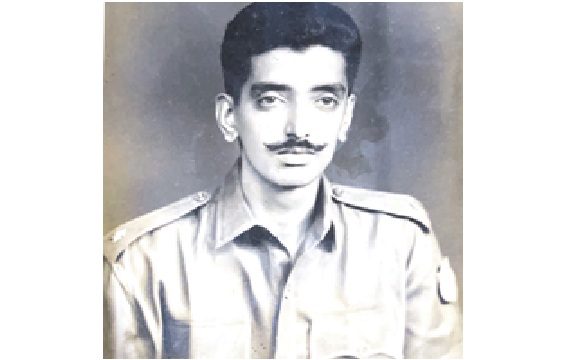

Service No : EC-56650
Place of birth : Kochi Dist (Kerala)
Service : Army
Last Rank : Second Lieutetant
Unit : 70 Med Regt
Arm/Regt : The Regiment of Artillery
Operation : Indo-Pak War-1965
Martyrdom : September 25, 1965
Second Lieutetant U Karunakaran
Indo-Pak War (Western Sector): Sep 1965
During September 1965, 2nd Lt U. Karunakaran was serving with 70 Medium Regiment of the Regiment of Artillery when the Indo-Pak War entered one of its most decisive phases. Following Pakistan's offensive in the Chhamb-Akhnoor sector, India launched Operation Riddle, a major counter-offensive in the Lahore sector under XI Corps. The objective was not merely to threaten Lahore itself, but to compel Pakistan to divert forces from the Chhamb front, seize tactically important ground up to the Ichhogil (BRB) Canal, and alter the course of the war in India's favour. As Indian troops crossed the International Border on the night of 5–6 September 1965, 70 Medium Regiment formed part of the corps-level artillery supporting the advancing formations of 15 Infantry Division towards Dograi and Batapur, 7 Infantry Division towards Burki, and 4 Mountain Division towards Kasur. Equipped with medium howitzers capable of delivering accurate long-range fire, the regiment played a vital role in engaging Pakistani artillery batteries, troop concentrations, fortified defensive positions, road junctions, and bridges around the Ichhogil Canal. These sustained bombardments disrupted enemy reinforcements, weakened defensive positions, and provided indispensable fire support that enabled the infantry to press forward under extremely challenging combat conditions.
Throughout the fierce fighting around Dograi, Burki, and the Ichhogil Canal, artillery duels became a defining feature of the campaign. Pakistani forces repeatedly attempted to halt the Indian advance with heavy artillery and armour, while Indian medium regiments maintained relentless counter-battery fire and supported successive assaults on strongly defended positions. As a young artillery officer, 2nd Lt U. Karunakaran shared these demanding responsibilities, helping coordinate fire missions and ensuring continuous artillery support to the advancing troops in one of the war's most intense operational theatres. As a young officer of the Regiment of Artillery, 2nd Lt U Karunakaran worked in proximity to the combat zone, where observation, reconnaissance, and fire control required both technical skill and exceptional courage. He continued to perform his duties despite constant exposure to enemy shelling, minefields, and the hazards of operating in forward areas. His composure under pressure and unwavering commitment to his mission earned him the respect of those who served alongside him. During the Lahore operations, 2nd Lt Karunakaran displayed remarkable bravery, reportedly eliminating eight Pakistani soldiers and contributing to the capture of two enemy artillery batteries during the fighting. These recollections reflect the fearless spirit with which he carried out his responsibilities in the midst of intense combat. Even after active fighting began to subside and the ceasefire approached, operational responsibilities continued. Around the time of the ceasefire, 2nd Lt Karunakaran was assigned a reconnaissance mission—a vital task that required officers to assess routes, positions, and ground conditions before the movement of troops and equipment. While travelling in a military jeep through an operational area, the vehicle struck a landmine, triggering a powerful explosion that inflicted grievous injuries upon him.
He was immediately evacuated to the Military Hospital at Jullundur (Jalandhar), where every effort was made to save his life. Despite the best medical care available, the young officer succumbed to his injuries on 25 September 1965, at just 28 years of age, only days after the war had effectively fallen silent. 2nd Lt U Karunakaran made the supreme sacrifice while carrying out his duty in an operational area, embodying the highest ideals of courage, leadership, and selfless service.
No Comments