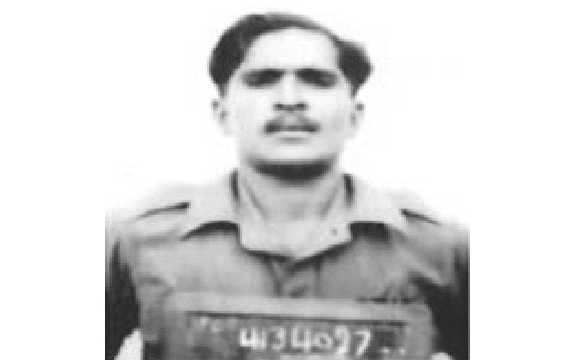

Service No : 4134027
Place of birth : Gurdaspur, Punjab
Service : Army
Last Rank : Sepoy
Unit : 13 Kumaon
Arm/Regt : The Kumaon Regiment
Operation : Indo-China War 1962
Martyrdom : November 18, 1962
Sepoy Bahar
Sepoy Bahar hailed from Deen Nagar village in the Gurdaspur district of Punjab, a land known for its rich martial heritage and deep-rooted patriotism. From an early age, he was inspired by a strong desire to serve the nation, which led him to join the Indian Army. He was inducted into the 13th Battalion of the Kumaon Regiment, one of the Army’s most respected infantry regiments, with a proud lineage dating back to the 18th century and a long record of gallantry and distinguished service in numerous campaigns.
Throughout his service, Sepoy Bahar displayed exemplary discipline, unwavering dedication, and selfless commitment to duty. He wore the uniform of the Kumaon Regiment with pride and consistently upheld the regiment’s traditions and high standards. By 1962, his battalion was stationed at Ambala and was soon mobilised to Jammu & Kashmir, reflecting the critical role entrusted to his unit in safeguarding the nation during a period of growing security challenges.
Battle of Rezang La (Indo-China War): 18 Nov 1962
In June 1962, the 13 Kumaon Battalion, in which Sepoy Bahar was serving, was redeployed from Ambala to Baramulla in Jammu & Kashmir under the leadership of Lt Col H.S. Dhingra. With the situation along the northern borders deteriorating rapidly, the battalion was ordered in September to move to Leh at very short notice. Upon reaching Leh, it came under the command of the 114th Infantry Brigade, led by Brigadier T.N. Raina, who later rose to become the Chief of Army Staff. The brigade was entrusted with the formidable responsibility of securing nearly 400 kilometres of the Indo-China border, including the strategically crucial Chushul sector. Its composition included several battle-hardened units such as 14 J&K Militia, 7 J&K Militia, 5 Jat, 1/8 Gorkha Rifles, along with 13 Kumaon.
Sepoy Bahar was a member of ‘C’ Company of 13 Kumaon, commanded by the indomitable Major Shaitan Singh. Under the brigade’s defensive deployment, ‘C’ Company was assigned the vital position at Rezang La. While ‘A’ Company under Maj G.N. Sinha was held in reserve near the battalion headquarters at Chushul, ‘B’ and ‘D’ Companies, commanded by Capt R.V. Jatar, occupied positions on Maggar Hill to provide depth to the defence. By 26 October 1962, the troops at Rezang La had completed the preparation of strong defensive positions in anticipation of an imminent Chinese attack. ‘C’ Company was spread across the forward slopes of Rezang La, with Platoon 7 under Jemadar Surja Ram guarding the northern approaches, Platoon 8 led by Jemadar Hari Ram covering the pass, and Platoon 9 under Jemadar Ram Chander defending the central sector along with the Company Headquarters. A mortar detachment commanded by Naik Ram Kumar Yadav was deployed on the reverse slope to provide fire support.
The enemy launched its major offensive in the early hours of 18 November 1962, in coordination with attacks at Sela in NEFA. Chinese forces mounted a simultaneous assault on Gurung Hill and the Rezang La positions held by ‘C’ Company, which formed a critical barrier to the Chushul airfield through the Dungti axis. The first attack, directed at Platoon 8 around 2:00 AM, was detected in time and successfully repelled. Further attacks followed in quick succession at approximately 4:00 AM, 4:55 AM, 6:00 AM, and 6:30 AM, each meeting fierce resistance from the Indian defenders. Outnumbered and under constant pressure, Sepoy Bahar and his comrades fought with extraordinary grit and resolve. By the time the sixth assault was launched at about 7:40 AM, the defenders had already suffered severe losses. At 8:40 AM, the enemy brought a 57 mm recoilless rifle into action, setting the stage for the final and most intense attack, which began around 9:00 AM.
Battling extreme cold, inhospitable terrain, and sustained enemy fire, Sepoy Bahar continued to hold his ground with unwavering courage until he was critically wounded and laid down his life in the line of duty. The valiant stand of 13 Kumaon at Rezang La proved instrumental in slowing the Chinese advance and protecting the Chushul airfield. Following the ceasefire, Rezang La became a desolate no-man’s land, and the bodies of Sepoy Bahar and his fallen comrades remained buried beneath the snow until they were discovered nearly three months later by a local shepherd—a poignant testament to their sacrifice and heroism.
Sepoy Bahar is survived by his Son, Shri Raj.
No Comments