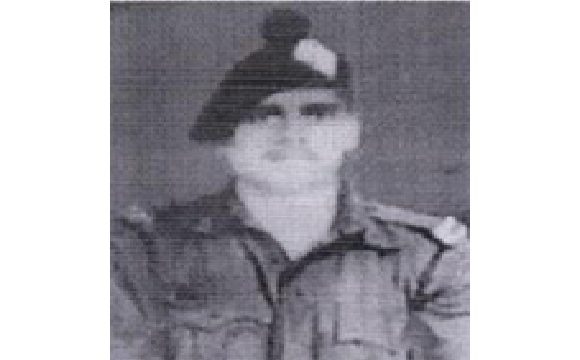

Service No : 2564561L
Place of birth : Raichur Dist (Kar)
Service : Army
Last Rank : Sepoy
Unit : 18 Madras
Arm/Regt : The Madras Regiment
Operation : Indo-Pak War 1971
Martyrdom : December 17, 1971
Sepoy Basav Rajappa
Sepoy Basav Rajappa, son of Smt Gaddamma hailed from the Raichur district of Karnataka, where he spent his formative years in an environment that instilled in him the values of discipline, perseverance, and a deep sense of duty. Motivated by a desire to serve the nation, he joined the Indian Army after completing his school education and was recruited into the 18 Madras Battalion of the Madras Regiment. The Madras Regiment, one of the oldest and most distinguished infantry regiments of the Indian Army, is celebrated for its illustrious history, unwavering discipline, and proven record of battlefield valour. Being part of such a prestigious regiment not only offered him a career but also imbued in him a strong sense of honour and purpose, which he upheld with sincerity and pride throughout his service. In 1971, India faced a grave national crisis as tensions with Pakistan escalated into a full-scale war. During this crucial period, Sep Basav Rajappa’s unit was deployed in the Nayachor–Umarkot sector on the western front. This sector held considerable strategic importance, forming a key part of the desert theatre of operations that extended across southern Rajasthan into Sindh. The terrain in this region was exceptionally harsh and unforgiving, characterised by vast expanses of barren land, shifting sand dunes, extreme temperatures, and acute logistical challenges. The scarcity of water, limited infrastructure, and difficult mobility conditions placed immense strain on the troops operating in the area.
Alongside these environmental hardships, the constant threat of enemy action further intensified the challenges faced by the soldiers. The sector was vulnerable to enemy infiltration and offensive manoeuvres, requiring troops to remain in a perpetual state of alertness and readiness. Under such demanding circumstances, 18 Madras was entrusted with the critical responsibility of defending the sector, containing enemy advances, and ensuring that no breakthrough could be achieved by opposing forces. Despite the adversity, the battalion carried out its mission with remarkable efficiency and determination. Through well-coordinated defensive operations, sustained vigilance, and resolute action, the unit successfully repelled enemy attempts to penetrate their positions. Their steadfast efforts played a crucial role in maintaining the stability of the front and preserving the integrity of the sector during a decisive phase of the war. The performance of 18 Madras in such a challenging environment stands as a testament to its training, discipline, and collective spirit. As a dedicated soldier of this battle-hardened battalion, Sep Basav Rajappa contributed significantly to these operations. He discharged his duties with professionalism, courage, and quiet determination, exemplifying the highest traditions of the Indian Army. Whether engaged in active combat or performing routine operational tasks, he remained steadfast in his commitment to duty, consistently placing the mission and the nation above all else. Over the course of his military service, he was deployed in various operational areas and participated in several important assignments. In every role entrusted to him, he demonstrated discipline, reliability, and unwavering devotion to the nation. Though his contributions may not have always been in the spotlight, they were vital to the success of the larger mission.
Indo-Pak War: 16-17 Dec 1971
In 1971, Sepoy Basav Rajappa’s unit, 18 Madras, was deployed in the southern Rajasthan sector during a period of grave national crisis. India was compelled to go to war with Pakistan following the large-scale atrocities committed by the Pakistani Army in its eastern wing, which resulted in an unprecedented influx of millions of refugees into India. The magnitude of this humanitarian crisis made armed conflict unavoidable, leading India into a two-front war—on the eastern front, which culminated in the liberation of Bangladesh, and on the western and northern fronts to counter Pakistani military offensives. On the western front, the Rajasthan sector held considerable strategic importance. Indian forces in this theatre included the 11 Infantry Division and the 12 Infantry Division, while the opposing Pakistani forces comprised the 18 Infantry Division, supported by additional brigades and paramilitary elements. The Indian Army’s operational plan envisaged a bold double thrust: the 12 Infantry Division advancing along the Longewala–Rahim Yar Khan axis, and the 11 Infantry Division along the Barmer–Naya Chor axis. However, these plans were disrupted when Pakistan launched a major armoured assault on Longewala on the night of 3 December 1971. This attack was decisively repulsed by resolute Indian troops, supported by effective air strikes from the Indian Air Force, resulting in heavy enemy losses and a decisive shift in momentum in India’s favour.
Amid these developments, 18 Madras, operating under the 11 Infantry Division, launched offensive operations on 4 December 1971. The battalion rapidly overran Pakistani border posts and, maintaining relentless momentum, advanced nearly 45 kilometres into enemy territory, establishing contact with the Naya Chor defences by 11 December. By 16 December 1971, after a gruelling advance of over 40 miles across harsh desert terrain under constant threat of enemy fire, the battalion reached Hingora Tar, just two kilometres short of Umarkot. At this critical juncture, Captain Shankar Shankhapan Walkar, serving as the battalion’s Mortar Officer, played a vital role in sustaining the unit’s combat effectiveness.Sepoy Basav Rajappa was an integral part of this forward deployment and shared in the hardships and dangers of continuous combat operations. On 16 December 1971, as the battalion consolidated its positions at Hingora Tar, it came under intense and sustained enemy shelling. Displaying exceptional courage, composure, and devotion to duty, Sepoy Basav Rajappa continued to carry out his responsibilities amidst the heavy bombardment. During the course of this fierce engagement, he sustained grievous injuries. Despite all efforts to save him, he succumbed to his wounds, making the supreme sacrifice in the line of duty. The operations in this sector came at a high cost to 18 Madras. Alongside Captain SS Walkar and Sepoy Basav Rajappa, 21 other brave soldiers of 18 Madras made the supreme sacrifice during these operations, including Sub AP Sreedhara Dass, Nb Sub NN Krishnan, Hav A P Ponnappan, Nk M Mani, L Nk SA Narayan, L Nk Panoly Govi, Sep M Muthaiah, Sep Amir Miyan, Sep Rajan, Sep NCM Appachu, Sep Sampathu, Sep RG Krishna Kurup, Sep Gajendran, Sep Shaik Mahaboob, Sep MA Kasinathan, Sep Arasan Raju, Sep GV Pillai, Sep J Ganesan, Sep C Kandasamy, Sep Revan Siddappa and Sep V Somasekharan.
No Comments