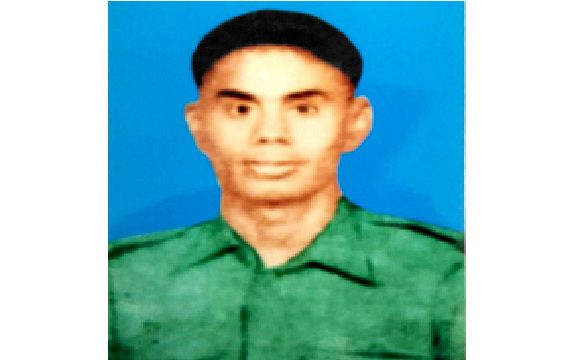
Amid these developments, 18 Madras, operating under 11 Infantry Division, commenced offensive operations on 4 December 1971. The battalion swiftly overran Pakistani border outposts and, maintaining its momentum, advanced deep into enemy territory. Covering nearly 45 kilometres, it established contact with the Naya Chor defences by 11 December. By 16 December 1971, after a demanding advance of over 40 miles across inhospitable desert terrain under constant threat of enemy action, the battalion reached Hingora Tar, halting just two kilometres short of Umarkot. Sepoy C. Kandasamy was an integral part of this forward thrust, sharing in the hardships and risks of sustained combat operations in the desert theatre. At this critical stage, Captain Shankar Shankhapan Walkar, the battalion’s Mortar Officer, played a key role in supporting the advance by providing effective and timely firepower. On 16 December 1971, while the battalion was consolidating its positions at Hingora Tar, it came under intense and prolonged enemy shelling. Despite the heavy bombardment, Sepoy Kandasamy exhibited exceptional courage, calmness, and unwavering commitment to duty, steadfastly performing his responsibilities despite the extremely hazardous conditions. During the course of the intense engagement, he sustained severe injuries. In spite of all possible efforts to save him, he eventually succumbed to his injuries, making the supreme sacrifice in keeping with the highest traditions of the Indian Army. The operations in this sector came at a heavy cost to 18 Madras. Alongside Captain S.S. Walkar and Sepoy C. Kandasamy, 21 other brave soldiers of 18 Madras made the supreme sacrifice during these operations, including Sub AP Sreedhara Dass, Nb Sub NN Krishnan, Hav A P Ponnappan, Nk M Mani, L Nk SA Narayan, L Nk Panoly Govi, Sep M Muthaiah, Sep Amir Miyan, Sep GV Pillai, Sep Rajan, Sep NCM Appachu, Sep Sampathu, Sep RG Krishna Kurup, Sep Gajendran, Sep Shaik Mahaboob, Sep MA Kasinathan, Sep Arasan Raju, Sep Basav Rajappa, Sep J Ganesan, Sep Revan Siddappa and Sep V Somasekharan.

No Comments