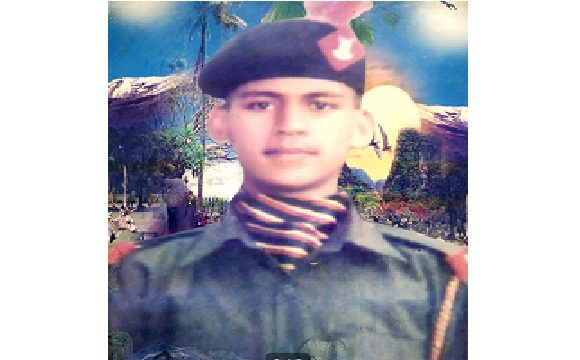

Service No : 14703089
Date of Birth : December 1, 1977
Place of birth : Chamoli dist(U'Khand)
Service : Army
Last Rank : Sepoy
Unit : 2 Naga
Arm/Regt : The Naga Regiment
Operation : Op Vijay ( Kargil )
Awards : Sena Medal
Martyrdom : July 7, 1999
Sepoy Himmat Singh Negi SM
Sepoy Himmat Singh Negi was born on 1 December 1977 to Shri Balwant Singh Negi and Smt. Chaita Devi in Banswara village, located in the Chamoli district of Uttarakhand. Chamoli, nestled in the Garhwal region of the Himalayas, is widely known for its rich cultural heritage, resilient hill communities, and a proud tradition of producing brave soldiers who have served the nation with courage, honour, and dedication. Growing up in this disciplined and patriotic environment, Himmat Singh Negi was deeply influenced by the values of hard work, perseverance, and service to the country.Raised amidst the serene yet demanding terrain of the Himalayan region, he developed qualities such as endurance, humility, physical toughness, and mental resilience from an early age. The strong martial traditions of Uttarakhand, particularly the Garhwal region, inspired in him a deep sense of patriotism and a desire to serve the nation in uniform. After completing his school education, he chose the noble path of military service and joined the Indian Army. He was recruited into the 2nd Battalion of the Naga Regiment (2 Naga), one of the youngest and highly respected infantry regiments of the Indian Army. His induction into the regiment marked the beginning of a life dedicated to discipline, courage, and service to the nation.
The Naga Regiment, though relatively young compared to many historic infantry regiments, has built a strong reputation for professionalism, battlefield efficiency, and gallantry. The 2nd Battalion (2 Naga) was raised on 11 February 1985 at Haldwani, and since its inception, it has upheld the highest traditions of military service. The regiment’s motto, “Parakramo Vijayate,” meaning “Valour Triumphs,” reflects the spirit of bravery, determination, and steadfast commitment expected from its soldiers. Its battle cry, “Jai Durga Naga,” meaning “Victory to Durga Naga,” symbolizes courage, unity, and the warrior spirit of the regiment. For a young soldier like Sepoy Himmat Singh Negi, becoming part of the Naga Regiment was both a matter of pride and a solemn responsibility. Within the regiment, he underwent rigorous military training that strengthened his physical endurance, sharpened his combat skills, and enhanced his mental toughness. Through discipline, sincerity, and dedication, he steadily adapted to the demanding life of a soldier and embraced the values of loyalty, courage, and selfless service that define the ethos of the Indian Army. His journey reflected his unwavering commitment to duty and his determination to serve the nation with honour and integrity.
Battle of Point 4875 (Kargil War): 05-07 Jul 1999
In July 1999, during the Kargil War, Sepoy Himmat Singh Negi was serving with the 2nd Battalion of the Naga Regiment (2 Naga), which was deployed in the strategically vital Drass sector of Jammu and Kashmir along the Line of Control (LoC). This period marked one of the most intense phases of the conflict, as Indian forces were engaged in fierce operations to reclaim key mountain positions occupied by Pakistani regulars and paramilitary-supported infiltrators. In May 1999, the Indian Army detected a large-scale intrusion by Pakistani military and paramilitary forces across the Line of Control in the Kargil region. These infiltrators had occupied several dominating heights overlooking critical supply routes, threatening India’s military movement and strategic stability in the region. In response, the Indian Army launched Operation Vijay, a large-scale military campaign aimed at evicting the intruders and restoring control over Indian territory. Over the following weeks, Indian troops conducted a series of courageous and hard-fought operations under extremely difficult conditions, battling not only heavily fortified enemy positions but also harsh weather, steep mountain terrain, and high-altitude warfare. By 5 July 1999, several significant objectives had been recaptured, including the strategically crucial Tiger Hill, one of the turning points of the Kargil conflict. Following the capture of Tiger Hill, the next major operational objective was Point 4875, one of the most fiercely defended and strategically important enemy-held features in the Drass sector. This dominating height overlooked approximately 30 kilometers of the National Highway between Mushkoh and Drass, making it crucial for maintaining military movement and supply lines. A connecting feature known as Rocky Knob linked Point 4875 with Tiger Hill and served as an important approach to the enemy’s administrative and logistical base.
Point 4875 was a complex battlefield objective divided into several enemy-held sub-features, including Whale Back, Pimple 1, Pimple 2, the Southern Slope of Point 4875, Flat Top, Twin Bumps, and Saddle. Due to the tactical complexity of the terrain, the assault was carefully planned in two phases involving multiple battalions, including 17 Jat, 12 Mahar, 13 JAK Rif, 21 Para (SF), and 2 Naga. Under Phase I, 17 Jat was tasked with capturing Pimple 1 and Whale Back from the southern side, while 13 JAK Rif was to secure South Spur from the southeast by 5 July 1999. Following the successful completion of these initial objectives, Phase II commenced on the night of 5/6 July 1999. In this phase, 17 Jat was assigned to capture Pimple 2, 13 JAK Rif was to secure Flat Top, and 2 Naga was entrusted with the critical task of capturing Twin Bumps by first light on 7 July and then exploiting the advance toward the northwest. As part of this decisive assault, Sepoy Himmat Singh Negi and his comrades of 2 Naga launched a fierce and determined attack on heavily defended enemy positions. Advancing through steep, rocky slopes under hostile fire, the soldiers fought under extremely dangerous battlefield conditions. Despite stiff enemy resistance, relentless firing, and the challenges of high-altitude combat, Sepoy Himmat Singh and his fellow soldiers displayed exceptional courage, resilience, and determination. Fighting with unwavering commitment and tactical discipline, the troops of 2 Naga made steady progress and successfully captured Twin Bumps as planned by 7 July 1999. This achievement proved to be of immense tactical importance. The capture of Twin Bumps enabled the battalion to launch a successful raid on enemy mortar positions and destroy them, significantly weakening hostile firepower in the area. The newly secured position also served as a firm operational base for subsequent assaults launched by 2 Naga on Rocky Knob, Hump, and Tip, contributing greatly to the larger success of the Battle of Point 4875.
Thus, the capture of Twin Bumps by Sepoy Himmat Singh Negi and his comrades played a pivotal role in the success of subsequent military operations in the Drass sector and significantly strengthened India’s hold over the region. However, during the fierce battle, Sepoy Himmat Singh Negi and several of his comrades sustained grievous injuries while courageously engaging the enemy. Despite the severity of the situation, they continued to fight with determination and devotion to duty. Unfortunately, the injuries sustained by Sepoy Himmat Singh proved fatal, and he eventually succumbed to his wounds, making the supreme sacrifice in the service of the nation at the young age of just 21. Several other brave soldiers of 2 Naga also laid down their lives during the operation. These gallant martyrs included Havildar Molan Pun Nagar, Naik Anand Singh, Naik HB Ghale, Naik Devender Singh, Lance Naik SC Prasad, Sepoy RK Pradhan, Sepoy S Gerneithang, Sepoy Mohan Singh, Sepoy Suresh Chhetri, Sepoy Rajesh Gurung, Sepoy Kailash Kumar, Sepoy NGBB Mayon, Sepoy Sanjay Gurung, Sepoy Kishan Singh, and Sepoy Jai Singh Negi. Together, these brave soldiers displayed extraordinary courage, sacrifice, and unwavering dedication in one of the most significant battles of the Kargil War. For his exceptional bravery, devotion to duty, and supreme sacrifice, Sepoy Himmat Singh Negi was posthumously awarded the Sena Medal, one of the distinguished gallantry awards of the Indian Army. Sepoy Himmat Singh Negi remains remembered as a valiant and committed soldier who fought fearlessly for his nation. His courage, sacrifice, and steadfast dedication continue to inspire future generations and stand as a proud chapter in the glorious legacy of the Naga Regiment and the Indian Army.
Sep Himmat Singh is survived by his father Shri Balwant Singh Negi and his mother Smt Chaita Devi.
No Comments