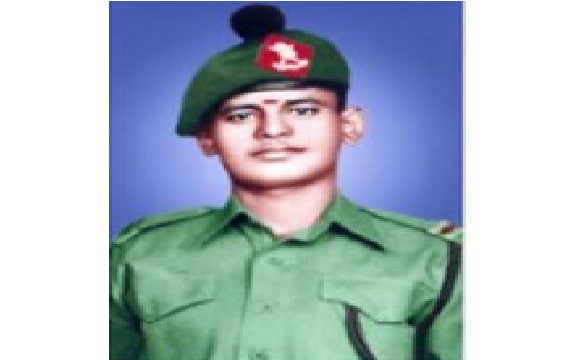
Service No : 2547125X

Place of birth : Virudhunagar, TN

Service : Army

Last Rank : Sepoy

Unit : 18 Madras

Arm/Regt : The Madras Regiment

Operation : Indo-Pak War 1971

Martyrdom : December 17, 1971

Sepoy M Muthaiah

Sepoy M. Muthaiah hailed from Erichanatham village in Sivakasi taluka of Virudhunagar district in Tamil Nadu, a region noted for its deep-rooted tradition of patriotism and service to the nation. After completing his schooling, he chose to serve the country by joining the Indian Army, committing himself to a life of duty and discipline.He was inducted into 18 Madras Battalion of the Madras Regiment—one of the oldest and most distinguished infantry regiments of the Indian Army, known for its steadfast discipline, courage in the face of adversity, and a proud legacy of valour. Being part of such a prestigious regiment instilled in him a strong sense of honour, responsibility, and pride, values that he upheld throughout his military service. During the Indo–Pak War of 1971, Sepoy Muthaiah’s unit, 18 Madras, was deployed in the strategically important Nayachor–Umarkot sector on the western front. The area posed significant operational challenges, including harsh desert conditions, extreme climate, and the ever-present threat of enemy engagement. Despite these difficulties, the battalion displayed remarkable resilience and determination, playing a crucial role in containing and repelling Pakistani forces. Its steadfast performance ensured that no major enemy breakthrough occurred, thereby contributing significantly to the stability and security of the sector.


Indo-Pak War: 16-17 Dec 1971


In 1971, Sepoy M Muthaiah’s unit, 18 Madras, was deployed in the southern Rajasthan sector during a period of grave national crisis. India was compelled to go to war with Pakistan following the large-scale atrocities committed by the Pakistani Army in its eastern wing, which led to an unprecedented influx of millions of refugees into India. The magnitude of this humanitarian crisis made armed conflict unavoidable. Consequently, India found itself engaged in a two-front war—on the eastern front, which culminated in the liberation of Bangladesh, and on the western and northern fronts to counter Pakistani military offensives. On the western front, the Rajasthan sector assumed considerable strategic importance. Indian forces in this region included the 11 Infantry Division and the 12 Infantry Division, while the opposing Pakistani forces comprised the 18 Infantry Division, supported by additional brigades and paramilitary elements. Indian operational plans envisaged a bold double thrust: the 12 Infantry Division advancing along the Longewala–Rahim Yar Khan axis, and the 11 Infantry Division along the Barmer–Naya Chor axis. However, these plans were disrupted when Pakistan launched a major armoured assault on Longewala on the night of 3 December 1971. This attack was resolutely repulsed by determined Indian ground forces, supported by effective air strikes from the Indian Air Force, resulting in heavy Pakistani losses and shifting the momentum decisively in India’s favour.


Amid these developments, 18 Madras, under the command of 11 Infantry Division, commenced offensive operations on 4 December 1971. The battalion swiftly overran Pakistani border outposts and, maintaining its momentum, advanced deep into enemy territory. Covering nearly 45 kilometres, it established contact with the Naya Chor defences by 11 December. By 16 December 1971, after a demanding advance of over 40 miles across harsh desert terrain under continuous enemy threat, the battalion reached Hingora Tar, halting just two kilometres short of Umarkot. At this critical stage, Captain Shankar Shankhapan Walkar, the battalion’s Mortar Officer, played an important role in sustaining the unit’s combat effectiveness. Sepoy M. Muthaiah was an integral part of this forward deployment and shared in the hardships and dangers of prolonged operations. On 16 December 1971, as the battalion consolidated its positions at Hingora Tar, it came under intense and sustained enemy shelling. Displaying notable courage and unwavering devotion to duty, Sepoy Muthaiah continued to perform his responsibilities under heavy bombardment. In the course of these operations, he sustained grievous injuries. Despite all possible efforts, he later succumbed to his injuries, making the supreme sacrifice in the line of duty. The operations in this sector came at a heavy cost to 18 Madras. Alongside Captain S.S. Walkar and Sepoy M. Muthaiah, 21 other brave soldiers of 18 Madras made the supreme sacrifice during these operations, including Sub AP Sreedhara Dass, Nb Sub NN Krishnan, Hav A P Ponnappan, Nk M Mani, L Nk SA Narayan, L Nk Panoly Govi, Sep Amir Miyan, Sep GV Pillai, Sep Rajan, Sep NCM Appachu, Sep Sampathu, Sep RG Krishna Kurup, Sep Gajendran, Sep Shaik Mahaboob, Sep MA Kasinathan, Sep Arasan Raju, Sep Basav Rajappa, Sep J Ganesan, Sep C Kandasamy, Sep Revan Siddappa and Sep V Somasekharan Sepoy M. Muthaiah’s sacrifice stands as a testament to his courage, devotion to duty, and the highest traditions of the Indian Army.


Sepoy M. Muthaiah is survived by his wife, Smt Thayammal.

  • If you find any information that is incorrect or inappropriate or have additional information about the soldier that can be added to his memorial site, please contact us by using the tab given below.
No Comments

Post a Comment