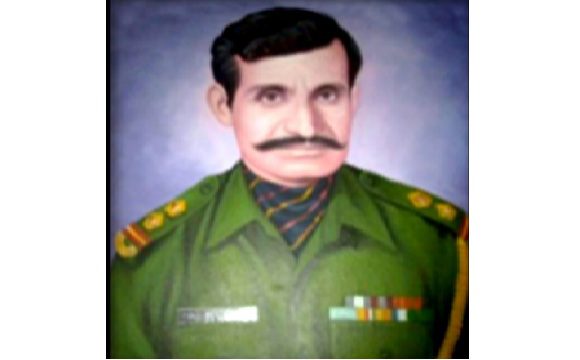
Subedar Daljit Singh hailed from Beh Lakhan village in Hoshiarpur district of Punjab, a region known for its rich martial traditions and a deep-rooted culture of service to the nation. He completed his preliminary education in his native village, where he developed a strong sense of responsibility and a desire to serve the country. Motivated by this calling, he joined the Indian Army at the young age of 19 years, embarking on a career dedicated to the defence of the nation. He was recruited into the 9 Dogra Battalion of the Dogra Regiment, one of the most distinguished infantry regiments of the Indian Army. The Dogra Regiment has a long and illustrious history, marked by a proud tradition of valour and service. Renowned for producing soldiers of exceptional bravery, discipline, and professionalism, the Regiment has consistently distinguished itself across numerous operations and battlefields, earning a place of great honour in the annals of military history.
During his service with his parent unit, Subedar Daljit Singh honed his soldiering skills and earned a reputation as a disciplined, dependable, and courageous soldier. His dedication and professional competence led to his deputation to the 31 Rashtriya Rifles Battalion, a specialized counter-insurgency force deployed in Jammu and Kashmir. Serving with 31 Rashtriya Rifles, he operated in some of the most challenging and high-risk environments, where troops are required to maintain constant vigilance and respond swiftly to militant threats. It was here that Subedar Daljit Singh continued to display exemplary leadership, and an unwavering commitment to duty, ultimately setting the stage for the extraordinary gallantry he would later exhibit in the line of duty.
Poonch Operation (J&K): 26 Apr 1999
During April 1999, Subedar Daljit Singh was serving with 31 Rashtriya Rifles, a unit operating under the Romeo Force of the Counter-Insurgency Grid in Jammu and Kashmir. The force functioned under the operational control of XVI Corps, also known as the White Knight Corps, headquartered at Nagrota Cantonment in Jammu district. At the time, his unit was deployed in the Poonch district—an area highly vulnerable to militant infiltration due to its rugged terrain and close proximity to the Line of Control. The unit remained actively engaged in counter-terrorism operations, maintaining a constant state of alert. Regular patrols, ambushes, and search operations were conducted to prevent infiltration and eliminate militant presence within its Area of Responsibility. On 26 April 1999, during one such operation, Subedar Daljit Singh led a team to Rupwala, a locality in Poonch district known for militant activity. The mission was undertaken in tense and hostile conditions, demanding high levels of vigilance and rapid tactical decision-making. At approximately 1845 hours, he detected the presence of four heavily armed militants concealed within a nallah, skillfully exploiting the terrain for cover. Recognizing the seriousness of the situation and the potential threat to both his troops and the surrounding area, Subedar Daljit Singh immediately took charge and initiated decisive action. Deploying his Light Machine Gun, he manoeuvred aggressively to outflank the militants, with the aim of cutting off their escape routes and securing a tactical advantage.
Displaying commendable courage and leadership, Subedar Daljit Singh advanced towards the militants under intense and sustained enemy fire, which included both small arms and precise sniper fire. Fully exposed to danger, he crawled forward for nearly 50 meters, maintaining continuous engagement with the enemy. His bold and determined assault resulted in the elimination of two militants. As the encounter intensified, a third militant lobbed a grenade towards him, which exploded in close proximity and caused him grievous injuries. Despite his critical condition and the option of being evacuated for medical treatment, Subedar Daljit Singh refused to withdraw. Demonstrating an unyielding sense of duty and indomitable spirit, he chose to continue the fight. Summoning his remaining strength, he brought a rocket launcher into action and accurately targeted the militant positions. His relentless engagement led to the elimination of the third militant. However, the severe injuries he had sustained ultimately proved fatal, and he succumbed while still fighting bravely in the line of duty. Subedar Daljit Singh’s actions reflected the highest traditions of the Indian Army, marked by conspicuous bravery, and unwavering devotion to duty in the face of extreme adversity. For his exceptional courage, indomitable fighting spirit, and supreme sacrifice, he was posthumously awarded the nation’s second-highest peacetime gallantry award, the Kirti Chakra.
.
Subedar Daljit Singh is survived by his wife, Smt. Veena Kumari.

gopal
2023 at 9:35 pmHe is my father in law and I want his valuable information to be updated by his family and batch officers